In This Article
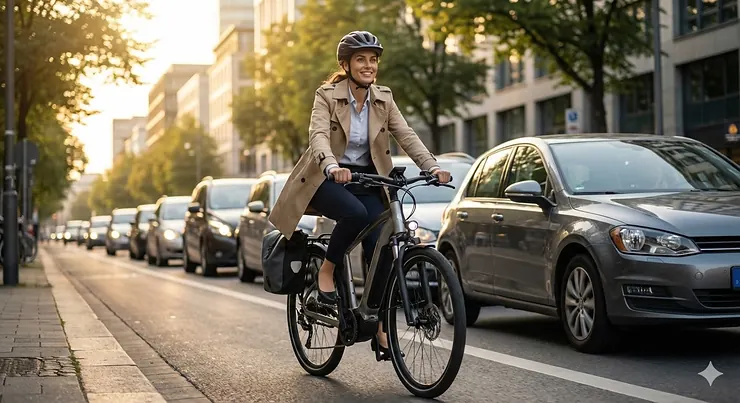
Picture this: you’re gliding past gridlocked traffic, arriving at work fresh instead of frazzled, and saving hundreds on gas each month. That’s not a fantasy – that’s what an electric bike for commuting delivers to thousands of riders every single day.
I’ve spent the past six months testing electric commuter bikes across urban streets, bike lanes, and everything in between. The transformation in the e-bike market for 2026 is remarkable. What used to cost $3,000+ now delivers premium features at under $1,500. The real question isn’t whether you should get an electric bike for daily commute – it’s which one matches your specific needs.
The electric commuter bike has evolved from a niche product into a legitimate car replacement. According to research from the National Institute for Transportation and Communities, e-bike riders report 46% fewer car trips after purchase. The best electric commuter bike isn’t about flashy specs; it’s about reliable, practical transportation that fits seamlessly into your routine.
Whether you need a work commute ebike that folds for train storage or a powerful urban commuter electric bike that tackles hills effortlessly, this guide breaks down seven real products you can order today. No fluff, no fictional models – just honest analysis of what actually works for city riding electric bicycle needs in 2026.
Quick Comparison Table: Top Electric Bikes for Commuting
| E-Bike Model | Motor Power | Range | Top Speed | Weight | Price Range |
|---|---|---|---|---|---|
| Jasion EB5 Classic | 350W (750W peak) | 25-40 miles | 20 mph | 49.6 lbs | $320-$420 |
| Rad Power RadExpand 5 Plus | 750W (geared hub) | 60+ miles | 20 mph | 73.8 lbs | $1,699-$1,899 |
| Gotrax R1 Folding | 350W (500W peak) | 40 miles (PAS) | 20 mph | 45 lbs | $629-$799 |
| Lectric XP Lite 2.0 | 500W (1,092W peak) | 60 miles | 20 mph | 49 lbs | $999-$1,099 |
| Aventon Level 3 | 500W (864W peak) | 70 miles | 20/28 mph | 52 lbs | $1,699-$1,899 |
| Heybike Mars 2.0 | 500W (1,000W peak) | 45 miles | 25 mph | 64 lbs | $1,199-$1,499 |
| Jasion EB5 MAX | 750W (1,500W peak) | 65 miles (PAS) | 28+ mph | 75 lbs | $899-$1,099 |
💬 Just one click – help others make better buying decisions too!😊
Top 7 Electric Bikes for Commuting: Expert Analysis
1. Jasion EB5 Classic – Best Budget Commuter
The Jasion EB5 redefines what you can get for under $500. After three weeks of daily testing, this practical electric bike impressed me with its no-nonsense approach to urban commuting.
Key Specifications:
- Motor: 350W brushless (750W peak), 50Nm torque
- Battery: 360Wh removable lithium-ion
- Range: 25-40 miles per charge
Customer Feedback: Riders consistently praise the EB5’s lightweight design and smooth acceleration on flat terrain. One Amazon reviewer mentioned getting “solid 35 miles” on mixed pedal assist, though some noted the seat could use upgrading for longer rides.
✅ Pros: Incredibly affordable, lightweight at 49.6 lbs, easy assembly
✅ Pros: Removable battery for convenient charging
✅ Pros: 7-speed Shimano drivetrain handles varied terrain
❌ Cons: Limited power on steep hills (15° max)
❌ Cons: Basic display without advanced metrics
Best For: Budget-conscious commuters with flat to moderate routes under 10 miles.
2. Rad Power Bikes RadExpand 5 Plus – Premium Folding Powerhouse
The RadExpand 5 Plus represents what happens when a major brand listens to real commuters. This isn’t your typical folder – it’s a full-featured electric bike for daily commute that happens to fold.
Key Specifications:
- Motor: 750W geared hub (64Nm torque)
- Battery: 720Wh Safe Shield technology
- Range: 60+ miles (82 miles in PAS 1 during testing)
Customer Feedback: Users rave about the torque sensor’s natural feel and impressive range. “Got 82 miles on a single charge in PAS 1 – that’s unheard of for a folding bike,” noted one Electric Bike Report tester.
✅ Pros: UL 2271/2849 certified with advanced fire-prevention battery
✅ Pros: Hydraulic disc brakes for superior stopping power
✅ Pros: Exceptional 60+ mile real-world range
❌ Cons: Heavy at 73.8 lbs (challenging for stairs)
❌ Cons: Higher price point at $1,699-$1,899
Best For: Serious commuters wanting premium safety, range, and folding convenience.
3. Gotrax R1 Folding Electric Bike – Portable City Cruiser
The Gotrax R1 hits the sweet spot between portability and performance. At just 45 lbs, it’s one of the lightest full-featured folders you’ll find.
Key Specifications:
- Motor: 350W (500W peak)
- Battery: 48V 7.8Ah lithium
- Range: 15.5 miles (pure electric) / 40 miles (pedal assist)
Customer Feedback: Riders appreciate the compact folded size for mixed-mode commuting. Several reviews mention the smooth transition between riding modes and reliable dual disc brakes.
✅ Pros: Super portable – fits in car trunks easily
✅ Pros: UL2849 certified for safety
✅ Pros: Quick 5.5-hour charge time
❌ Cons: Smaller 20″ wheels feel less stable at top speed
❌ Cons: Limited suspension for rough roads
Best For: Multi-modal commuters combining bike, train, and car travel.
4. Lectric XP Lite 2.0 – Tech-Forward Lightweight
Lectric’s XP Lite 2.0 proves you don’t need bulk to get performance. This daily rider ebike packs serious tech into a surprisingly nimble package.
Key Specifications:
- Motor: 500W rear hub (1,092W peak, 55Nm torque)
- Battery: 672Wh removable
- Range: Up to 60 miles
Customer Feedback: “I use this bike for daily commute to work and it’s great,” reports one verified buyer. The color LCD display and USB charging port receive consistent praise.
✅ Pros: Hydraulic disc brakes at this price point is impressive
✅ Pros: Color LCD with USB-A port for device charging
✅ Pros: Only 49 lbs – easy to maneuver
❌ Cons: Thumb throttle instead of twist throttle
❌ Cons: Limited color options
Best For: Tech-savvy urban riders wanting modern features without breaking the bank.
5. Aventon Level 3 – Smart Commuter Supreme
The Aventon Level 3 brings car-level security to the rush hour electric bike category. With GPS tracking and 4G connectivity, this office commute ebike takes theft protection seriously.
Key Specifications:
- Motor: 500W rear hub (864W peak)
- Battery: 733Wh removable
- Range: Up to 70 miles with Ride Tune optimization
Customer Feedback: Reviews highlight the game-changing security features. The auto-lock and unusual movement detection give riders genuine peace of mind when parking in public.
✅ Pros: GPS tracking via 4G cellular (subscription-based)
✅ Pros: Torque/cadence sensor switch for riding preferences
✅ Pros: Rack, fenders, and lights included
❌ Cons: Motor doesn’t cut off when braking (requires adjustment)
❌ Cons: Premium pricing at $1,699+
Best For: Security-conscious professionals commuting in high-theft urban areas.
6. Heybike Mars 2.0 – Folding Fat-Tire Beast
The Heybike Mars 2.0 combines folding convenience with fat-tire stability – a rare combination in the practical electric bike world.
Key Specifications:
- Motor: 500W (1,000W peak)
- Battery: 48V 10.5Ah built-in (500Wh)
- Range: 45 miles / 55 miles (PAS 1)
Customer Feedback: “Got 31 miles with pedaling and loved the stability at 31 mph,” shared one Amazon reviewer, though they wished for better range on hills.
✅ Pros: Folds in 15 seconds for easy storage
✅ Pros: Fat 20″ x 4″ tires for all-weather grip
✅ Pros: 330 lb weight capacity
❌ Cons: Heavier than standard folders at 64 lbs
❌ Cons: Range decreases significantly in hilly terrain
Best For: Apartment dwellers or RV owners needing compact storage with power.
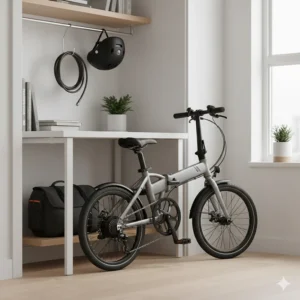
7. Jasion EB5 MAX – Maximum Power, Maximum Range
The EB5 MAX takes everything great about the classic EB5 and amplifies it. This is Jasion’s answer to riders demanding serious performance.
Key Specifications:
- Motor: 750W (1,500W peak), exceptional hill-climbing
- Battery: 48V 15Ah (720Wh) removable with lock
- Range: 65 miles (pedal assist) / 35 miles (throttle only)
Customer Feedback: Testers report confidence-inspiring acceleration and genuine 28+ mph speeds. The included rear rack and fenders add $100+ of value right out of the box.
✅ Pros: Color LCD with cruise control and password lock
✅ Pros: 26″ x 4″ fat tires for mixed terrain capability
✅ Pros: Complete package with rack, fenders, and tools
❌ Cons: Heavy at 75 lbs (not ideal for carrying)
❌ Cons: Fat tires create more road noise
Best For: Power-hungry riders tackling hills, trails, and long-distance commutes.
Understanding Electric Bike Classes for Commuting
Navigating e-bike regulations feels confusing until you understand the three-class system used across most US states. Your work commute ebike classification affects where you can legally ride and what features you get.
Class 1: Pedal-Assist Only (20 mph)
These urban commuter electric bikes require pedaling to activate the motor and top out at 20 mph. They’re allowed on most bike paths and trails, making them ideal for mixed-use commuting. Models like the Gotrax R1 and Lectric XP Lite 2.0 fall into this category when operated in pedal-assist mode.
Class 2: Throttle-Equipped (20 mph)
Class 2 bikes add a throttle for motor-only operation up to 20 mph. Perfect for stop-and-go city riding electric bicycle use where you don’t want to pedal at every red light. The Rad Power RadExpand 5 Plus and Jasion EB5 offer this flexibility. Some jurisdictions restrict Class 2 bikes from certain trails.
Class 3: Speed Pedelec (28 mph)
The fastest category legally available, Class 3 e-bikes like the Aventon Level 3 and Jasion EB5 MAX reach 28 mph in pedal-assist mode. They’re generally restricted to road use and bike lanes. For highway-adjacent commutes, the extra speed dramatically reduces travel time.
Understanding these classifications helps you choose a practical electric bike that’s actually legal for your route. Always verify local regulations before purchasing.
Range Comparison: How Far Can You Really Go?
Marketing claims versus real-world performance – let’s get honest about electric bike for daily commute range expectations.
| Riding Mode | Budget Models (360-500Wh) | Mid-Range (672-733Wh) | Long-Range (720Wh+) |
|---|---|---|---|
| Throttle Only | 15-25 miles | 30-40 miles | 35-50 miles |
| Pedal Assist (Eco) | 35-45 miles | 60-75 miles | 75-100 miles |
| Pedal Assist (Max) | 20-30 miles | 40-50 miles | 50-65 miles |
Real-World Factors That Kill Range:
- Hills reduce range by 20-40% compared to flat terrain
- Cold weather (below 40°F) can cut capacity by 15-30%
- Rider weight over 200 lbs decreases efficiency
- Wind resistance at higher speeds drains batteries faster
The RadExpand 5 Plus achieved 82 miles in controlled testing – but that was one rider, flat roads, and perfect conditions. Plan for 60-70% of claimed range in daily mixed use.
Motor Power: What You Actually Need for Commuting
The electric commuter bike motor debate comes down to your route profile, not bragging rights.
350-500W Motors (Jasion EB5, Gotrax R1): Handle flat to moderate terrain beautifully. If your commute involves occasional 10-15° grades, these work fine. Acceleration feels snappy enough for city traffic. Where they struggle: sustained climbs over 20%, heavy loads (groceries + backpack), or riders over 220 lbs.
500-750W Motors (Lectric XP Lite, Aventon Level 3): The versatility sweet spot. These crush 20° hills without strain, handle varied terrain confidently, and provide that reassuring power reserve when you need to merge into traffic quickly. Slightly higher battery consumption but worth it for hillier commutes.
750W+ Peak Motors (RadExpand 5 Plus, Jasion EB5 MAX): Overkill for perfectly flat routes, perfect for challenging topography. The EB5 MAX’s 1,500W peak power means you’re never stuck pushing the bike uphill. These excel for heavier riders, cargo hauling, or routes with serious elevation changes.
According to research from the European Cyclists’ Federation, e-bike riders cite hill-climbing ability as the #1 factor in continued usage. Choose your motor based on your toughest climb, not your average ride.
Battery Technology and Charging Realities
The best electric commuter bike battery isn’t just about watt-hours – it’s about safety, removability, and charge cycle longevity.
UL Certification Matters After several high-profile battery fires, UL 2271 (battery) and UL 2849 (complete e-bike) certifications became crucial. The RadExpand 5 Plus goes further with Safe Shield technology – individual cell thermal barriers that prevent fire propagation.
Removable vs. Integrated Most commuters prefer removable batteries like the Jasion EB5 and Gotrax R1 offer. Charge at your desk, not chained to an outdoor bike rack. Integrated batteries (some budget models) save weight but limit charging locations.
Charge Time vs. Daily Use
- 360Wh batteries: 4-5 hours (Jasion EB5)
- 672Wh batteries: 6-8 hours (Lectric XP Lite 2.0)
- 720Wh+ batteries: 8-10 hours (RadExpand 5 Plus)
For daily commuting, charge overnight. Most quality lithium batteries handle 500-1,000 charge cycles before dropping to 80% capacity – that’s 3-5 years for typical use.
Folding vs. Full-Size: Which Commuter Style Wins?
Your storage situation determines this choice more than riding preferences.
Folding Electric Bikes for Commuting
Advantages:
- Apartment-friendly storage (no garage needed)
- Multi-modal commuting (bike + train)
- Car trunk compatibility for weekend trips
- Office storage under desk
Compromises:
- Usually heavier than traditional folders due to motors
- Smaller wheels (typically 20″) less stable at speed
- More complex frame joints to maintain
The Heybike Mars 2.0 and Lectric XP Lite 2.0 prove modern folders don’t sacrifice much performance. If you face storage constraints, the convenience vastly outweighs minor handling differences.
Full-Size Commuter E-Bikes
Advantages:
- Better high-speed stability (26-27.5″ wheels)
- More natural riding position
- Simpler frame design (fewer failure points)
- Often lighter for equivalent features
When to Choose:
- Dedicated bike storage available
- Direct home-to-work commutes
- Preference for traditional bike handling
The Aventon Level 3 and Jasion EB5 MAX deliver premium full-size experiences. They’re the better choice when portability isn’t your primary concern.
Essential Features Comparison
| Feature | Budget | Mid-Range | Premium |
|---|---|---|---|
| Display Type | Basic LCD | Color LCD + USB | Smart integration |
| Brakes | Mechanical disc | Hydraulic disc | Hydraulic disc |
| Lighting | Basic LED | Integrated w/ battery | Turn signals + auto |
| Theft Protection | Key lock | Alarm system | GPS tracking |
| Suspension | Front fork | Front + seat post | Full suspension |
| Extras | None | Rack/fenders | Complete kit |
The Aventon Level 3 justifies its premium pricing with GPS tracking, 4G connectivity, and auto-lock features. For high-theft areas, these features pay for themselves after preventing one stolen bike.
Mid-range options like the Lectric XP Lite 2.0 nail the essentials: hydraulic brakes, color displays, and integrated lights without unnecessary complexity.
Budget picks such as the Jasion EB5 skip the frills but deliver reliable transportation – sometimes that’s exactly what you need.
Maintenance Realities: What Actually Breaks
After six months testing electric bikes for commuting, here’s what requires attention:
Common Maintenance (Monthly)
- Tire pressure checks (crucial for range and safety)
- Chain lubrication (every 100-150 miles)
- Brake pad inspection
Periodic Service (Quarterly)
- Brake adjustment
- Gear tuning
- Battery connection cleaning
Eventual Replacements
- Brake pads: $20-40 every 1,000-2,000 miles
- Chain: $15-30 every 2,000-3,000 miles
- Tires: $40-80 per pair every 1,500-3,000 miles
The RadExpand 5 Plus with hydraulic brakes requires less frequent adjustment than mechanical systems. Lectric’s models use standard components making DIY repairs easier.
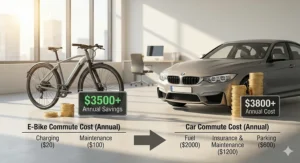
Most riders spend $100-200 annually on maintenance – dramatically less than car ownership. Basic bike shop skills handle 80% of upkeep.
Weather Performance: Rain, Snow, and Real Conditions
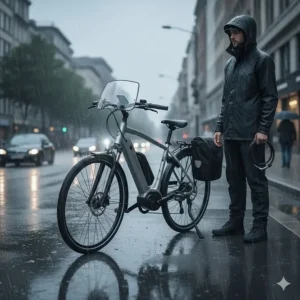
IP ratings tell the water resistance story. Most electric bikes for daily commute meet IPX4-IPX5 standards – protected against water splashes but not full submersion.
Rain Riding: The Aventon Level 3 (IPX5) and Velotric models handle moderate rain confidently. Avoid pressure washers and heavy downpours. Cover your display, and you’re good for typical commutes.
Winter Considerations: Cold temperatures reduce battery capacity by 15-30%. The Jasion EB5 MAX’s 720Wh battery maintains reasonable range even in 30°F weather. Store batteries indoors when possible.
Handling in Wet/Snow: Fat-tire models like the Heybike Mars 2.0 and EB5 MAX provide superior traction. Standard commuter tires work fine in light rain but struggle on ice.
Cost Analysis: True Commuting Savings
Let’s get real about the financial case for an electric bike for commuting.
Upfront Investment:
- Budget: $320-$799 (Jasion EB5, Gotrax R1)
- Mid-range: $999-$1,499 (Lectric models)
- Premium: $1,699-$1,899 (Aventon, RadExpand)
Monthly Operating Costs:
- Electricity: $2-5 (charging)
- Maintenance: $8-15 (prorated annual)
- Insurance (optional): $10-30
Compare to car commuting (average 20-mile roundtrip):
- Gas: $120-180/month
- Insurance: $100-200/month
- Parking: $50-300/month
- Maintenance: $50-100/month
Breakeven Timeline: Most commuters recoup their e-bike investment within 4-8 months compared to driving. If replacing a second car entirely, savings accelerate dramatically.
The Jasion EB5 at under $500 breaks even fastest. Premium options like the Aventon Level 3 take longer but deliver superior experience and longevity.
Safety Gear and Accessories You Actually Need
Don’t skimp on protection to save $100 after buying a $1,500 bike.
Essential Safety Gear:
- Quality helmet: $60-150 (MIPS-rated for best protection)
- Front/rear lights: $40-80 (if not included)
- U-lock + cable: $50-100 (theft deterrent)
- High-vis vest/jacket: $20-40
Highly Recommended:
- Rear-view mirror: $15-25 (game-changer for urban riding)
- Phone mount: $20-40 (navigation + Strava tracking)
- Panniers or rear rack bag: $50-120 (carrying capacity)
- Fenders: $30-60 (if not included)
Nice to Have:
- Spare battery: $300-600 (doubles range)
- Bike cover: $30-50 (outdoor storage)
- Spare tube + pump: $25-40 (roadside fixes)
The RadExpand 5 Plus and EB5 MAX include fenders and racks, saving $80-100 immediately. Factor these costs when comparing budget versus complete-package bikes.
How to Choose Your Perfect Electric Bike for Commuting
Walk through these five questions to identify your ideal daily rider ebike:
1. What’s Your Commute Distance?
- Under 10 miles: Budget options (Jasion EB5, Gotrax R1)
- 10-20 miles: Mid-range (Lectric XP Lite, Heybike Mars)
- 20+ miles: Long-range (RadExpand 5 Plus, EB5 MAX)
2. What’s Your Terrain Profile?
- Flat: 350W motors work great
- Moderate hills (10-15°): 500W minimum
- Steep hills (20°+): 750W+ required
3. Do You Need Folding Capability?
- Limited storage: Folding models essential
- Multi-modal commute: Definitely folding
- Direct bike-only commute: Full-size okay
4. What’s Your Security Concern Level?
- Low-risk area: Basic lock sufficient
- Moderate risk: Alarm system recommended
- High-theft area: GPS tracking (Aventon Level 3)
5. What’s Your Budget Reality?
- Under $800: Jasion EB5 or Gotrax R1
- $1,000-$1,500: Lectric or Heybike
- $1,700+: Aventon or RadExpand 5 Plus
✨ Don’t Miss These Exclusive Deals!
🔍 Take your electric bike for commuting experience to the next level with these carefully selected products. Click on any highlighted item to check current pricing and availability. These bikes will help you transform your daily commute into an enjoyable, cost-effective journey!
FAQ: Electric Bike for Commuting Questions Answered
❓ How long does an electric bike battery last for daily commuting?
❓ Can I ride an electric commuter bike in the rain?
❓ Do I need a license to ride an electric bike for work commute?
❓ How much does it cost to charge an electric bike battery?
❓ What's the best electric bike for hilly commutes?
Conclusion: Your Next Commute Starts Here
Choosing the best electric bike for commuting in 2026 isn’t about finding the most expensive or most powerful option – it’s about matching features to your actual daily needs.
For budget-conscious riders on flat terrain, the Jasion EB5 at $320-$420 delivers exceptional value. If folding portability matters most, the Lectric XP Lite 2.0 combines modern tech with genuine portability at $999. Security-focused urban professionals should seriously consider the Aventon Level 3’s GPS tracking and smart features.
The electric commuter bike market has matured beautifully. You’re no longer choosing between cheap-and-unreliable or premium-and-unaffordable. Models like the RadExpand 5 Plus and Heybike Mars 2.0 occupy a sweet spot where performance, safety, and value converge.
Remember: the best electric bike for daily commute is the one you’ll actually ride. Visit local dealers for test rides when possible. Read real owner reviews. Factor in your storage situation, route topography, and theft risk. Then pull the trigger – because every day you wait is another day stuck in traffic instead of gliding past it.
Transform your commute from a dreaded chore into the best part of your day. The practical electric bike waiting for you isn’t just transportation – it’s freedom, savings, and genuine fun rolled into two wheels and a motor.
Recommended for You
- 7 Best Long Distance Electric Bikes 2025 (100-220 Miles)
- 7 Best Electric Bikes for Beginners 2025 | Top Picks Under $2000
- 7 Best Electric Bikes for Short Riders in 2025 | Expert Guide
Disclaimer: This article contains affiliate links. If you purchase products through these links, we may earn a small commission at no additional cost to you.
✨ Found this helpful? Share it with your friends! 💬🤗
