
In This Article
A bluetooth helmet communicator for sport riders is a compact, helmet-mounted device with speakers and a microphone that links to your phone, GPS and other riders’ headsets. It handles calls, navigation prompts, music and rider-to-rider intercom hands-free, and it’s built to stay usable at sport-bike speeds, in a tucked riding position, inside a snug full-face lid.

That’s the dry version. The lived version is this: at 70 mph on a sport bike, your helmet is a loud little room. Engine noise fades into the background once you’re moving, and the real villain is wind. According to Inside Science’s coverage of helmet acoustics research, audible wind noise can climb to 115 decibels or more, roughly power-saw territory. Now try to hear a turn-by-turn prompt over that. Or your riding buddy saying “gas stop, next exit.” Good luck.
So the best bluetooth helmet communicator for sport riders isn’t just a gadget. It’s a small bundle of engineering compromises: speaker size versus helmet padding, range versus battery, microphone clarity versus wind blast, and mount strength versus the shape of your shell. Get the compromises wrong and you’ve bought an expensive way to hear static. Get them right and the ride gets safer, calmer and honestly more fun.
This guide covers seven real, currently available communicators, from flagship mesh systems to a wallet-friendly workhorse. Every product comes with analysis built on spec sheets and aggregated reviewer feedback, not marketing gloss. We’ll also dig into the details most listings gloss over: how Bluetooth 5.0 range really behaves, what a wind noise reducing motorcycle intercom setup actually looks like, why your noise cancelling microphone needs placement more than technology, and how a helmet mounting clamp can make or break your install.
One honest note up front: I haven’t strapped these onto my own lid, and I won’t pretend otherwise. What follows is analysis of published specs and the consistent themes in real owner and reviewer reports. Where something can’t be verified, I’ll say so.
Quick Comparison: The 7 Contenders at a Glance
Here’s the lineup before we get into the weeds. Prices are ranges only, since they shift constantly. Check current pricing before you buy.
| Model | Intercom Type | Group Size / Claimed Range | Approx. Battery (Claimed) | Price Range | Best For |
|---|---|---|---|---|---|
| Sena 60S | Mesh 3.0 + WAVE | Large groups; claimed long range | ~13 hrs talk | $400-$450 range | Tech-forward riders who want every feature |
| Cardo PACKTALK Pro | Dynamic Mesh | Up to 15 riders; about a mile | ~13 hrs talk | $450-$500 range | Hands-off group riding with crash detection |
| Cardo PACKTALK Edge | Dynamic Mesh | Claimed ~1.6 km mesh | ~12-13 hrs | Premium tier | Weather-proof, magnetic-mount convenience |
| Sena 50S | Mesh 2.0 | Claimed ~1.9-2 km mesh | ~14-16 hrs claimed | Premium tier | Long touring days, Harman Kardon sound |
| Cardo FREECOM 4X | Bluetooth intercom | Up to 4 riders; ~1.2 km | ~13 hrs | $250-$300 range | Best mid-range balance |
| LEXIN G2P | Bluetooth intercom | Up to 6 riders; claimed ~1 km | Up to ~20 hrs talk (claimed) | Budget tier | Value seekers and small groups |
| Cardo SPIRIT HD | Bluetooth intercom | Two riders; short range | ~12 hrs | Entry tier | Pairs and simple setups |
The table tells a clear story: premium mesh units cost nearly double the mid-range Cardo FREECOM 4X, yet their battery claims barely differ. What you’re really buying with mesh is group-management smarts, not extra hours. If your riding crew is two or three people, the Cardo FREECOM 4X or the LEXIN G2P gets you 90% of the benefit for a fraction of the cost. If you lead six-bike Sunday canyon runs, mesh earns its premium.
💬 Just one click — help others make better buying decisions too!😊
Top 7 Bluetooth Helmet Communicator for Sport Riders: Expert Analysis
1. Sena 60S — the feature-stuffed flagship
The Sena 60S is Sena’s current top-of-the-line unit, and it leans hard into being smaller, lighter and smarter than the Sena 50S it replaced. Reviewers highlight its Mesh 3.0 intercom, AI-enhanced audio processing and the WAVE intercom, which is designed to link riders beyond normal radio range by leaning on a data connection.
On paper, that smaller footprint matters more to sport riders than anyone. A slimmer body sits closer to the shell, creating less turbulence near your ear and less leverage on the mount. Sound comes from Harman Kardon speakers, and talk time lands around 13 hours, roughly on par with Cardo’s flagship.
Who’s it for? Riders who like to tinker. One comparison reviewer notes the 60S requires a button press to activate WAVE, which can slow response in the moment, while Cardo’s rival needs no interaction once mounted. That’s a real consideration at track-day pace or on a twisty road when your gloved thumb is busy.
Aggregated reviewer sentiment is warm on audio and feature depth, with the recurring caveat that Sena’s app and menus reward patience.
Pros:
- ✅ Compact body suits tucked sport riding
- ✅ Mesh 3.0 plus WAVE for flexible grouping
- ✅ Harman Kardon audio with AI-assisted processing
Cons:
- ❌ WAVE needs a button press to activate
- ❌ Premium pricing for features many riders won’t use
Expect a price in the $400-$450 range. Great value if you’ll use mesh and WAVE, overkill if you won’t.
2. Cardo PACKTALK Pro — the “mount it and forget it” mesh king
The Cardo PACKTALK Pro is the unit reviewers keep crowning in head-to-head tests against the Sena 60S. Its Dynamic Mesh Communication links up to 15 riders with a claimed range of roughly a mile between units, and it reconnects automatically when a rider drops back into range, no button taps required.
That “no interaction” quality is the real story. On a sport bike, every second your hand leaves a bar is a second you’ve spent not riding. One comparison reviewer notes that Cardo’s mesh has a slight edge over Sena’s in seamlessness and group management. It uses 30mm JBL speakers and, according to Cardo’s own comparison, adds built-in crash protection. Treat that last point as manufacturer-sourced; verify details on the product page.
Battery life is around 13 hours of talk time, which handles a long Saturday but won’t survive a multi-day tour without a top-up.
Reviewers broadly praise the intuitive operation, though the Cardo Connect app draws mild criticism for feeling dated next to Sena’s.
Pros:
- ✅ Dynamic Mesh handles up to 15 riders
- ✅ Auto-reconnect without button presses
- ✅ JBL speakers with crash-protection features
Cons:
- ❌ Highest price tier in the Cardo lineup
- ❌ Companion app feels dated to some owners
Plan on the $450-$500 range. Worth it if you ride in groups regularly and want the least fiddly experience.
3. Cardo PACKTALK Edge — the weather-ready, magnet-mount slimline
The Cardo PACKTALK Edge is the previous-generation flagship, and its biggest selling point now is that it’s a proven design that often costs less than the newest units. It carries an IP67 rating, JBL audio and a claimed mesh range around 1.6 km.
Here’s the thing about range claims: one tester who ran the Cardo PACKTALK Edge next to the Sena 50S found that neither hit its advertised mesh numbers consistently. Treat 1.6 km as a best-case figure on flat, open road, not a promise in canyons.
Battery performance showed up as a wash in that comparison: Cardo claimed 12 hours, Sena claimed 14, and the tester logged roughly 13 for each. So don’t let the box numbers drive your decision.
What the spec sheet doesn’t tell you, but reviewers keep mentioning, is how the magnetic mount makes it easy to pop on and off. For riders who switch between helmets or want to remove the unit at the track, that’s a quiet daily win.
Pros:
- ✅ IP67 water and dust protection
- ✅ Magnetic mount for quick on-off
- ✅ Fast reconnection reported by reviewers
Cons:
- ❌ Real mesh range falls short of claims
- ❌ App criticized as behind Sena’s
Pricing sits in the premium tier, but check current price since older stock often discounts. Good value if you don’t need the newest tech.
4. Sena 50S — the long-haul touring pick
The Sena 50S was Sena’s flagship before the 60S, pairing Mesh 2.0 with Harman Kardon sound and a claimed mesh range of 1.9 to 2 km. Reviewers generally praise its audio quality and endurance: claimed talk time is around 14 hours, with some retail write-ups quoting 16.
For touring-minded sport riders, who log six to ten hours on the road, that stamina matters. But there’s a catch. Reviewers report that mesh mode drains the battery faster than plain Bluetooth, so real-world mesh runtime can come in well below the headline number. One comparison cited owners seeing around 9 hours of mesh use.
Water is the other thing to watch. One review lists no official IP rating and mentions riders reporting shutdowns in heavy downpours. If you commute year-round, that’s worth weighing against the Cardo PACKTALK Edge.
It uses a clamp-style mount, which is sturdy and familiar, and we’ll dig into why that matters in the helmet mounting clamp section below.
Pros:
- ✅ Harman Kardon audio praised by reviewers
- ✅ Strong claimed battery for touring days
- ✅ Sturdy clamp mount
Cons:
- ❌ Mesh mode shortens battery life noticeably
- ❌ No official IP rating cited
Often available in the premium range at a lower price than new flagships. Check current price.
5. Cardo FREECOM 4X — the mid-range sweet spot
The Cardo FREECOM 4X is the unit I’d point most sport riders toward first. It offers Bluetooth 5.2 connectivity, intercom for up to four riders over a claimed 1.2 km (about 0.75 miles), and 40mm JBL speakers that are only about 10mm thick, which is exactly what you need inside a snug full-face helmet.
Natural voice control (“Hey Cardo”) means you can skip the button hunt. That matters because reviewers note the volume wheel is small and can be hard to find with a gloved thumb. Battery runs around 13 hours of talk time, and fast charging can reportedly deliver about two hours of talk time from a 20-minute top-up, a genuinely useful trick when you’ve forgotten to charge overnight.
One reviewer also noted the unit connects to other major brands, including Sena, and found infrequent static plus limited intercom range. It’s not a mesh system, so it won’t hold a big group together across hills.
Pros:
- ✅ Slim JBL speakers fit tight helmets
- ✅ Voice control reduces glove fumbling
- ✅ Works with other major intercom brands
Cons:
- ❌ Small volume wheel is tricky with gloves
- ❌ Intercom range limited versus mesh
Typically in the $250-$300 range. Excellent value for small groups.
6. LEXIN G2P — the budget group-intercom workhorse
The LEXIN G2P punches above its price. Listings advertise intercom for up to six riders, 40mm HD speakers, IP67 dust and water resistance, and interchangeable shells. It ships with two microphone options, a button mic for full-face helmets and a boom mic for open-face, which is relevant here since sport riders mostly wear full-face lids.
Battery figures are the headline: retail listings claim up to roughly 25 hours of music playback and about 20 hours of talk time from an 800mAh battery. Those are manufacturer maximums. One review analysis stresses that mixed use of intercom, music and calls reduces actual runtime.
Range is where honesty matters. Advertised figures vary across listings, anywhere from about 0.6 miles to 1,000 meters or more. Aggregated buyer feedback indicates real-world range often falls short, especially in cities, hills and tree cover. Cross-brand pairing with non-LEXIN units can also be hit or miss.
If your crew all buys the same budget kit, though, the LEXIN G2P is a seriously strong value, which is why it keeps showing up near the top of budget roundups.
Pros:
- ✅ Strong claimed battery for the price
- ✅ Button mic option suits full-face helmets
- ✅ IP67 rating and glove-friendly button
Cons:
- ❌ Real range often shorter than advertised
- ❌ Cross-brand pairing can be unreliable
Budget tier. Check current price, especially for dual packs.
7. Cardo SPIRIT HD — the simple two-rider starter
The Cardo SPIRIT HD is the entry rung of Cardo’s lineup, built for riders who want clean phone, GPS and music audio plus basic intercom without the complexity. One European comparison notes it adds FM radio and lets you pair phone and navigation separately, features some rivals charge more for.
Retail listings put battery life around 12 hours, with a Bluetooth intercom range in the neighborhood of 100 meters. That’s short. It’s fine for two bikes riding in a tight pair, but it won’t keep you connected across a spread-out pack.
So who’s it for? A rider who mainly wants navigation and music at sport pace, with an occasional chat with one partner. The small footprint is also a plus under a tight shell.
The trade-off is simple: you’re giving up range, group size and speaker thickness options to keep cost down. Reviewer sentiment around the Spirit line leans toward reliability and ease of use, rather than headline features.
Pros:
- ✅ Simple pairing and operation
- ✅ Separate phone and GPS pairing
- ✅ Low-profile body for tight helmets
Cons:
- ❌ Intercom range is quite short
- ❌ Limited group size
Entry-tier pricing. Check current price, since bundles vary.
Now let’s put the specs side by side, because numbers hide differences you only notice after the purchase.
| Model | Audio | Weather Rating | Mount Style | Best For |
|---|---|---|---|---|
| Sena 60S | Harman Kardon | Check current spec | Clamp / Air Mount style | Feature lovers |
| Cardo PACKTALK Pro | 30mm JBL | Check current spec | Cardo cradle | Hands-off group leaders |
| Cardo PACKTALK Edge | JBL | IP67 | Magnetic | Wet-weather commuters |
| Sena 50S | Harman Kardon | No official IP cited | Clamp | Touring riders |
| Cardo FREECOM 4X | 40mm JBL | Waterproof | Cradle | Value-focused riders |
| LEXIN G2P | 40mm HD | IP67 | Clamp / adhesive style | Budget groups |
| Cardo SPIRIT HD | Standard | Check current spec | Cradle | Two-rider starters |
The pattern here is Cardo’s weatherproofing consistency versus Sena’s audio branding. If you ride in rain often, the Cardo PACKTALK Edge and the LEXIN G2P are the two with clear IP67 claims in the sources I reviewed. Audio snobs may lean toward the Sena 50S or Sena 60S, but remember that sound only matters if it survives a downpour.
✨ Don’t Miss These Exclusive Deals!
🔍 Take your ride to the next level with these carefully selected communicators. Click on any highlighted item to check current pricing and availability. These tools will help you create the clear, hands-free riding experience you’ve been after!
How to Choose a Bluetooth Helmet Communicator for Sport Riders
Choosing well means working through a few filters in the right order. Here’s the sequence I’d use:
- Decide your group size first. Two riders? A Bluetooth intercom like the Cardo FREECOM 4X is plenty. Four to six? Consider the LEXIN G2P or step up. More than six, or hilly terrain? Mesh pays off.
- Match brands across the group. Cross-brand pairing works on paper, but reviewers report occasional hiccups. If everyone buys the same ecosystem, life gets easier.
- Check helmet fit before specs. Your shell’s shape, padding depth and chin bar design decide whether speakers sit properly. Thin speakers like the 10mm JBL units in the Cardo FREECOM 4X exist for a reason.
- Prioritize microphone type. Full-face helmets need a button or short boom mic. Modular helmet owners must also consider how the chin bar lifts and drops when positioning the mic.
- Be realistic about battery. Manufacturer figures are best-case. Plan on 70-80% of the claim when running intercom and music together.
- Weigh weather exposure. IP67 matters if you ride year-round.
- Think about ecosystem and updates. Over-the-air firmware updates, app quality and support length all affect long-term value.
Features that actually matter: speaker thickness, mic placement, auto-reconnect and battery honesty. Features that mostly don’t: gimmicky light effects and extreme range claims you’ll never reach.

Bluetooth 5.0 Range: What the Numbers Really Mean
Here’s a fact that surprises many buyers: Bluetooth 5.0 range is a spec for your phone-to-headset link, not for rider-to-rider intercom. According to Wikipedia’s Bluetooth overview, each Bluetooth version brought changes in speed, range and efficiency, and version 5 was notable for pushing theoretical range well beyond earlier generations. But theory and your helmet are two different animals.
In practice, your phone sits in a pocket or tank bag within a couple of meters, so Bluetooth 5.0 range is almost irrelevant for phone calls. Where it matters is stability: newer Bluetooth versions generally handle interference and reconnection more gracefully, which means fewer dropouts when you swing your head or pass other riders.
Intercom range is a separate beast. It’s governed by the manufacturer’s own radio design, antenna placement and, crucially, terrain. Reviewers repeatedly note that line of sight dominates: hills, curves and dense traffic slash real-world range. One tester found neither a Sena 50S nor a Cardo PACKTALK Edge hit its claimed mesh range consistently.
So here’s the practical translation. Treat a claimed 1.2 km as perhaps a third to half of that in mixed terrain. If a unit lists Bluetooth 5.0 range and a longer intercom number, ask which one applies to your use. A Cardo FREECOM 4X with Bluetooth 5.2 is good for stable phone pairing; its 1.2 km intercom claim is what governs bike-to-bike chat.
Wind Noise Reducing Motorcycle Intercom: What Actually Works
No communicator can truly delete wind noise, and any listing implying otherwise deserves a raised eyebrow. A wind noise reducing motorcycle intercom setup is really a system: helmet, seals, windscreen, speaker placement and, yes, electronics.
The problem starts with the helmet itself. A report in Hearing Review on University of Bath research describes wind tunnel testing that traced a major noise source to the area beneath the helmet near the chin bar, and notes that even legal-speed wind noise can exceed safe levels. That’s directly relevant to sport riders, whose tucked posture and full-face lids put the chin bar right in the airflow.
Here’s what helps:
- Seal the gaps. A snug neck roll and a well-fitted chin curtain cut noise before any electronics do.
- Choose thin, high-quality speakers. The Cardo FREECOM 4X uses 40mm JBL speakers; the Sena 60S and Sena 50S use Harman Kardon units. Bigger drivers push sound further above the roar.
- Use filtered earplugs. Earplugs designed to block harmful high frequencies while letting speech through are widely recommended by hearing specialists, and they let you run lower speaker volume.
- Rely on software tweaks. The Sena 60S advertises AI-enhanced audio processing, and the Cardo PACKTALK Pro leans on adaptive volume.
Honest takeaway: a wind noise reducing motorcycle intercom helps, but the quietest rides come from fixing the helmet first and the headset second.
Noise Cancelling Microphone: Why Placement Beats Technology
A noise cancelling microphone sounds like magic, but what it really does is filter steady background hum so your voice stands out. It can’t invent clarity from a gale. If the mic is bouncing around in turbulent air, even the best processing struggles.
For full-face helmets, a button-style or short boom mic placed close to your mouth tends to work best. The LEXIN G2P ships with a button mic specifically for full-face use and a boom mic for open-face helmets, which tells you the designers considered the difference. Modular helmets add another wrinkle, since the chin bar moves and can displace the mic.
Placement tips that cost nothing:
- Position the mic about a finger-width from your lips, angled slightly toward the corner of your mouth.
- Keep the wire clear of the helmet’s seal so it doesn’t buzz against foam.
- Add a small windscreen sponge if your kit includes one.
- Test by recording a voice memo at speed before you commit to a sticky-tape position.
Reviewers consistently describe voice clarity as the make-or-break feature of any intercom, which is why a good noise cancelling microphone matters most on mesh units like the Sena 60S and Cardo PACKTALK Pro, where multiple riders can talk at once.
Helmet Speaker System for Full Face Helmets: Fit and Sound
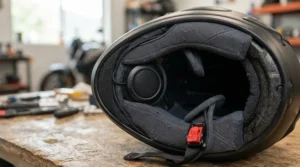
A helmet speaker system for full face helmets lives or dies on thickness. Full-face lids have tight ear pockets, and a speaker that presses on your ear becomes a headache by hour two.
That’s why the roughly 10mm thickness of the JBL speakers in the Cardo FREECOM 4X gets attention. Meanwhile, the LEXIN G2P offers 40mm HD speakers and interchangeable shells, and the Sena 50S and Sena 60S pair Harman Kardon audio with slim cables.
Fit steps worth following:
- Place speakers directly over your ear canal, not just near it.
- Peel back the cheek pad edge and route cables along channels, not across padding.
- Use hook-and-loop pads for a gentle position, rather than hard adhesive on foam.
- Listen at low volume with the engine off first, then adjust at speed.
A smart helmet speaker system for full face helmets also pays off in safety. Reviewers note that moderate, clear audio beats cranked volume, since pushing volume to beat wind noise just adds to hearing strain.
Motorcycle Headset With Long Battery Life: Real-World Runtime Math
Everybody wants a motorcycle headset with long battery life, and manufacturers happily oblige with big numbers. The honest picture is messier.
Claimed talk times cluster around 12 to 14 hours for premium units: the Cardo PACKTALK Edge at about 12 to 13, the Sena 50S at about 14, the Cardo FREECOM 4X at about 13, and the Sena 60S and Cardo PACKTALK Pro both near 13. The LEXIN G2P claims roughly 20 hours of talk time from an 800mAh battery, though one review analysis warns manufacturer maximums drop in mixed use.
Mesh is the hidden drain. Reviewers note it consumes noticeably more power than plain Bluetooth, and one comparison cited around nine hours of real-world mesh use on an older Sena unit.
How to stretch runtime:
- Lower speaker volume; it costs power and hearing.
- Turn off features you aren’t using, like FM radio or WAVE.
- Charge before every long ride, and use fast-charging if available. The Cardo FREECOM 4X reportedly delivers about two hours of talk time after 20 minutes.
- Avoid leaving the unit in a hot garage or a freezing saddlebag.
A motorcycle headset with long battery life matters most on tours and track days. For commuting, any unit here is fine.
Helmet Mounting Clamp: Clamp vs Adhesive vs Magnetic
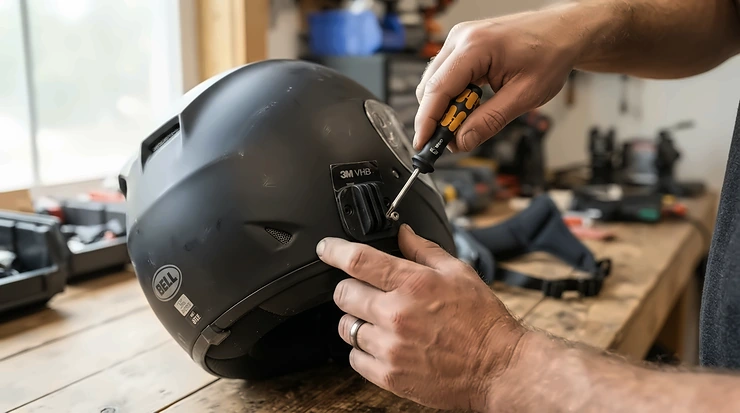
The helmet mounting clamp is the unglamorous part that decides whether your communicator survives its first crash-free year. A clamp grips the lower edge of the shell, an adhesive plate sticks to the surface, and a magnetic mount lets you pop the unit off.
Clamps, like those on the Sena 50S, tend to be more secure and easier to move between helmets. Their downside is fit: thick edges, spoilers or unusual shell shapes can make a helmet mounting clamp sit awkwardly. Adhesive mounts suit helmets with no usable edge but are semi-permanent. The Cardo PACKTALK Edge adds a magnetic mount, which reviewers like for quick removal.
Mounting tips:
- Test-fit the helmet mounting clamp before sticking anything down.
- Position the unit low and toward the rear on sport helmets to keep it out of the airflow and away from your visor mechanism.
- Check the mount again after your first week; clamps can loosen.
- Never drill or modify the shell, which can compromise helmet protection.
A solid helmet mounting clamp isn’t flashy, but it’s the thing that keeps your investment on your head and not in the road.
Bluetooth Intercom vs Mesh Intercom vs Riding Silent
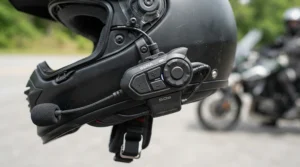
Is mesh worth it? Depends on the ride.
| Option | Group Size | Range Behavior | Battery Impact | Best For |
|---|---|---|---|---|
| Basic Bluetooth intercom (Cardo FREECOM 4X, LEXIN G2P) | 2-6 riders | Direct, line-of-sight | Lower | Small groups on a budget |
| Mesh intercom (Sena 60S, Cardo PACKTALK Pro) | Up to 15 | Self-healing, hop-based | Higher drain | Large groups, mixed terrain |
| Riding silent with earplugs | Any | None | None | Solo riders prioritizing hearing |
Read it this way: mesh solves a problem small groups simply don’t have. If three friends ride together, a Bluetooth unit like the Cardo FREECOM 4X is cheaper, lighter on battery and easier to learn. If you lead a twenty-minute-spread pack through mountains, the extra cost of a Cardo PACKTALK Pro is actually buying you a connection that holds together. And honestly, riding silent with good filtered earplugs is a legitimate choice for solo riders who want zero distraction.
Price Range, Value and Long-Term Cost
Total cost of ownership extends beyond the sticker. Add mounts, spare cables, a second unit for a partner, and eventually a replacement when the battery fades.
| Tier | Example | Price Range | Value Note |
|---|---|---|---|
| Entry | Cardo SPIRIT HD | Under $200 range | Good for pairs and simple needs |
| Budget group | LEXIN G2P | Budget tier | Best cost per rider if the group matches brands |
| Mid-range | Cardo FREECOM 4X | $250-$300 range | Best all-round balance |
| Premium mesh | Sena 60S, Cardo PACKTALK Pro | $400-$500 range | Pays off only with regular group riding |
Looking at this, the Cardo FREECOM 4X is the quiet winner on value: it’s about half the price of flagship mesh yet carries comparable battery life and speaker quality. The LEXIN G2P wins on cost per rider, but only if everyone buys the same system. Premium mesh makes sense for frequent group riders, since sharing the cost over many rides lowers the effective price per ride.
Practical Setup Guide: Your First 30 Days
Installing a communicator well takes about an hour. Using it well takes a few weeks of small tweaks.
Day 1: Install and pair. Charge fully, mount the unit using a test-fit, and pair your phone first. Update firmware through the manufacturer’s app before your first ride.
Week 1: Tune the audio. Ride at your usual speeds and adjust volume and mic position. Many first-time owners crank volume too high; try lowering it a notch and fixing the seal instead.
Week 2: Learn the controls with gloves on. Practice the jog dial or wheel in the driveway so it becomes muscle memory. If the Cardo FREECOM 4X volume wheel is fiddly, use voice commands.
Weeks 3-4: Add the group. Pair with riding buddies in a parking lot, not on the highway. Test auto-reconnect by riding out of range and back.
Common first-month mistakes:
- Charging in a hot car dashboard
- Routing speaker cables over the cheek pad’s tight spot
- Forgetting firmware updates
- Mixing brands without testing the connection first
Real-World Scenarios: Three Sport Riders, Three Picks
The solo canyon carver. You ride alone on twisty weekend roads, using nav and music. Budget is moderate. The Cardo FREECOM 4X gives slim speakers, voice control and strong battery without mesh complexity.
The six-bike Sunday group. Your crew rides together weekly through hilly terrain. Mesh reliability matters more than cost. The Cardo PACKTALK Pro offers hands-free reconnection, while the Sena 60S suits a group that enjoys customizing settings.
The student on a budget with a riding partner. Two of you commute and occasionally ride out together. Buying two units of the LEXIN G2P keeps cost low, and matching brands avoids pairing issues. If you only need simple chat, a pair of Cardo SPIRIT HD units also works.
Each scenario highlights the same principle: pick for your group first, features second.
Problem → Solution Guide
Problem: I can’t hear anything above 60 mph. Fix helmet seals first, switch to filtered earplugs and reposition speakers over your ears. Then consider a unit with stronger audio like the Sena 60S.
Problem: My voice sounds muffled. Reposition the noise cancelling microphone closer to your mouth, away from the foam, and check for wind buffeting.
Problem: The unit dies halfway through a long ride. Lower volume, turn off unneeded features and consider the Sena 50S or LEXIN G2P for longer claimed runtime. Remember mesh drains faster.
Problem: My group keeps dropping out. Check that everyone runs the same firmware, ride in staggered formation for line-of-sight, and consider upgrading to mesh.
Problem: The mount keeps loosening. Re-seat the helmet mounting clamp, add a small amount of thread-lock-safe pad (never anything that eats the shell) and check it weekly.
Safety, Awareness and Legal Notes
Does a helmet communicator make you less aware? Research suggests the helmet itself isn’t the main problem. A NHTSA helmet study, hosted by webBikeWorld, found no difference in hearing thresholds across no-helmet, partial and full-coverage conditions, though hearing ability dropped with speed due to wind noise.
That’s a useful reminder: speed and wind, not the shell, are the main hearing challenges, and a communicator adds another sound source competing for your attention. Keep volume moderate, avoid long phone conversations in dense traffic and don’t let navigation chatter drown out horns or sirens. Laws about headsets and earbuds vary by state, so check your local rules before you ride.

Frequently Asked Questions
❓ How far can a bluetooth helmet communicator for sport riders actually reach?
❓ Can I mix Sena and Cardo headsets in one group?
❓ Is a mesh intercom worth it for a small group?
❓ Will a communicator fit under a snug full-face helmet?
❓ How long do the batteries last on a long sport ride?
Conclusion
Choosing a bluetooth helmet communicator for sport riders comes down to honest answers about how you ride. Small group, tight budget, simple needs? The Cardo FREECOM 4X is the sweet spot, with the LEXIN G2P as the cost-conscious pick for matching crews. Leading big groups through varied terrain? The Cardo PACKTALK Pro and Sena 60S justify their premium with smarter group management, while the Cardo PACKTALK Edge and Sena 50S deliver strong value as previous-generation flagships. For two-rider simplicity, the Cardo SPIRIT HD does the job.
Remember the practical details that decide real satisfaction: Bluetooth 5.0 range is about phone stability, not group distance; a wind noise reducing motorcycle intercom works best when the helmet fit is right; a good noise cancelling microphone depends on placement; and a solid helmet mounting clamp keeps everything where it belongs. Pair those with a motorcycle headset with long battery life and a helmet speaker system for full face helmets that actually fits, and you’ll have a setup that disappears into your ride.
✨ Ready to upgrade your ride?
🏍️ Check current pricing and availability on the models above, and pick the communicator that matches your group, not just the spec sheet. Your next ride deserves a better soundtrack, and clearer conversations along the way!
Recommended for You
- Sport Bike Style Electric Moped For Adults: 7 Best Picks 2026
- Full Face Helmet For Electric Sport Bike Riders: 7 Best Buys 2026
- Safest Electric Scooter For Kids: 7 Proven Picks (2026)
Disclaimer: This article contains affiliate links. As an Amazon Associate, I earn from qualifying purchases. If you purchase products through these links, we may earn a small commission at no additional cost to you.
✨ Found this helpful? Share it with your friends! 💬🤗
