In This Article
Running late to your 8 AM lecture with a backpack full of textbooks, racing across campus—sound familiar? What if there was a smarter way to navigate college life without breaking a sweat or your budget?
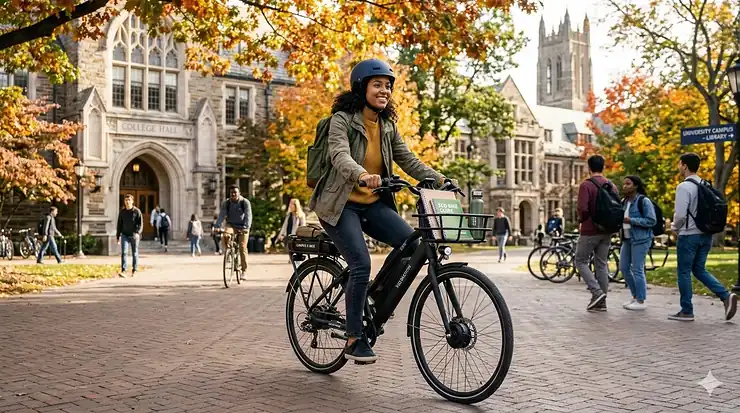
Enter the electric bike for college students—your solution to stress-free commuting and eco-friendly transportation. Unlike traditional bicycles that leave you exhausted climbing campus hills, these pedal-assisted bikes offer perfect balance between exercise and efficiency. And unlike cars, they don’t require expensive parking permits or drain your budget on gas.
An electric bicycle is a bicycle with an integrated electric motor used to assist propulsion, typically reaching speeds of 16-28 mph depending on the model. Modern student electric bike models are lightweight, affordable, and packed with features perfect for campus life—foldable designs that fit dorm rooms, theft-resistant components, and batteries lasting through multiple classes without recharging.
In this guide, I’ll walk you through the 7 best electric bike for college students in 2026, covering budget student bike options under $800 to premium models. Whether you need a compact college ebike for tight dorm storage, a dorm-friendly ebike complying with residence policies, or a theft-resistant campus bike surviving semesters, you’ll find your perfect match here.
Quick Comparison Table
| Model | Motor | Top Speed | Range | Weight | Price | Best For |
|---|---|---|---|---|---|---|
| ANCHEER StreetRider 14″ | 500W Peak | 22 MPH | 20-50 mi | 48.5 lbs | ~$799 | Dorm storage |
| Lectric XP Lite 2.0 | 819W Peak | 20 MPH | 45-80 mi | 49 lbs | $799 | Budget |
| ANCHEER Gladiator 26″ | 500W | 20 MPH | 50 mi | 65 lbs | ~$449 | Best value |
| Heybike Mars 2.0 | 1200W Peak | 28 MPH | 35-55 mi | 73 lbs | $899 | All-terrain |
| Lectric XP4 | 750W | 28 MPH | 45-75 mi | 68 lbs | $999 | Performance |
| Heybike Horizon | 750W | 25 MPH | 40-60 mi | 75 lbs | $1,499 | Comfort |
| Rad Power RadRunner | 750W | 20 MPH | 45 mi | 65 lbs | $1,499 | Cargo |
💬 Just one click – help others make better buying decisions too!😊
Top 7 Electric Bike for College Students: Expert Analysis
1. ANCHEER StreetRider 14″ Folding Electric Bike – Best Compact College Ebike
If dorm space is tighter than your schedule, the ANCHEER StreetRider deserves attention. This compact powerhouse folds to just 50×21×42 inches, making it the ultimate dorm-friendly ebike.
Key Specs: 350W/500W Peak motor, 48V 7.8Ah battery, 20-50 mile range, 22 MPH max
Student Feedback: Reviews highlight how easily this fits into narrow dorm closets or under loft beds. One rider mentioned taking it on subway trains—the folded size fits perfectly in overhead racks.
✅ Pros:
- Ultra-compact folding for dorm storage
- Dual shock absorbers for rough paths
- Integrated brake taillight for safety
- UL2849 Compliant certification
❌ Cons:
- Smaller 14″ wheels less stable at top speeds
- Lower weight capacity (265 lbs)
Price: $799-$850
2. Lectric XP Lite 2.0 – Best Budget Student Bike
For cash-strapped students, the Lectric XP Lite 2.0 delivers remarkable value at $799. You’re getting hydraulic disc brakes—a premium feature rarely found at this price—plus optional upgrades.
Key Specs: 300W/819W peak motor, 48V system, 45-80 mile range (upgraded), only 49 lbs
Student Feedback: Students praise its lightweight construction. Several reviews mention effortlessly carrying it up stairs or loading into car trunks for weekend trips.
✅ Pros:
- Lightest option at 49 lbs
- Hydraulic brakes for reliable stopping
- Five color options
- Optional Gates carbon belt drive
❌ Cons:
- Fenders sold separately
- Limited to 20 MPH (Class 2)
Price: $799-$999
3. ANCHEER Gladiator 26″ Electric Mountain Bike – Best Value Campus Commuter Bike
The ANCHEER Gladiator punches above its sub-$500 price, offering features typically reserved for bikes costing twice as much.
Key Specs: 500W motor, 48V 10.4Ah removable battery, 50 mile range, 3.5-hour fast charge
Student Feedback: Buyers report 15+ mile daily commutes without range anxiety. One student accumulated over 1,300 miles in six months, praising durability.
✅ Pros:
- Unbeatable price-to-performance ratio
- Removable battery charges indoors
- 21-speed Shimano gearing
- 4.90/5 from 391 verified reviews
❌ Cons:
- Heavier at 65 lbs
- Basic components
Price: $449-$499
4. Heybike Mars 2.0 Folding Fat Tire Electric Bike – Best All-Terrain
Snow days shouldn’t stop your commute. The Heybike Mars 2.0 tackles icy sidewalks to sandy beach paths with massive 20×4″ fat tires.
Key Specs: 750W (1200W peak), 48V battery, 35-55 mile range, full suspension
Student Feedback: Riders in snowy regions mention how confidently this handles winter conditions where traditional bikes would slip.
✅ Pros:
- Fat tires excel in snow/sand/rough terrain
- Powerful 1200W peak motor
- Folds despite larger frame
- Throttle option available
❌ Cons:
- Heavy at 73 lbs
- Bulkier folded footprint
Price: $899-$1,199
5. Lectric XP4 Long-Range Folding Utility Ebike – Best Performance
When you need speed, power, and range combined, the Lectric XP4 emerges as top performer. This Class 3 bike legally reaches 28 MPH.
Key Specs: 750W motor, 48V (10.4Ah or 17.5Ah options), 45-75 mile range, 28 MPH
Student Feedback: Students with longer commutes rave about time savings—one calculated shaving 15 minutes off daily rides compared to traditional biking.
✅ Pros:
- Class 3 speed for faster commuting
- Torque sensor for natural feel
- Includes fenders and rack
- Proven reliability
❌ Cons:
- Higher price point
- Heavier battery
Price: $999-$1,299

6. Heybike Horizon Full Suspension Electric Bike – Best Comfort
Long campus days demand comfort. The Heybike Horizon prioritizes ergonomics with dual suspension and step-through design.
Key Specs: 750W motor, full dual suspension, step-through frame, 40-60 mile range
Student Feedback: Riders highlight how suspension transforms rough campus roads into smooth journeys. Step-through frame makes hopping on/off between classes easier.
✅ Pros:
- Dual suspension absorbs bumps
- Step-through ideal for easy mounting
- Comfortable for extended riding
- Reduces fatigue
❌ Cons:
- Premium price ($1,499)
- Heavier at 75 lbs
Price: $1,499
7. Rad Power RadRunner Utility Bike – Best for Versatility
The Rad Power RadRunner offers unique utility design with customizable accessories—add passenger seats, cargo baskets, or security features.
Key Specs: 750W geared hub, 672Wh removable battery, 45 mile range, 300 lb capacity
Student Feedback: Students using this for food delivery praise its earning potential—one mentioned making enough through weekend deliveries to cover monthly payments.
✅ Pros:
- Extensive accessory compatibility
- Single-speed simplicity
- Sturdy utility design
- Student discount available
❌ Cons:
- No folding capability
- Heavier than pure commuters
Price: $1,499 (student discount available)
✨ Don’t Miss These Exclusive Deals!
🔍 Take your campus commuting to the next level with these carefully selected electric bikes. Click on any highlighted item to check current pricing and availability. These bikes will help you create stress-free commuting your campus life deserves!
What Makes a Good Campus Electric Bike?
Not all electric bikes suit university life. Here’s what actually matters for campus riding.
Portability Over Raw Power
Campus buildings have stairs and narrow hallways. Bikes over 75 pounds become nightmares hauling upstairs. You don’t need motorcycle-level power to cross campus—you need something manageable.
Compact Storage
Dorm rooms lack garage space. Folding mechanisms transform bikes into something that tucks beside desks or hangs on wall hooks—try that with full-size mountain bikes.
Theft Resistance
According to UL Standards & Engagement research, theft remains a persistent university concern. Ideal theft-resistant campus bike features include removable batteries (charge indoors while securing frames outside), less flashy designs, and heavy-duty U-lock compatibility.
Battery Life
Forgetting your charger shouldn’t strand you. Quality models provide 40-60 miles per charge—enough for several days of typical use without recharging.
Campus Compliance
Many universities now require UL safety standards, maintain speed limits, or restrict indoor charging. Check your school’s specific policies before purchasing.
Understanding Electric Bike Classifications
Federal laws categorize electric bikes into three classes:
Class 1: Pedal-assist only, 20 MPH max. Most campus-permissive category.
Class 2: Throttle-assisted, 20 MPH max. Some campuses restrict from pedestrian zones.
Class 3: Speed pedelec, 28 MPH max. Many universities prohibit due to safety concerns.
Practical Advice: Unless your campus explicitly permits Class 3, stick with Class 1 or 2. Speed differences rarely matter on crowded paths anyway.
Battery Safety and Dorm Regulations
Lithium-ion battery fires prompted many universities to implement strict charging regulations. The University of Florida’s policy typifies institutions: electric bikes cannot be parked, stored, or charged inside campus buildings. Similar restrictions exist at Princeton, MIT, and countless others.
Safer Charging Practices
- Only use manufacturer-provided chargers
- Never leave batteries charging overnight unattended
- Charge in well-ventilated areas away from flammables
- Invest in UL2849-certified models
Dorm Prohibitions?
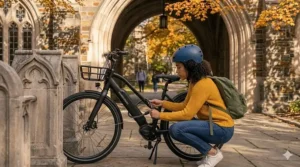
Look for removable batteries. Legally bring just the battery pack inside to charge, then reinstall on your secured bike outside. The ANCHEER Gladiator and Rad Power RadRunner both offer this feature.
Budget Breakdown: Total Ownership Costs
Initial Purchase vs. Long-Term Value
Budget options start around $450, premium models push $1,500+. However, that price gap shrinks when factoring maintenance, reliability, and resale value.
Ongoing Costs
Electricity: Negligible—$0.02-$0.05 per full charge, under $20 annually even with daily charging.
Maintenance: Budget $50-$150 annually for chain lubrication, brake adjustments, tire replacements.
Security: Quality U-lock runs $50-$100, cable locks another $20-$40.
Accessories: Fenders ($30-$50), lights ($20-$60), rain covers ($15-$30).
Cost Savings
Versus cars: Average college car ownership exceeds $10,000 annually—gas, insurance, parking, maintenance. Even $1,500 electric bikes save massive money.
Versus public transit: Semester bus passes run $200-$500. Electric bikes pay for themselves in 3-6 semesters with far more flexibility.
Campus-Specific Selection Guide
Terrain Considerations
Flat campuses (UF, Kansas, Purdue): Lower-power motors (250-350W) suffice.
Hilly campuses (UC Berkeley, Pittsburgh, Cornell): Need 500W+ motors for steep grades.
Climate Factors
Snowy regions: Fat tire models like Heybike Mars 2.0 provide traction on icy paths.
Rainy areas: Look for fender compatibility, IPX4-rated water resistance, hydraulic disc brakes.
Hot climates: Battery performance degrades in extreme heat—seek battery management systems preventing overheating.
Campus Size
Large campuses (5,000+ acres): Prioritize 50+ mile range and Class 3 capability.
Compact campuses (under 500 acres): Portability and maneuverability matter more.
Essential Safety Features
Lighting Systems
Integrated lights beat add-ons—always there when needed.
Front lights: Minimum 200 lumens for urban riding, 400+ for unlit paths.
Rear lights: Brake-activated taillights alert people behind you.
Braking Systems
Mechanical disc brakes: Adequate, cheaper, require more hand strength.
Hydraulic disc brakes: Superior stopping power, better wet performance, virtually maintenance-free. The Lectric XP Lite 2.0 includes these despite bargain pricing.
Additional Safety
- Reflective elements on frame tubes and tire sidewalls
- Horn or bell (required by many campuses)
- Helmet (mandatory at some universities regardless of age)
Maintenance for Busy Students
Monthly Quick Checks (10 Minutes)
- Tire pressure: 30-50 PSI depending on tire size
- Brake function: Test before every ride
- Chain lubrication: Clean dirt, apply bike-specific lubricant
- Battery health: Monitor charge level indicators
When to Visit Shops
Some repairs exceed DIY capabilities:
- Brake pad replacement
- Wheel truing (bent rims)
- Motor/controller issues
- Unusual noises
Many college towns have bike co-ops offering free or cheap labor if buying parts through them.
Campus Policies and Registration
Registration Requirements
Princeton requires all e-bikes to register with Transportation and Parking Services and display visible registration labels. Unregistered bikes risk tickets or impoundment.
Registration usually costs nothing and provides theft recovery assistance, parking privileges, and insurance program eligibility.
Restricted Areas
Common restrictions include:
Walk-only zones: Areas around libraries, student unions often require dismounting.
Speed limits: Princeton mandates 10 mph maximum speeds on campus, well below 28 mph Class 3 capability.
Prohibited hours: Some ban bikes from central pathways during class change periods.
Parking Guidelines
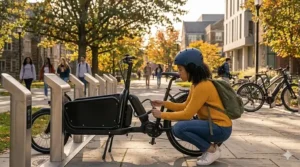
Electric bikes must park at designated racks, locked securely. Cannot chain to handrails, benches, light poles. Improper parking triggers fines and towing.
Theft Prevention Strategies
Locking Best Practices
- Never use just cable locks—use hardened steel U-locks
- Lock to immovable objects
- Secure frame AND wheels
- Position locks high and tight
Location Matters
Well-lit, high-traffic areas with security camera visibility deter theft.
Battery Security
Battery theft runs rampant—always remove batteries when parking extended periods.
Insurance Options
Renters insurance often covers bikes up to $1,000-$2,000. Specialized bike insurance runs $100-$200 annually.
Environmental Impact
Electric bikes offer environmental benefits by using small battery packs relative to electric cars, making them excellent candidates for renewable energy charging. The rise of electric bicycles is increasing commuting in hilly areas while reducing carbon emissions.
Carbon Footprint Comparison
- Gasoline car: 4.6 metric tons CO2 annually
- Electric car: 1.5 metric tons CO2 annually
- Bus/transit: 0.6 metric tons CO2 per passenger
- Electric bike: <0.1 metric tons CO2 annually
Switching from car to electric bike reduces transportation carbon footprint by over 90%.
Frequently Asked Questions
❓ How fast can an electric bike for college students go safely on campus?
❓ What happens if my dorm prohibits indoor electric bike charging?
❓ Can I use my electric bike during winter on snowy campus paths?
❓ How long does an electric bike battery last before replacement?
❓ Are electric bikes worth the extra cost for short campus commutes?
Conclusion
Choosing the right electric bike for college students matches features with your campus lifestyle. Whether you need a compact college ebike fitting tight dorm spaces, a budget student bike preserving finances, or a theft-resistant campus bike surviving semesters, 2026’s lineup offers perfect options.
The ANCHEER StreetRider wins for portability, Lectric XP Lite 2.0 delivers unbeatable value, and ANCHEER Gladiator provides maximum features per dollar. Meanwhile, Heybike Mars 2.0 tackles challenging terrain, Lectric XP4 satisfies performance needs, Heybike Horizon pampers comfort seekers, and Rad Power RadRunner serves utility-focused students.
Beyond the bike, factor in campus regulations, charging logistics, security measures, and maintenance commitment. Electric bikes promote public health by making cycling feasible for daily commutes, leading to increased physical activity while reducing environmental impact. Your investment pays dividends throughout college—in time saved, money saved on alternative transportation, and spontaneous adventures making college memorable.
Start by evaluating your budget, measuring storage space, checking university policies, and honestly assessing which features matter for your routine. Then choose confidently from our recommendations knowing you’ve found a campus commuter bike engineered for student success.
Recommended for You
- 7 Best Electric Bike with Basket 2026
- 7 Best Electric Bike Under 60 Pounds on Amazon: Lightweight 2026
- 7 Best Electric Bikes for Rain 2026 | Waterproof Reviews
Disclaimer: This article contains affiliate links. If you purchase products through these links, we may earn a small commission at no additional cost to you.
✨ Found this helpful? Share it with your friends! 💬🤗
