
In This Article
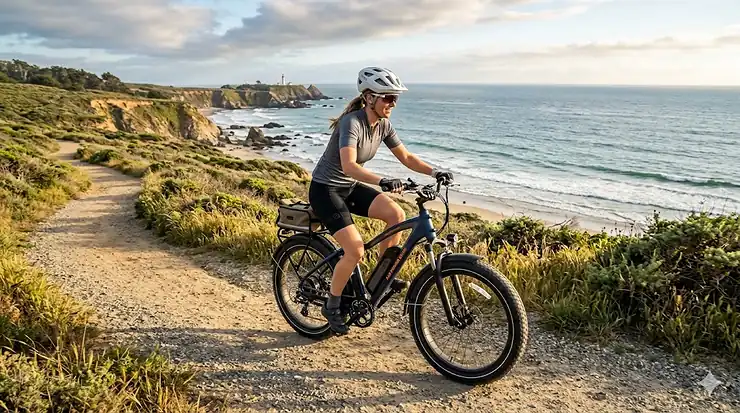
Here’s something the average ebike buyer finds out the hard way: a bike built for city streets will start quietly self-destructing the moment it meets ocean air. Not dramatically — no sparks, no explosions. Just a slow, invisible war between salt molecules and every metal component on your ride. The chain rusts. The battery contacts corrode. The once-smooth rear hub starts grinding out a noise that sounds like a broken pepper mill. Three months into beach town life, your “perfectly good” commuter bike looks like it survived a shipwreck.
That’s exactly why choosing the right electric bike for coastal areas isn’t just about motor wattage or how fast it’ll carry you to the taco stand on the waterfront. It’s about materials engineering, sealed systems, fat tire geometry, and the kind of corrosion resistance that comes baked into the frame — not sprayed on as an afterthought.
I’ve spent months researching what riders in places like Santa Cruz, Myrtle Beach, the Florida Keys, and the Outer Banks of North Carolina are actually riding — and more importantly, what’s still rolling strong after two rainy seasons. This guide cuts through the marketing fluff to give you seven real, verified electric bikes for coastal areas, all currently available on Amazon, ranked across budget tiers and use cases.
Whether you’re a weekend beach town visitor hunting for a seaside electric bike, a daily coastal commuter who needs something that laughs at salt air, or a retirement community resident who wants a beach community bike that won’t fight back — this is your definitive 2026 guide.
Quick Comparison: Top Electric Bikes for Coastal Areas at a Glance
| Model | Motor | Battery | Tire Size | Range | Best For | Price Range |
|---|---|---|---|---|---|---|
| HAPPYRUN Tank G60 | 750W (1500W peak) | 48V 18Ah | 20″×4″ | 68 miles | Power riders, sand terrain | $800–$1,000 |
| VELOWAVE Grace Step-Thru | BAFANG 750W | 48V 15Ah LG | 20″×4.0″ | 60+ miles | Casual coastal cruising | $900–$1,100 |
| ECOTRIC Coolboy | 750W | 48V 12.5Ah | 26″×4″ | 45+ miles | Budget beach riders | $700–$900 |
| MACFOX X1S | 500W (750W peak) | 48V | 20″×4.0″ | 38 miles | Urban coastal commuters | $500–$700 |
| VELOWAVE Ranger 2.0 | 750W (1200W peak) | 48V 14.4Ah LG | 26″×4.0″ | 65+ miles | Long-range coastal touring | $1,000–$1,200 |
| MACFOX X7 | 750W | 48V 13Ah | 20″×4.5″/5.0″ | 30+ miles | Deep sand, extra stability | $700–$900 |
| Rad Power RadRover 6 Plus | 750W | 48V | 26″×4″ | 45 miles | Premium all-around coastal | $1,500–$2,000 |
What this table tells you: At first glance, many of these bikes look interchangeable — 750W motors, fat tires, similar price brackets. But dig one layer deeper and the differences become dramatic. The VELOWAVE Ranger 2.0’s 1200W peak on LG cells crushes the MACFOX X1S in sustained hill-climbing power, while the MACFOX X7’s 5.0-inch rear tire gives it a flotation advantage on loose beach sand that nothing else in this chart can match. Budget matters, but so does what kind of riding your coastline actually demands.
💬 Just one click — help others make better buying decisions too! 😊
Top 7 Electric Bikes for Coastal Areas: Expert Analysis!
1. HAPPYRUN Tank G60 Electric Bike — Best All-Terrain Coastal Powerhouse
The HAPPYRUN Tank G60 is built the way a coastal e bike should be — like it fully expects to get dirty. This moped-style fat tire beast runs on a 750W brushless rear hub motor with a peak output of 1500W, and it pairs that muscle with a 48V 18Ah removable lithium battery that gives you up to 68 miles of range on pedal-assist mode one. That’s not “68 miles if you weigh 130 lbs and there’s a tailwind.” That’s genuinely usable coastal touring distance.
What makes it coastal-ready isn’t just the 20″×4″ fat tires — though those do a stellar job spreading the bike’s weight across soft sand. It’s the build confidence: hydraulic brakes that still bite in wet conditions, LED lighting for those early-morning surf check rides, and a Harley-inspired steel frame that doesn’t flinch at water exposure the way lighter alloy frames sometimes do. Three riding modes — pure electric, pedal assist, and manual — give you flexibility depending on whether you’re hammering down a beach path or conserving battery on a long coastal commuter run.
The tank is where this bike earns its reputation among beach town riders who need cargo capacity and long range in one package. The 265-lb payload limit is appropriate for most riders plus gear, though serious cargo haulers might wish for more. Owners consistently report it arrives 90% pre-assembled, which means you’re on the sand, not in the garage, within an hour of delivery.
✅ 750W/1500W peak motor handles coastal headwinds without begging for mercy
✅ 68-mile range — enough for a full day of beach town exploration
✅ Hydraulic brakes perform reliably in wet, salty conditions
❌ 265-lb payload limit rules it out for heavier riders or heavy gear loads
❌ Moped-style design is polarizing — some beach communities prefer a lower-profile look
Price range: $800–$1,000. For the motor output and battery capacity, that’s exceptional value. Best for: power-hungry coastal riders who want genuine all-terrain capability without a $2,000 price tag.
2. VELOWAVE Grace Step-Thru Electric Bike — Best for Casual Seaside Cruising
If the Tank G60 is a pickup truck, the VELOWAVE Grace Step-Thru is a well-engineered beach cruiser that actually knows what year it is. It runs a genuine BAFANG 750W motor — not a rebadged generic hub, but the real Bafang, which is the gold standard for reliability in the mid-range ebike world — with a 48V 15Ah LG cell battery delivering 60+ miles of coastal range.
Here’s what most buyers overlook about this model: the step-thru frame geometry isn’t just for aesthetics. On a coastal commuter, where you’re stopping at coffee shops, fish taco joints, and beach access points every few blocks, a low step-through makes mounting and dismounting genuinely effortless. The upright handlebar position keeps your back comfortable on long boardwalk rides. And the dual hydraulic disc brakes — not mechanical, hydraulic — provide stopping power that holds up in salt spray and wet conditions that would have mechanical disc brakes squealing like seagulls.
The 20″×4.0″ fat tires handle packed sand and boardwalk surfaces with ease. They’re not designed for deep, soft dune riding — no 20-inch fat tire really is — but for the 95% of coastal riding that happens on bike paths, hardpack beach access roads, and waterfront promenades, they’re absolutely perfect. VELOWAVE also backs this with a 2-year warranty on electrical components, which matters in a saltwater environment where electrical corrosion is the real long-term threat.
✅ BAFANG motor is one of the most reliable hub motors you can buy at this price
✅ LG battery cells deliver consistent, trustworthy range estimates
✅ Step-thru frame makes casual beach town riding genuinely comfortable
❌ 20″ wheel size isn’t ideal for riders over 6’0″
❌ Not the best choice for aggressive off-road or deep sand riding
Price range: $900–$1,100. The Bafang motor + LG battery combination at this price is genuinely hard to beat. Best for: active retirees, casual riders, and anyone who prioritizes comfort and reliability over raw power.
3. ECOTRIC Coolboy Electric Bike 26″ Fat Tire 750W — Best Budget Beach ebike Under $900
Don’t sleep on the ECOTRIC Coolboy just because it sits at the lower end of this list’s price spectrum. ECOTRIC has been in the US market since 2017, and their UL-certified bikes have earned a reputation for surviving conditions that destroy cheaper no-name imports in under a season. The Coolboy runs a 750W hub motor paired with a 48V 12.5Ah removable battery, delivering around 45+ miles of mixed-terrain range — enough for a full day of beach town riding if you’re not thrashing it on maximum throttle.
The 26″×4″ fat tires are where this bike earns real coastal respect. On a 26-inch wheel, those 4-inch fat tires give you a larger contact patch than the 20-inch models at similar widths, which translates to better stability over the uneven surfaces you find on coastal paths — loose gravel, cracked boardwalk planks, sandy beach access ramps. The dual shock absorber system (front fork + rear suspension) smooths out the kinds of bumps that cheaper rigid-frame bikes transmit straight up your spine.
The hydraulic brake system is a genuine surprise at this price point. Most bikes under $900 cut corners with mechanical disc brakes; the Coolboy uses hydraulics, which are self-adjusting, more powerful, and far more reliable in the wet, salty conditions that define coastal riding. Customer reviews consistently highlight assembly ease and prompt customer service — two things that matter enormously when you’re a first-time ebike buyer who just spent almost a grand.
✅ UL-certified safety — not just a marketing badge, but a real independent electrical safety test
✅ Hydraulic brakes at a sub-$900 price is genuinely unusual
✅ 26″ fat tires give better stability on rough coastal surfaces than 20″ equivalents
❌ 12.5Ah battery is smaller than premium competitors — range drops faster under heavy throttle
❌ Build quality trails off compared to VELOWAVE or Rad Power in long-term durability reports
Price range: $700–$900. The best value entry point for a legitimate coastal fat tire ebike. Best for: budget-conscious riders, first-time ebike buyers, and occasional beach visitors who don’t need daily commuter durability.
4. MACFOX X1S Electric Bike — Best Urban Coastal Commuter
The MACFOX X1S answers a specific question: what if you live in a beach town but do most of your riding on paved waterfront paths and urban streets, not sand? It’s a 500W continuous / 750W peak brushless motor on a lightweight steel frame, rated Class 2 (20 MPH max via throttle) or Class 3 (28 MPH via pedal-assist on the upgraded version), delivering up to 38 miles of range. That’s on the shorter end for coastal touring, but here’s why it doesn’t matter for this bike’s ideal user.
The MACFOX X1S is lighter and more maneuverable than every other bike on this list. At a coastal commuter’s typical riding distance of 8–15 miles per day, 38 miles of range means charging every two or three days. The 20″×4.0″ fat tires handle the mixed-surface reality of most beach towns — packed gravel, brick streets, sandy patches near beach access — with enough grip to stay confident without the sluggish weight penalty of bigger bikes. UL2849 certification means the electrical system has been independently validated for fire and explosion safety, which matters for any ebike you’re charging indoors.
The triple braking system — front disc, rear disc, plus an e-brake — is a smart design choice for a beach town where pedestrian traffic and stop-and-go riding are constant. The 33″ PU memory foam saddle is noticeably more comfortable than the stock saddles on similarly priced competitors. What the spec sheet won’t tell you: the X1S’s smaller, more compact silhouette makes it far easier to lock up at busy boardwalk spots or squeeze into a condo storage room.
✅ Lightweight and maneuverable — perfect for crowded beach town streets
✅ UL2849 certified for electrical safety
✅ Triple braking system gives extra confidence in pedestrian-heavy coastal environments
❌ 38-mile range is limiting for longer coastal touring days
❌ Not built for genuine sand or off-road beach riding
Price range: $500–$700. The most accessible price point in this guide. Best for: daily coastal commuters, college students in beach towns, and riders who primarily use paved waterfront paths.
5. VELOWAVE Ranger 2.0 Electric Bike 26“ — Best Long-Range Coastal Touring ebike
The Ranger 2.0 is VELOWAVE’s flagship, and it earns that title by doing what long-range ocean air resistant bikes need to do: go further, faster, longer, without sacrificing the coastal-ready build quality. The 750W brushless motor with 1200W peak power pulls from an integrated 48V 14.4Ah LG cell battery to deliver 35–65+ miles depending on your ride mode. In pedal-assist mode, you’re realistically looking at 55+ miles — enough to ride the entire length of many barrier islands and back.
The integrated (hidden) battery design is smarter than it sounds for a salt air resistant bike. By tucking the battery inside the frame rather than bolting it on externally, VELOWAVE shields the most vulnerable electrical component from direct exposure to salt spray, road moisture, and humidity. That’s not marketing — it’s basic materials engineering that extends battery life in coastal environments where externally mounted packs quietly degrade season after season. The battery still removes for indoor charging, which is essential for anyone living in a condo where you can’t roll the whole bike to an outlet.
At 28+ MPH in pedal-assist mode, the Ranger 2.0 handles coastal headwinds without losing momentum — something that genuinely matters when you’re facing 15–20 mph onshore breezes on a beachfront path. The 26″×4.0″ Kenda puncture-resistant tires roll efficiently on pavement and boardwalks while still providing enough sand flotation for casual beach access riding.
✅ Integrated battery design offers better protection against salt air and coastal moisture
✅ 65+ miles on a single charge covers serious coastal touring distances
✅ 1200W peak motor maintains speed against ocean headwinds
❌ Integrated battery means you need to bring the whole bike to an outlet if no indoor storage is available
❌ Heavier than step-thru models — not ideal for riders who need to lift it frequently
Price range: $1,000–$1,200. Best for: long-range touring riders, daily coastal commuters covering 20+ miles, and anyone who wants premium battery protection in a high-humidity salt environment.
6. MACFOX X7 Electric Bike — Best for Deep Sand and Maximum Tire Width
The MACFOX X7 does something genuinely unusual in this category: it runs a 20″×4.5″ front fat tire and a 20″×5.0″ rear fat tire. That asymmetric setup — wider in the rear where your weight concentrates — is the kind of engineering decision that separates a bike designed by people who actually ride sand from one designed by people who looked at a spec sheet. The wider rear tire creates more surface contact where sinking is most likely to occur, which is why the X7 floats over loose sand that would stop the 4.0-inch tire bikes cold.
The 750W motor paired with a 48V 13Ah battery delivers around 30+ miles of range — shorter than most competitors here, but the X7 isn’t built for long-range touring. It’s built for riders who do frequent, shorter loops on soft sandy terrain, beach access paths, and dune-adjacent riding where standard fat tires struggle. Hydraulic brakes round out the package, providing reliable stopping power even when your brake rotors are coated in fine beach sand.
The X7 is heavier than the X1S by virtue of those bigger tires and the heavier frame needed to support them, but that weight also means stability — essential when you’re riding on a surface that shifts under you. UL2849 certification on the electrical system is a reassuring presence for a bike that’s going to spend significant time in wet, salty conditions. For riders who’ve been frustrated by fat tire bikes that still bottom out in soft beach sand, the X7’s 5.0-inch rear tire is a genuine upgrade.
✅ 5.0″ rear fat tire provides superior flotation on loose, soft beach sand
✅ Hydraulic brakes maintain performance even with sand coating the rotors
✅ UL2849 certified electrical system
❌ 30-mile range is the shortest on this list — plan your rides accordingly
❌ Heavier and less maneuverable than narrower-tire models on paved surfaces
Price range: $700–$900. Best for: riders who frequently access soft sandy beaches, surf spots, or dune-adjacent trails where maximum tire width is the deciding factor.
7. Rad Power Bikes RadRover 6 Plus — Best Premium Coastal ebike for Serious Riders
If you’re going to spend serious money on a beach town ebike, the RadRover 6 Plus is the bike that justifies it. It’s a 750W geared hub motor — geared, not direct-drive, which matters because geared hub motors regenerate less resistance when you’re freewheeling, making them more efficient and easier to pedal without power — paired with a 48V battery system good for up to 45 miles of real-world range. The 26″×4″ puncture-resistant reflective tires are one of the details that separate a premium coastal bike from budget alternatives: those tires are designed to resist the sharp shell fragments and debris common on beach access paths, while the reflective sidewalls boost visibility during dawn/dusk rides.
The RadRover 6 Plus received upgraded all-new hydraulic disc brakes in its sixth generation — a meaningful improvement over the mechanical disc brakes on the previous version. In a coastal environment where salt air accelerates brake pad and rotor corrosion, hydraulic systems are easier to maintain and more reliable over a multi-season ownership period. The redesigned wire routing and removable downtube cover are also coastal-smart details: they minimize the exposed cable surface area where salt and moisture can infiltrate and cause long-term electrical damage.
Rad Power Bikes has mobile service vans and retail stores across the US — in Seattle, San Diego, Vancouver, and elsewhere — which gives the RadRover something no budget Amazon brand can match: real-world service support when something goes wrong. For a daily-use coastal commuter riding 40-plus weeks a year through humidity, rain, and salt air, that service network is worth factoring into your total cost calculation.
✅ Geared hub motor is more efficient and easier to live with than direct-drive alternatives
✅ Puncture-resistant reflective tires are purpose-built for debris-heavy coastal paths
✅ Real retail service network across the US — no waiting for international support emails
❌ Highest price in this guide — a significant investment for casual riders
❌ Class 2 speed limit (20 MPH) may feel slow for riders accustomed to faster commuter bikes
Price range: $1,500–$2,000. Best for: serious daily riders, coastal commuters who clock high annual mileage, and anyone who values manufacturer support and long-term build quality over initial savings.
Top 7 Models: Side-by-Side Specification Comparison
| Model | Motor | Peak Power | Battery | Range | Tire | Brakes | Weight Limit | Price Range |
|---|---|---|---|---|---|---|---|---|
| HAPPYRUN Tank G60 | 750W | 1500W | 48V 18Ah | 68 mi | 20″×4″ | Hydraulic | 265 lbs | $800–$1,000 |
| VELOWAVE Grace | BAFANG 750W | 1000W | 48V 15Ah LG | 60+ mi | 20″×4″ | Hydraulic | 330 lbs | $900–$1,100 |
| ECOTRIC Coolboy | 750W | — | 48V 12.5Ah | 45+ mi | 26″×4″ | Hydraulic | 260 lbs | $700–$900 |
| MACFOX X1S | 500W | 750W | 48V | 38 mi | 20″×4″ | Triple disc | 200 lbs | $500–$700 |
| VELOWAVE Ranger 2.0 | 750W | 1200W | 48V 14.4Ah LG | 65+ mi | 26″×4″ | Hydraulic | 300 lbs | $1,000–$1,200 |
| MACFOX X7 | 750W | — | 48V 13Ah | 30+ mi | 20″×4.5/5.0″ | Hydraulic | 300 lbs | $700–$900 |
| RadRover 6 Plus | 750W geared | — | 48V | 45 mi | 26″×4″ | Hydraulic | 275 lbs | $1,500–$2,000 |
Looking at this comparison, the HAPPYRUN Tank G60 wins on raw range-per-dollar, but the VELOWAVE Ranger 2.0’s premium LG battery and integrated salt-resistant design makes it the smarter long-term investment for daily coastal commuters. Budget riders should note that the MACFOX X1S’s 38-mile range and 200-lb weight limit are genuine constraints — it’s a great bike for urban beach town riding, but wrong for riders over 180 lbs who push power hard.
Coastal Riding Buyer’s Framework: Who Should Buy What
Not sure which of these beach town ebikes is actually yours? Run yourself through this decision framework — it’s faster than reading every review twice.
If you’re a daily coastal commuter covering 10–20 miles per day on paved waterfront paths: The VELOWAVE Grace Step-Thru or VELOWAVE Ranger 2.0 are your bikes. Reliable Bafang/LG components, hydraulic brakes, and enough range to cover your round trips for 3+ days between charges. The Grace wins for comfort; the Ranger wins for speed and range.
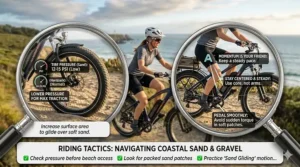
If you’re a weekend beach visitor who primarily rides soft sandy beach access paths: The MACFOX X7’s 5.0-inch rear tire is the only option in this list purpose-built for loose sand flotation. Pair it with tire pressure in the 10–15 PSI range and you’ll glide over surfaces that bog down every other bike here.
If you’re on a budget but still want something built to survive coastal conditions: The ECOTRIC Coolboy at $700–$900 delivers UL certification, hydraulic brakes, and 26-inch fat tires at a price most beach town riders can swallow. It’s not the most sophisticated option — but it’s real, honest coastal e bike hardware at an honest price.
If you’re buying your first ebike for a beach community and comfort is paramount: The VELOWAVE Grace Step-Thru’s upright geometry, wide saddle, and low step-through frame make it the most approachable option for riders returning to cycling after a gap, older adults, or anyone for whom ease of mounting and dismounting matters more than top speed.
If you want the best and cost is secondary: The Rad Power RadRover 6 Plus. Better service support, better long-term reliability track record, and a geared hub motor that holds up season after season. The premium price buys you real-world durability data and manufacturer accountability that budget Amazon brands simply can’t match yet.
How to Choose an Electric Bike for Coastal Areas: 7 Things That Actually Matter
Buying an ocean air resistant bike isn’t the same as buying any other ebike. Here’s the condensed expert framework — seven criteria, each one carrying a lesson learned the expensive way by coastal riders who got it wrong first.
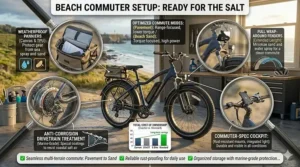
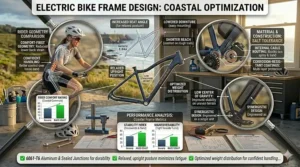
1. Corrosion resistance comes first. Aluminum alloy frames (6061 series) and powder-coated finishes are your baseline. Stainless steel hardware on critical fasteners, sealed bearings in the hubs and bottom bracket, and waterproof battery casings are what separate a coastal-capable ebike from a regular one. Ask specifically about these — the spec sheet often glosses over them.
2. Motor type matters more than raw wattage. A 750W geared hub motor is quieter, more efficient when freewheeling, and better at sustaining speed against headwinds than a cheap 750W direct-drive hub. The RadRover 6 Plus uses a geared hub; most budget models don’t. For coastal riding where headwinds are constant, this gap is real.
3. Battery quality isn’t interchangeable. LG and Samsung cells — used by VELOWAVE — have decades of manufacturing data behind them and consistent real-world range performance. Generic cells can range wildly. In a salt-air environment where battery degradation accelerates with humidity, starting with premium cells extends your ownership window significantly. According to the U.S. Department of Energy’s electric vehicle research, battery longevity is the single biggest factor in long-term EV ownership cost.
4. Tire width is about surface, not preference. For hard pack sand, gravel, and boardwalks: 4.0″ fat tires are sufficient. For loose, soft beach sand: go 4.5″ minimum, and the MACFOX X7’s 5.0″ rear is the current Amazon-available benchmark. For mixed coastal urban riding: 4.0″ is the sweet spot between beach capability and paved road efficiency.
5. Brakes degrade faster near the ocean. Hydraulic disc brakes are self-adjusting, more powerful, and resist salt-induced corrosion better than mechanical disc brakes. Every single product on this list uses hydraulics — that’s not coincidence. Avoid any coastal bike that only offers mechanical disc brakes.
6. Weight limits and payload matter. A 200-lb rider on a 200-lb payload bike has zero margin for gear, a backpack, or a light cargo load. Most serious coastal riders want at least a 275-lb limit to accommodate rider plus equipment. The VELOWAVE Grace and MACFOX X7 both support up to 330 lbs, which is a genuine differentiator.
7. Range math should include headwinds. Manufacturers report range under ideal conditions. In coastal riding, where 15–20 mph headwinds are normal, subtract 20–30% from any claimed range figure. A bike rated at 45 miles delivers roughly 32–36 miles into a stiff ocean breeze. Plan accordingly.
Common Mistakes When Buying an Electric Bike for Coastal Areas
🚫 Mistake 1: Choosing a commuter bike and hoping it’ll survive. Standard urban commuter ebikes have exposed bearings, standard steel hardware, and minimal weatherproofing. They’ll work for a season. Then the corrosion accelerates, the repair costs stack up, and you’re back where you started. Buy purpose-built from the beginning.
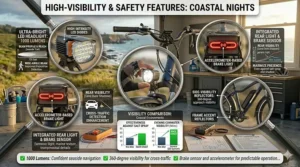
🚫 Mistake 2: Ignoring IP ratings. An IP54 or IP65 waterproof rating on the motor and electrical system isn’t luxury — it’s the minimum you should accept for a salt air resistant coastal setup. Unrated electrical components exposed to sea spray will fail, usually at the worst possible moment.
🚫 Mistake 3: Buying on range claims alone. A bike claiming 80-mile range on pedal-assist mode 1 is telling you one number under near-zero load conditions. Real coastal range — real headwinds, real hills, actual human weight — looks very different. Divide claimed range by 1.4 for a grounded estimate.
🚫 Mistake 4: Skipping tire pressure adjustment for sand. Fat tires on beach sand need to run at 10–15 PSI, sometimes lower for very soft conditions. Riders who inflate to the max-rated pressure and then complain that their fat tire bike “doesn’t handle sand well” are solving the wrong problem. The bike is fine; the pressure isn’t.
🚫 Mistake 5: Not rinsing after beach rides. Even water-resistant bikes accumulate salt deposits on brake calipers, drivetrain components, and battery connections. A rinse with fresh water — low pressure, not a power washer — after beach rides dramatically extends component life. The Bicycle Safety Institute and most coastal cycling communities recommend a post-ride wipe-down as standard protocol.
Electric Bike vs. Traditional Bike in Coastal Areas: The Real Comparison
| Factor | Traditional Bike | Electric Bike for Coastal Areas |
|---|---|---|
| Headwind handling | Exhausting, speed-limiting | Handled by motor assist |
| Hill climbing on coastal paths | Tiring, especially loaded | Effortless with pedal assist |
| Cargo capacity | Limited by rider energy | Can carry loads with motor assistance |
| Maintenance frequency | High near ocean | Moderate, similar corrosion concerns |
| Cost of ownership | Lower initial, similar long-term | Higher initial, lower energy cost |
| Best For | Short recreational rides | Daily commuting + touring |
The comparison reveals something non-obvious: in a coastal environment specifically, the energy assistance of an ebike pays dividends beyond convenience. Headwinds that turn a 30-minute traditional bike commute into a sweaty ordeal become a non-issue. The ability to carry groceries, beach gear, or a change of clothes without arriving at your destination soaked through is a quality-of-life upgrade that traditional bike riders in beach towns consistently undervalue until they switch.
Long-Term Coastal ebike Maintenance: What to Expect and What It Costs
The math on coastal ebike ownership favors the prepared. Here’s what you’re realistically signing up for over a 2–3 year ownership window in a beach environment.
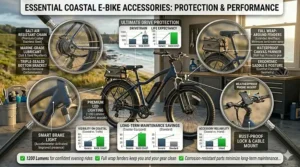
Drivetrain cleaning ($0–$30 monthly): Salt and sand are aggressive lubricant strippers. A monthly chain clean and re-lube with a wet-condition lube (not the standard dry lube used inland) keeps the drivetrain running smoothly and prevents the “grinding pepper mill” syndrome mentioned at the top of this guide.
Battery terminal maintenance ($5 annually): A thin coat of dielectric grease on battery contact points every 6–12 months prevents salt-induced corrosion at the most expensive electrical junction on your bike. This five-minute task costs almost nothing and prevents failures that can run $200–$500 to fix.
Brake pad replacement ($15–$40 per axle): Coastal riding accelerates brake pad wear due to sand grit acting as an abrasive. Expect to replace pads annually rather than every 18–24 months you’d see inland. On hydraulic systems like those on the Ranger 2.0 and RadRover 6 Plus, bleeding the hydraulic lines every 18 months keeps braking performance at factory spec.
Tire replacement ($50–$120 per tire): Fat tires in coastal riding conditions — sand, gravel, shell fragments — typically last 1,500–2,500 miles before tread wear becomes noticeable. Budget one tire replacement cycle every two years for regular riders.
Total estimated annual maintenance cost: $120–$300 per year for a rider doing 1,500+ annual miles in a coastal environment. That’s still dramatically cheaper than car ownership, fuel costs, or parking in any US beach town worth living in.
Electric Bikes and Coastal Trail Regulations: What You Need to Know
Before you buy, know where you can ride. In the US, ebike classification significantly impacts access to coastal paths, beach boardwalks, and protected dune areas. According to PeopleForBikes’ national trail access database, most coastal multi-use paths in the US currently allow Class 1 and Class 2 ebikes (20 MPH maximum), while Class 3 (28 MPH) is often restricted to road bike lanes.
Several popular beach communities have specific ebike rules that may surprise you. Miami Beach restricts motorized vehicles including ebikes from the hardpack sand beach itself, while allowing bike path riding on adjacent boardwalks. Outer Banks, NC bike paths on the Cape Hatteras National Seashore follow National Park Service rules, which generally permit Class 1 and 2 ebikes on designated multi-use paths. Santa Monica, CA’s beach bike path — one of the most popular in the country — allows Class 1 and 2 ebikes throughout.
The practical advice: check your specific beach community’s ordinances before purchasing, particularly if you’re planning to ride on any federally protected coastal areas, National Seashores, or state park trails. Most of the bikes in this guide are available in both Class 2 (throttle up to 20 MPH) and Class 3 configurations, giving you the ability to choose the right compliance level for your local rules.
FAQ: Electric Bikes for Coastal Areas
❓ What features should I look for in an electric bike for coastal areas?
❓ Can a regular ebike handle salt air near the ocean?
❓ What tire pressure should I use for beach sand riding on a fat tire ebike?
❓ How far can a coastal electric bike go on a single charge?
❓ Is a beach community bike legal to ride on boardwalks and coastal paths?
Conclusion: The Best Electric Bike for Coastal Areas Is the One Built for Where You Actually Ride
Here’s the honest truth after all of this: there’s no single best electric bike for coastal areas. There’s the best one for your coastline, your ride style, your payload, and your maintenance budget. The HAPPYRUN Tank G60 is an extraordinary value machine that belongs in the garage of any power rider who wants genuine sandy terrain capability without a $2,000 price tag. The VELOWAVE Grace Step-Thru is the bike that turns a retired schoolteacher into a daily boardwalk rider without the learning curve. The RadRover 6 Plus is the one you buy when you’ve done the math and decided that reliability over five seasons is worth paying for upfront.
What unites all seven picks is this: they’re built with enough coastal intelligence to survive the environment that quietly destroys average bikes. Sealed systems. Hydraulic brakes. Fat tires calibrated for mixed-surface coastal riding. Batteries from brands with reputations worth protecting. If you take nothing else from this guide, take the anti-corrosion checklist: aluminum frame, sealed bearings, hydraulic brakes, waterproof battery, rinse after every beach ride.
Your coastline deserves a bike that keeps up with it.
✨ Don’t Miss These Exclusive Deals!
🔍 Click on any highlighted product above to check current pricing and availability on Amazon. Deals and stock change fast — especially on the top-rated models that coastal riders keep buying out.
Recommended for You
- 7 Best Electric Bike for Forest Trails 2026
- 7 Best Electric Bike for Desert Riding in 2026
- Best Electric Bike for Photography: 7 Expert Picks for 2026
Disclaimer: This article contains affiliate links. As an Amazon Associate, I earn from qualifying purchases. If you purchase products through these links, we may earn a small commission at no additional cost to you.
✨ Found this helpful? Share it with your friends! 💬🤗
