In This Article
An electric scooter for teenagers is a foldable, stand-up e-scooter with a manufacturer-rated age and weight range that suits riders roughly 12 to 17. The models in this guide top out between 13 and 19 mph, carry 180 to 265 pounds, and weigh 22 to 38 pounds, favoring controllable speed and dependable brakes over raw power.
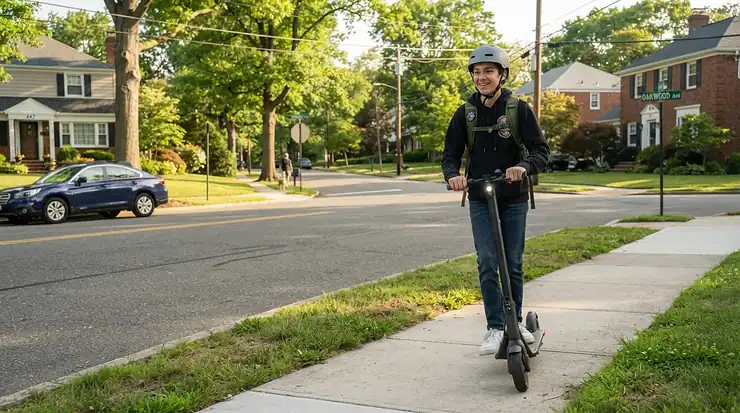
Here’s the awkward truth about shopping for an electric scooter for teenagers: the market splits into two camps. Kid-sized toys run out of steam by age 14. Adult commuters, on the other hand, can be too heavy, too fast, and frankly too much scooter for a 13-year-old. Between those extremes sits a sweet spot, and 2026 has real options worth your attention.
This guide sorts seven real models by age rating, speed, range, weight limit, and price. Everything comes from manufacturer specifications, independent test data, and aggregated owner feedback. I haven’t ridden these scooters, and I won’t pretend otherwise. What you get instead is honest analysis of what the numbers mean for a growing rider.
Along the way, you’ll see how each pick handles the six questions parents ask most: the right electric scooter for teens age 13-15, a teen electric scooter with speed limit controls, weight capacity for teens, battery life for daily use, a durable electric scooter for teens, and school commute suitability. Specs are manufacturer claims unless noted, and prices appear as ranges because they change constantly. Ready? Let’s roll.
Quick Comparison: 7 Picks for the Best Electric Scooter for Teenagers
Short on time? This table puts all seven scooters side by side before we dig into each one.
| Scooter | Rated Age | Top Speed (Claimed) | Weight | Best For |
|---|---|---|---|---|
| Hiboy S2 Lite | 12+ | 13 mph | 21.8 lb | Younger teens, first-time riders |
| Segway Ninebot E2 Plus II | 14+ | 15.5 mph | 36.2 lb | Comfort-first 14+ riders |
| GOTRAX GXL V2 | Check listing | 15.5 mph | About 27 lb | Short, flat, budget commutes |
| TurboAnt M10 Lite | Check listing | 16 mph | 30.9 lb | Learner-to-cruiser speed progression |
| NIU KQi 100P | 14+ | 17.4 mph | 38.1 lb | Taller, heavier teens |
| GOTRAX Apex | Check listing (adult-rated) | 15.5 mph | About 32 lb | Older teens who value braking |
| Hiboy S2 Pro | 16+ | 19 mph | 37.4 lb | 16-17-year-old commuters |
Looking at the comparison above, the Hiboy S2 Lite is the only pick with a 12+ rating, so it’s the safest starting point for the youngest riders. The NIU KQi 100P and Segway Ninebot E2 Plus II move up to 14+ with more comfort, but they add roughly 15 pounds. Meanwhile, the Hiboy S2 Pro at 19 mph belongs with 16-year-olds and up, not beginners. Several listings carry adult or unclear age guidance, so confirm current requirements before you buy.
💬 Just one click — help others make better buying decisions too!😊
Top 7 Electric Scooter for Teenagers: Expert Analysis
Each entry below pairs real specs with plain-English meaning, then summarizes what aggregated reviews say. Think of it as a spec sheet with a translator attached.
1. Hiboy S2 Lite — lightest pick for younger teens
Where most scooters chase speed, the Hiboy S2 Lite chases proportion, which is exactly what a first-time rider needs. Hiboy rates it for ages 12 and up and recommends riders between 3’7″ and 5’7″. That makes it the friendliest electric scooter for teens age 13-15 who are still growing into bigger machines.
The 250W motor (400W peak) tops out at 13 mph, roughly a brisk bike-path pace. At 21.8 pounds, a 13-year-old can carry it up a porch step without drama. The 6.5-inch solid tires never go flat, but they pass more pavement chatter to the rider than air-filled rubber would.
Here’s the catch: the 180-pound limit. Weight capacity for teens matters, and a taller 15-year-old with a loaded backpack can flirt with it. Based on the spec comparison, this is a starter scooter, not a forever scooter.
Reviews on Walmart’s listing are mixed but mostly positive. Parents praise the lights, controllable speed, and hill handling, while a minority report a stiff ride and, in one case, repeated front-motor repairs. Independent testers add that range falls 40-50% at top speed and charging takes five to six hours.
Pros:
- ✅ Only 21.8 pounds, easy for smaller teens to carry
- ✅ 13 mph top speed keeps beginners in control
- ✅ Dual braking plus a full lighting package
Cons:
- ❌ Claimed 10.6-mile range shrinks fast at top speed
- ❌ 180-pound limit leaves little headroom for growth
Expect roughly the $270-$350 range at the time of research, which is fair value for a scooter built around a young rider. Check current price.
2. Segway Ninebot E2 Plus II — front suspension and turn signals for beginners
Comfort is the headline for the Segway Ninebot E2 Plus II, and it’s rarer than you’d think at this price. Segway lists a 14+ minimum age, a minimum rider height near 4’6″, and a 198-pound payload.
The front spring suspension (27 mm of travel) and 8.1-inch tires deliver a steadier ride than small-wheeled kids’ models. The trade-off is heft: at 36.2 pounds, it’s a real carry for a small teen. Its 15.5 mph top speed and three riding modes also make it a workable teen electric scooter with speed limit behavior. Start in the gentlest mode, then step up. Segway rates range at about 12.4 miles at top speed and 15.5 miles in its eco-mode test.
Analytically, it’s a strong fit for school commute suitability on flat-to-mild routes. Built-in turn indicators add visibility, and the app can lock the motor as a theft deterrent.
Tom’s Guide describes it as comfortable and reliable for beginners and short, flat commutes, while flagging hills as its limit. A handful of owners report battery-longevity or loose-hardware concerns, so check every bolt on day one.
Pros:
- ✅ Front suspension smooths cracked pavement
- ✅ Turn indicators and app-based motor lock
- ✅ 14+ rating with beginner-friendly riding modes
Cons:
- ❌ 36.2 pounds is heavy for smaller teens
- ❌ Modest motor struggles on steeper hills
Plan on the $350-$400 range. You’re paying for comfort and brand support, which is a reasonable trade.
3. GOTRAX GXL V2 — proven budget classic with two speed modes
Some scooters earn their reputation the slow way: by selling in huge numbers and surviving teenagers. The GOTRAX GXL V2 is that scooter. One review site notes over 3,400 Amazon reviews averaging around 4.3 stars, a big sample, even if star averages always deserve skepticism.
Specs first. The 250W motor and 187Wh battery give a claimed 15.5 mph and 12 miles, with a 220-pound limit at about 27 pounds. Two speed modes (about 10 mph and 15.5 mph) act like training wheels. Rider Guide’s GPS test, however, clocked 13.5 mph and 10.1 miles with a 165-pound rider. For battery life for daily use, plan on roughly ten miles. Sources also disagree on whether current units ship with solid or air-filled 8.5-inch tires, so check the listing.
The analysis: it suits flat one-to-three-mile routes. The Top Zone flags the 220-pound limit as tight for heavier riders and notes reports of recharge trouble after hard impacts. Owners generally praise the light, simple design, while some complain that speed seems to sag over time.
Pros:
- ✅ Around 27 pounds, easy to lift and stash
- ✅ Two speed modes support gradual learning
- ✅ Huge review base and strong track record
Cons:
- ❌ Tested range near 10 miles versus 12 claimed
- ❌ 220-pound limit and weak hill power
Typical listings sit in the $200-$300 range, though you should check current price. Value verdict: hard to beat for short trips.
4. TurboAnt M10 Lite — 9 mph learner mode, 16 mph when ready
Beginner mode is the party trick here. TurboAnt lists a gentle Mode 1 at 9 mph and a Mode 2 at 16 mph, which bakes teen electric scooter with speed limit behavior right into the hardware.
The 350W front motor, 8.5-inch pneumatic tires, and 30.9-pound frame handle up to 220 pounds, with a claimed 15.5-mile range. Electric Scooter Insider found it actually reached its advertised 16 mph, which is uncommon. It also reported better-calibrated brakes than the standard M10, with a roughly 41% shorter stopping distance from 15 mph, and a deck about 3.2 inches wider than typical budget scooters. That extra foot room helps nervous beginners.
Front-wheel drive, though, means steep hills feel slow, and reviewers advise skipping big inclines. One tester reports getting about 60% of published range on most scooters. Applied here, that’s roughly nine miles, my arithmetic rather than a lab result.
Independent reviewers largely agree on strong value. The recurring caveats are real-world range and hills.
Pros:
- ✅ 9 mph beginner mode grows with the rider
- ✅ Well-tuned brakes with disc and electronic combo
- ✅ Roomy deck improves foot placement
Cons:
- ❌ Real-world range falls well short of claims
- ❌ Air-filled tires need pressure checks and can flat
Look in the $300-$400 range. Fair, particularly for the speed-mode flexibility.
5. NIU KQi 100P — plush ride and app-tuned controls
Bigger teens deserve a scooter that doesn’t feel like a toy, and the NIU KQi 100P fills that gap. NIU lists a 14+ minimum age, 17.4 mph top speed, 18-mile claimed range, and a 265-pound limit, the highest in this roundup. That makes it the standout for weight capacity for teens who are tall or still growing.
The 9.5-inch pneumatic tires and front spring suspension (about 36 mm of travel) create a planted feel. Through the app, parents can adjust starting speed, acceleration mode, braking strength, and riding mode. It’s a genuine durable electric scooter for teens candidate: IPX5 splash resistance and a reported two-year warranty support that reputation.
But there are limits. At 38.1 pounds, it’s the heaviest pick here. Tom’s Guide found real range closer to 10 miles and called it underpowered for bigger hills, best on flat terrain. Rider Guide reported about 11 miles.
Reviewers consistently praise ride comfort and build quality. They just wish the battery were bigger.
Pros:
- ✅ 265-pound limit leaves room for growing riders
- ✅ App controls for acceleration and braking strength
- ✅ Comfortable suspension and larger tires
Cons:
- ❌ 38.1 pounds is a lot to carry upstairs
- ❌ Real range around 10-11 miles versus 18 claimed
Expect the $300-$400 range. Strong value if flat commutes and comfort matter most.
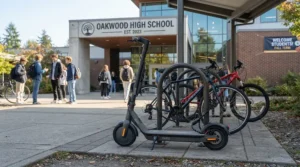
6. GOTRAX Apex — rear-wheel drive with strong brakes
Braking is where the GOTRAX Apex earns attention. Electric Scooter Insider praised its front handbrake driving a rear disc brake plus electronic anti-lock, and called its stopping power serious for the price.
The 250W rear motor and in-deck battery shift weight toward the rear wheel, which GOTRAX says improves traction and stability. Other specs: 15.5 mph, claimed 15.5-mile range, 8.5-inch pneumatic tires, 220-pound limit, about 32 pounds, and UL 2272 certification listed by the maker. That combination suits school commute suitability for older teens on flat routes.
The caution is age. Hiboy’s roundup tells buyers to check GOTRAX’s current age guidance, and another reviewer says GOTRAX lists it as an adult scooter. There’s also no suspension, so rough pavement will be felt. Expect about 60% of claimed range, according to one recent tester.
Owners on GOTRAX’s site mostly praise value and speed for its size. A few mention noises and slow support.
Pros:
- ✅ Strong braking system for the price
- ✅ Rear-wheel drive helps traction on inclines
- ✅ UL 2272 certification listed by the maker
Cons:
- ❌ Adult-oriented, so verify age guidance first
- ❌ No suspension makes rough streets buzzy
Budget the $300-$400 range. A solid pick for older teens if the age check passes.
7. Hiboy S2 Pro — commuting range for older teens
If your teen is 16 or older and rides daily, the Hiboy S2 Pro is the range-and-power option. Hiboy recommends it for ages 16-60 and lists a 500W motor, 19 mph, a 220-pound limit, 37.4 pounds, and a claimed 25 miles from its 36V 11.6Ah battery.
Real numbers are lower. Electric Scooter Insider’s testing, as summarized by ScooterGearLab, puts tested range at 15-18 miles. For battery life for daily use, that still covers a five-mile-each-way commute with a comfortable buffer. The 10-inch honeycomb tires and dual rear suspension aim at comfort, though solid tires still transmit vibration. An IP54 rating handles splashes, and the Hiboy app supports speed control. That’s useful if a younger sibling ever borrows it.
Analytically, 19 mph and nearly 38 pounds are wrong for a first-time 13-year-old. For a experienced 17-year-old, they’re right. Reviewers praise the acceleration and range for the money and criticize ride harshness on rough pavement.
Pros:
- ✅ 15-18 real miles covers most commutes
- ✅ 500W motor climbs better than lighter picks
- ✅ App-based speed control adds flexibility
Cons:
- ❌ 19 mph and 37.4 pounds overwhelm beginners
- ❌ Solid tires transmit vibration on rough roads
Around $450, in the $400-$500 range, is the going rate. Good value for the right rider.
Here’s how the seven stack up on load, range, and reality checks:
| Scooter | Max Load | Claimed Range | What Reviewers Report | Price Range | Best For |
|---|---|---|---|---|---|
| Hiboy S2 Lite | 180 lb | 10.6 mi | Range drops about 40-50% at top speed | $270-$350 | Smaller, younger riders |
| Segway Ninebot E2 Plus II | 198 lb | 12.4-15.5 mi | Hills are the weak spot | $350-$400 | Comfort on flat routes |
| GOTRAX GXL V2 | 220 lb | 12 mi | About 10 mi in GPS testing | $200-$300 | Budget short trips |
| TurboAnt M10 Lite | 220 lb | 15.5 mi | Often around 60% of claim | $300-$400 | Learner-to-cruiser progression |
| NIU KQi 100P | 265 lb | 18 mi | About 10-11 mi tested | $300-$400 | Bigger, taller teens |
| GOTRAX Apex | 220 lb | 15.5 mi | Around 60% of claim typical | $300-$400 | Older teens wanting brakes |
| Hiboy S2 Pro | 220 lb | 25 mi | 15-18 mi tested | $400-$500 | Longer commutes |
The pattern is hard to miss. Tested range lands around 60% of claims for almost every model, so the Hiboy S2 Pro is the only pick with real headroom for longer daily trips. The NIU KQi 100P offers the most weight headroom but the biggest gap between claimed and tested range. Budget buyers can lean on the GOTRAX GXL V2, provided the route is short and flat.
How to Choose an Electric Scooter for Teenagers: 7 Steps
Start with the manufacturer’s age and height rating, then match speed, weight limit, real-world range, carry weight, brakes, and certification to your teen’s size and route. Here’s the order I’d use:
- Check the rated age and height first. A scooter rated 14+ isn’t automatically fine for a mature 12-year-old.
- Cap the speed. Beginners learn faster at 9-13 mph, and multiple riding modes let you raise the ceiling later.
- Add up real weight. Count your teen plus a loaded backpack, then leave a cushion below the stated limit.
- Cut the claimed range roughly in half to 60%. Independent testers keep finding this gap.
- Weigh the scooter itself. If your teen must carry it up stairs, every extra pound counts.
- Prioritize brakes and lights over motor power. Dual braking systems give a backup if one fails.
- Look for UL 2272 certification and a real warranty. Fire safety and support both matter for something charged at home.
Electric Scooter for Teens Age 13-15: Getting the Fit Right
This age band is trickiest because manufacturer ratings jump. The Hiboy S2 Lite is rated 12+, while the Segway Ninebot E2 Plus II and NIU KQi 100P start at 14+, and the Hiboy S2 Pro starts at 16. A 13-year-old, therefore, has exactly one clean fit among our seven picks.
Height matters too. The Hiboy S2 Lite recommends riders up to 5’7″, so a tall 15-year-old may outgrow it within a year. The Segway Ninebot E2 Plus II lists a minimum height near 4’6″, which works for smaller 14-year-olds.
Then there’s the law. Minimum ages for public-road riding commonly fall between 14 and 16, and Two Wheeling Tots reports that New Jersey has passed a law barring riders under 14 starting in 2026. Because these rules shift, check your state and city before your teen rides anywhere but private property.
My suggested path for an electric scooter for teens age 13-15: start light and slow, then upgrade when height and confidence grow. Buying a bigger scooter “to grow into” usually backfires.
Teen Electric Scooter With Speed Limit: Modes, Apps and Local Laws
A teen electric scooter with speed limit control doesn’t have to be a specialty product. Several mainstream models offer it. The Hiboy S2 Lite has Eco and Sport modes, the TurboAnt M10 Lite has a 9 mph Mode 1, and the GOTRAX GXL V2 has a roughly 10 mph mode. The NIU KQi 100P goes further, letting you adjust starting speed and acceleration through its app, while the Hiboy S2 Pro offers app-based speed control.
Here’s the honest caveat. Two Wheeling Tots’ testers found kids often bumped up their speed without noticing, so a low-speed mode isn’t a safety guarantee. Before buying, verify whether your chosen app lets you lock a speed setting.
Local rules also cap speeds. Rider Guide notes 15-20 mph caps on public ways in many places, even when the scooter can go faster. ERideHero’s state-by-state e-scooter law tool is a handy place to check age, helmet, and sidewalk rules.
In short, treat speed modes as a training tool. Pair them with supervised practice, and a teen electric scooter with speed limit settings becomes a smoother learning curve rather than a false sense of security.
Weight Capacity for Teens: Why the Limit Matters More Than the Motor
Weight capacity for teens is the spec parents skip and regret. Here are the limits: Hiboy S2 Lite 180 pounds, Segway Ninebot E2 Plus II 198, GOTRAX GXL V2, TurboAnt M10 Lite, GOTRAX Apex, and Hiboy S2 Pro 220, and NIU KQi 100P 265. Some review sources list different figures for a few models, so confirm on the current listing.
Why care? Rider Guide notes that hill climbing, range, and top speed all drop as you approach a scooter’s limit. A teen at 150 pounds plus a 15-pound backpack riding a 180-pound-limit scooter is technically fine, but it leaves almost no headroom, and the motor works harder every hill.
My rule of thumb (analysis, not a manufacturer standard): pick a limit at least 30-40 pounds above your teen’s loaded weight. That buffer covers growth spurts and heavier backpacks.
For smaller teens, weight capacity for teens matters less than carry weight, which is where the Hiboy S2 Lite and GOTRAX GXL V2 shine. For taller teens, the NIU KQi 100P offers the widest margin. Match the limit to today’s teen and next year’s teen.
Battery Life for Daily Use: Claimed Range vs. Reality
Battery life for daily use isn’t the number on the box. Testers keep reporting the same gap. The GOTRAX GXL V2 managed 10.1 miles against a 12-mile claim, the NIU KQi 100P roughly 10-11 against 18, and the Hiboy S2 Pro 15-18 against 25. One reviewer sums up the pattern as about 60% of published range.
So do the math. A two-mile school route means four miles round trip, plus after-school detours. Even the modest Hiboy S2 Lite can cover that, but a five-mile-each-way commute calls for the Hiboy S2 Pro or similar.
Charging time matters too. The Hiboy S2 Lite and NIU KQi 100P take roughly five to six hours, and the TurboAnt M10 Lite takes four to five. That’s an overnight job, except you shouldn’t leave it charging while everyone sleeps. The CPSC advises staying present while charging and only using the supplied charger.
Finally, batteries age. One GOTRAX reviewer says speed seemed to sag over time. For sustainable battery life for daily use, choose about 30% more range than your route needs, and treat the last bar as reserve rather than fuel.
School Commute Suitability: Will It Survive Monday Morning?
School commute suitability comes down to five practical questions. Can your teen carry it? Can it be locked? Is the route legal? Is it visible? Does the school allow it? School policies vary, so ask before the first ride.
Carry weight is the biggest daily factor. The Hiboy S2 Lite (21.8 pounds) and GOTRAX GXL V2 (about 27 pounds) are manageable, whereas the Segway Ninebot E2 Plus II (36.2) and NIU KQi 100P (38.1) are a real heave. For security, the Segway Ninebot E2 Plus II offers an app lock, and NIU’s app also offers locking and an alarm, but neither replaces a physical lock.
Visibility matters because traffic is the risk. CPSC’s 2017-2024 hazard report estimates emergency-room visits tied to micromobility products (e-scooters, e-bikes, hoverboards) rose from 37,300 in 2017 to 149,100 in 2024. Helmets, lights, and cautious routes aren’t optional extras.
Rain is the last variable. IPX4 to IP54 ratings tolerate splashes, not puddle-stomping. For a real school commute, pair a flat route with the TurboAnt M10 Lite or GOTRAX Apex, and keep a helmet and lock in the backpack.
Durable Electric Scooter for Teens: What Actually Holds Up
A durable electric scooter for teens needs to survive drops, curbs, and being tossed against a locker. Durability isn’t one spec, so look for signals.
- Tire type: Solid or honeycomb tires (Hiboy S2 Lite, Hiboy S2 Pro) avoid flats but ride firmer. Air-filled tires (NIU KQi 100P, TurboAnt M10 Lite) ride softer but need pressure checks.
- Water resistance: IPX4 on the Hiboy S2 Lite and Segway Ninebot E2 Plus II, IPX5 on the NIU KQi 100P, and IP54 on the Hiboy S2 Pro.
- Warranty: NIU’s two-year coverage is the longest reported here.
Reviews also reveal weak spots. One Reddit owner reported a Segway stem detaching with missing pinch bolts, a reminder to torque hardware. One Walmart reviewer of the Hiboy S2 Lite reported repeated front-motor repairs. The GOTRAX GXL V2 has drawn reports of recharge issues after hard impacts.
Realistically, every scooter here is a durable electric scooter for teens only if it’s maintained. Check bolts monthly, inspect the folding latch, and keep the warranty paperwork.
Electric Scooter for Teenagers vs Alternatives: Bikes, Kick Scooters and E-Bikes
Is a scooter even the right tool? Compare the options:
| Option | Upfront Cost | Portability | Effort | Best For |
|---|---|---|---|---|
| Electric scooter for teenagers | Moderate | Foldable, 22-38 lb | Low | Short commutes, mixed indoor storage |
| Standard bicycle | Low to moderate | Awkward indoors | Higher | Longer routes and exercise |
| Non-electric kick scooter | Low | Light and compact | Moderate | Very short hops |
| Electric bike | Higher | Heavy | Low | Longer, hillier routes |
The table shows why scooters win at the short end. A foldable frame fits lockers, buses, and bedroom corners, and it needs little effort on arrival. Bicycles beat scooters for range, ride stability, and exercise, while e-bikes handle hills better but cost more and often face separate age rules. If the route is under three miles and flat, an electric scooter for teenagers is hard to beat for convenience.
Real-World Scenarios: Matching a Scooter to Your Teen
Abstract specs only go so far, so here are three profiles. These are illustrative examples, not case studies of real riders.
Scenario 1: The 13-year-old with a 1.5-mile flat route. Height around 5’2″, weight near 105 pounds, riding five days a week on a tight budget. The Hiboy S2 Lite fits the rated age, weighs little, and keeps speed at 13 mph. Its short range is irrelevant on a three-mile round trip.
Scenario 2: The 15-year-old with a 3-mile mixed route. Height around 5’8″, 140 pounds plus a backpack, one moderate hill, and a mid-range budget. The NIU KQi 100P offers comfort and a big weight margin, while the TurboAnt M10 Lite starts in 9 mph mode. Both dislike steep hills, so the route matters.
Scenario 3: The 17-year-old with 5 miles each way. Height around 5’11”, 170 pounds, daily use, and a bigger budget. The Hiboy S2 Pro offers 15-18 tested miles, leaving buffer for errands. Its 19 mph speed suits an experienced rider.
Notice what drives each match: route length, height, and experience, not maximum speed.
✨ Don’t Miss These Top Picks!
🔍 Take your search for the right electric scooter for teenagers to the next level with these carefully selected products. Click on any highlighted product name to check current pricing and availability. These scooters can help your teen enjoy independence with confidence!
Setup, Charging and a 30-Day Practice Plan
Amazon listings rarely tell you what to do after the box arrives. Here’s a simple month-one plan.
Week 1: setup and basics. Unbox, tighten every bolt, and inspect the folding latch. Charge with the supplied charger while you’re home and awake. Practice starting and stopping in an empty parking lot, in the lowest speed mode, with a helmet.
Week 2: braking drills. Test both brake systems separately, then together. CPSC warns that small scooter tires can catch on obstacles, so practice slowing before cracks, gravel, and curbs.
Week 3: route rehearsal. Ride the school route together, at low speed, noting crossings and rough patches.
Week 4: earn the next mode. Move to a higher speed setting only after braking feels automatic.
Charging rules are non-negotiable. The CPSC’s Micromobility Information Center advises being present while charging and never charging while sleeping. CPSC also warns against “universal” chargers.
Common first-month mistakes include overloading the backpack, riding on wet pavement in a rush, and ignoring tire pressure on air-filled models. Fix those, and most problems disappear.
FAQ
❓ What is the best electric scooter for teenagers under $400?
❓ Which electric scooter for teenagers is lightest to carry?
❓ Are solid or air-filled tires better on an electric scooter for teenagers?
❓ How long does an electric scooter for teenagers take to charge?
❓ Do teenagers need a helmet on an electric scooter?
Conclusion
There’s no single winner, because a 13-year-old and a 17-year-old are different riders. Still, the patterns are clear. For younger teens, the Hiboy S2 Lite offers the right age rating, weight, and speed. For comfort-first 14-year-olds, the Segway Ninebot E2 Plus II and NIU KQi 100P step up, with the latter offering the most weight headroom. Budget shoppers can look to the GOTRAX GXL V2, TurboAnt M10 Lite, and GOTRAX Apex, while the Hiboy S2 Pro is the range option for older commuters.
Remember the six filters: fit for teens age 13-15, a teen electric scooter with speed limit modes, weight capacity for teens, battery life for daily use, a durable electric scooter for teens, and school commute suitability. Discount claimed range, verify age ratings and local laws, and insist on a helmet and safe charging habits.
Buy for the rider your teen is today, not the rider you hope they’ll be next year. That single habit prevents most regrets.
Recommended for You
- Electric Scooter For Kids: 7 Safe Picks Parents Trust In 2026
- 7 Best Vespa Style Electric Scooters For Adults In 2026
- Moped Style Electric Scooter: 7 Retro Rides Worth Riding In 2026
Disclaimer: This article contains affiliate links. As an Amazon Associate, I earn from qualifying purchases. If you purchase products through these links, we may earn a small commission at no additional cost to you.
✨ Found this helpful? Share it with your friends! 💬🤗
