In This Article
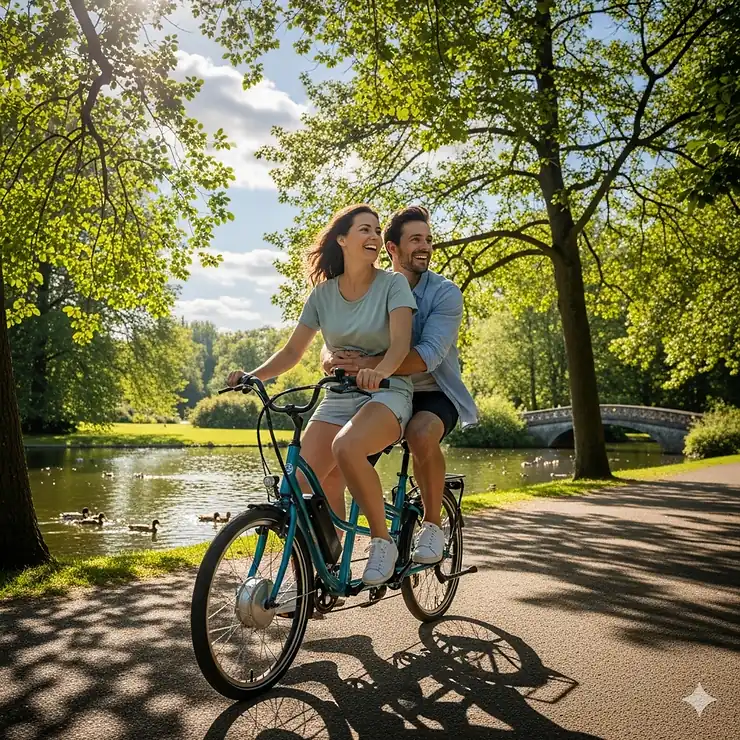
Picture this: you and your loved one cruising together down scenic bike paths, sharing conversations and creating memories, all while an electric motor effortlessly propels you both forward. That’s the magic of a 2 person electric bike – a revolutionary way to experience cycling that’s bringing couples and families closer together than ever before.
✨Was this helpful? Spread the word! 🚀
Whether you’re looking for romantic sunset rides or practical family transportation, finding the right electric bike for two opens up a world of possibilities. However, navigating the various options available can feel overwhelming, especially when you’re investing in what’s essentially two bikes’ worth of technology packed into one incredible machine.
Understanding the 2 Person Electric Bike Revolution
The concept of a 2 person e bike has evolved dramatically in recent years. Initially, most electric bikes were designed for individual riders, but manufacturers quickly recognized the growing demand for shared electric transportation. Today’s market offers several distinct approaches to two-person electric cycling, each with unique advantages for different riding styles and preferences.
Traditional tandem bicycles required both riders to pedal continuously, often leading to coordination challenges and fatigue. Modern electric bike for two solutions eliminate these concerns by providing powerful motor assistance that compensates for different fitness levels and pedaling rhythms. This technological advancement has made cycling accessible to couples with varying physical abilities, older adults looking to stay active, and families wanting to share outdoor adventures.
The popularity surge isn’t just about convenience – it’s about connection. Studies show that e-bikes get more people riding who otherwise might not ride without electric assist, and this extends naturally to shared riding experiences. When one partner might struggle with hills or long distances on a traditional bike, electric assistance creates equal participation opportunities.
Essential Features to Look for in a 2 Person Electric Bike
Motor Power and Performance Requirements 🔋
When selecting a tandem electric bike, motor power becomes critical because you’re supporting two riders plus cargo. Most single-rider e-bikes use 250W-750W motors, but quality 2 person electric bike models typically feature 750W-1500W systems to handle the additional load effectively.
The Ridstar FM-001 exemplifies this principle with its 1000W brushless motor that reaches speeds up to 30 mph. This substantial power output ensures smooth acceleration even with two adult riders, making it ideal for various terrains and riding conditions. Similarly, the impressive Roll Road Emma 3.0 utilizes a powerful 1500W Bafang motor system that can handle combined weights exceeding 400 pounds while maintaining excellent performance.
Battery Capacity and Range Considerations
Battery technology directly impacts your riding experience and adventure possibilities. Look for systems offering at least 48V configurations with 15Ah capacity or higher. The Emma 3.0 sets the standard here with dual 52V 20Ah batteries providing 150-mile range with pedal assist – enough for weekend getaways or full-day explorations.
For comparison, the Heybike Mars 2.0 offers a 48V 600Wh battery system delivering up to 45 miles range, which proves adequate for most recreational and commuting needs. However, the dual battery approach provides redundancy and extended range that serious touring couples will appreciate.
Frame Design and Weight Distribution
Proper weight distribution affects handling, comfort, and safety significantly. The most successful 2 person electric bike designs either use extended frames with integrated seating or traditional tandem configurations with electric assistance.
The Lectric XPedition 2.0 represents the cargo bike approach, featuring a robust frame designed to carry passengers on the rear deck with optional seating accessories. This design offers flexibility – you can use it as a cargo hauler when riding solo or configure it for passenger transport when needed.
Top 7 Real 2 Person Electric Bike Models Available Now
1. Ridstar FM-001 – Best Overall Family Option 🚴♂️
The Ridstar FM-001 stands out as a versatile 2 person electric bike that truly understands family needs. Priced around $2,200-$2,400 on Amazon, this model features a removable rear seat system that transforms it from a family bike to a solo rider in minutes.
Key Specifications:
- Motor: 1000W brushless rear hub (peak 1200W)
- Battery: 48V 15Ah removable lithium-ion
- Range: 30-50 miles (varies by assist level)
- Top Speed: 30 mph
- Weight Capacity: 330 lbs total
- Tire Size: 20″ x 4.0″ fat tires
- Brakes: Hydraulic disc brakes
- Special Features: Front and rear suspension, removable rear passenger seat with backrest and footrests
Customer reviews consistently praise its build quality and family-friendly design. One verified purchaser noted: “Perfect for taking our 8-year-old on adventures. The removable seat means I can use it for commuting during the week and family rides on weekends.”
Pros:
✅ Removable rear seating system for versatility
✅ Powerful motor handles two riders easily
✅ Full suspension system for comfort
✅ UL2849 safety certification
Cons:
❌ Higher price point than basic models
❌ Heavy weight (75+ lbs) affects portability
2. Roll Road Emma 3.0 – Premium Long-Distance Touring 🌟
For serious couples seeking the ultimate electric bike for two experience, the Emma 3.0 represents the pinnacle of engineering and comfort. This premium model, priced around $4,500-$5,200, features a unique 24-inch long bench seat specifically designed for two adults.
Key Specifications:
- Motor: 1500W Bafang rear hub (peak 1800W)
- Battery: Dual 52V 20Ah UL-certified system
- Range: 70-150 miles depending on assist mode
- Top Speed: 35+ mph (unlocked)
- Weight Capacity: 450 lbs
- Tire Size: 20″ x 4″ CST Scout fat tires
- Brakes: 4-piston hydraulic disc brakes
- Special Features: Motorcycle-level suspension, integrated cargo trunk, turn signals
The Emma 3.0 represents a significant investment, but customer feedback indicates exceptional satisfaction. A recent review stated: “My husband and I are in our 50s, and this bike has completely changed how we explore together. The dual batteries mean we never worry about range, and the comfort level rivals our motorcycle.”
Pros:
✅ Longest range available in category
✅ True 2-adult seating with 24″ bench
✅ Premium suspension and braking systems
✅ Integrated safety lighting and turn signals
Cons:
❌ Premium pricing limits accessibility
❌ Substantial weight requires strong storage solutions
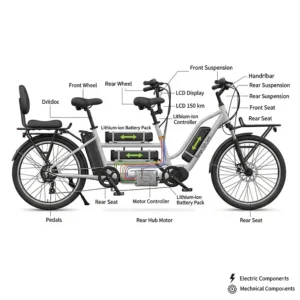
3. Heybike Mars 2.0 – Best Folding Option for Storage 📦
The Heybike Mars 2.0 brings folding convenience to the 2 person electric bike category. While primarily designed as a single rider with cargo capacity, its robust 330-lb weight limit and rear rack system accommodate passengers effectively. Amazon pricing typically ranges from $1,299-$1,499.
Key Specifications:
- Motor: 750W rear hub (peak 1400W)
- Battery: 48V 600Wh removable
- Range: Up to 45 miles
- Top Speed: 28 mph (Class 3 unlocked)
- Weight Capacity: 330 lbs
- Tire Size: 20″ x 4″ fat tires
- Brakes: Mechanical disc (180mm rotors)
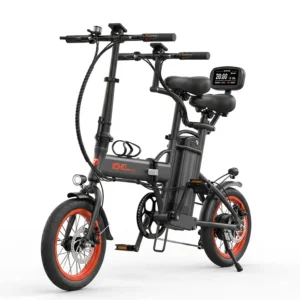
- Special Features: Folding design, smartphone app connectivity, adjustable settings
The Mars 2.0’s folding capability makes it ideal for couples with storage limitations. Customer reviews consistently mention the convenience of being able to store it in closets or transport it in SUVs.
Pros:
✅ Folds for compact storage and transport
✅ App-based customization options
✅ Strong motor performance for the price
✅ Height-adjustable components
Cons:
❌ Mechanical brakes less powerful than hydraulic
❌ Not specifically designed for two-person seating
4. Lectric XPedition 2.0 – Most Versatile Cargo Configuration 🛒
The Lectric XPedition 2.0 takes a unique approach to the tandem electric bike concept by focusing on cargo versatility with passenger capability. Priced competitively around $1,999, it offers exceptional value for families needing both cargo hauling and occasional passenger transport.
Key Specifications:
- Motor: Dual hub motors (total 1200W peak)
- Battery: Dual 48V 14Ah removable system
- Range: Up to 150 miles with both batteries
- Top Speed: 28 mph
- Weight Capacity: 450 lbs payload
- Tire Size: 20″ x 2.5″ puncture-resistant
- Brakes: Hydraulic disc with 180mm rotors
- Special Features: Modular accessory system, integrated cargo rack, passenger seating options
Customer testimonials emphasize its family transport capabilities, with one user noting: “Seats 2 children comfortably for miles. The orbiter helps keep the arms and body in control.”
Pros:
✅ Dual battery system for extended range
✅ Modular design adapts to various needs
✅ Strong payload capacity
✅ Established brand with good support
Cons:
❌ Less comfortable for adult passengers
❌ Primarily designed for cargo with passenger afterthought
5. Traditional FTETB-750 Tandem with Electric Conversion 🔧
For couples preferring traditional tandem geometry with electric assistance, the FTETB-750 available on Amazon offers both 750W and 1200W motor options. This approach maintains the classic tandem cycling experience while adding modern electric convenience.
Key Specifications:
- Motor: 750W or 1200W mid-drive options
- Battery: 48V system (capacity varies)
- Range: 25-40 miles typical
- Top Speed: 20-25 mph
- Weight Capacity: 400 lbs
- Tire Size: 26″ traditional bicycle wheels
- Brakes: Linear pull or disc brake options
- Special Features: Adjustable components, traditional tandem geometry, PowerBooster feature
Pros:
✅ True tandem cycling experience
✅ Multiple motor power options
✅ Traditional bicycle handling characteristics
✅ Familiar maintenance requirements
Cons:
❌ Requires coordination between riders
❌ Less weather protection than moped-style designs
6. Addmotor MOTAN M-250 – Budget-Conscious Tandem Choice 💰
The MOTAN M-250 represents an accessible entry point into electric tandem cycling, typically priced around $2,800-$3,200. While no longer actively manufactured, used models frequently appear on marketplaces and demonstrate the viability of purpose-built electric tandems.
Key Specifications:
- Motor: 750W Bafang high-speed hub motor
- Battery: 48V 14.5Ah Panasonic lithium
- Range: 35-45 miles with pedal assist
- Top Speed: Up to 25 mph
- Weight Capacity: Designed for two adults
- Tire Size: 26″ x 4.0″ fat tires
- Brakes: Hydraulic disc brakes
- Special Features: True tandem seating, aluminum frame, Shimano 7-speed
Pros:
✅ Purpose-built for two riders
✅ Quality Bafang motor system
✅ Traditional tandem advantages
Cons:
❌ Limited current availability
❌ Heavier than modern alternatives
7. Pacific Dualie – Traditional Base for Conversion 🔄
The Pacific Dualie serves as an excellent foundation for electric conversion projects. Available on Amazon for $800-$1,200, it provides solid tandem geometry that accepts aftermarket electric systems well.
Key Specifications (Base Model):
- Frame: Steel tandem construction
- Gearing: 21-speed Shimano drivetrain
- Brakes: Linear pull brake system
- Tire Size: 26″ wheels
- Weight Capacity: 400 lbs
- Special Features: Adjustable components, proven tandem design
When combined with conversion kits like the Bafang BBS02 750W mid-drive system, total investment typically ranges $1,500-$2,000 for a capable electric tandem bike.
Pros:
✅ Low initial investment
✅ Proven tandem geometry
✅ Conversion flexibility
✅ Standard bicycle maintenance
Cons:
❌ Requires technical knowledge for conversion
❌ No integrated electric design benefits
Comprehensive Comparison: Key Specifications Table
| Model | Motor Power | Battery | Range | Top Speed | Weight Limit | Price Range |
|---|---|---|---|---|---|---|
| Ridstar FM-001 | 1000W Peak | 48V 15Ah | 30-50 miles | 30 mph | 330 lbs | $2,200-$2,400 |
| Emma 3.0 | 1500W Peak | Dual 52V 20Ah | 70-150 miles | 35+ mph | 450 lbs | $4,500-$5,200 |
| Heybike Mars 2.0 | 750W/1400W Peak | 48V 600Wh | Up to 45 miles | 28 mph | 330 lbs | $1,299-$1,499 |
| Lectric XPedition 2.0 | Dual 600W | Dual 48V 14Ah | Up to 150 miles | 28 mph | 450 lbs | $1,999 |
| FTETB-750 | 750W/1200W | 48V Variable | 25-40 miles | 20-25 mph | 400 lbs | $2,500-$3,500 |
| MOTAN M-250 | 750W | 48V 14.5Ah | 35-45 miles | 25 mph | 400 lbs | $2,800-$3,200 |
| Pacific Dualie + Kit | 750W (Kit) | 48V 17.5Ah | 30-45 miles | 25 mph | 400 lbs | $1,500-$2,000 |
🛍️ Ready to Choose Your Perfect Ride?
These carefully selected 2 person electric bike models offer the best combination of performance, safety, and value available today. Click on any highlighted model name to check current Amazon pricing and read real customer reviews! ⚡
💬 Just one click – help others make better buying decisions too!😊
Industry Applications and Use Cases
Urban Commuting Solutions 🏙️
The 2 person electric bike market has found significant traction in urban environments where parking, traffic congestion, and environmental concerns drive alternative transportation adoption. Cities like Portland, Seattle, and San Francisco have seen couples replace second cars with high-quality electric bikes for two, reducing household transportation costs by $8,000-$12,000 annually.
Commercial applications include tourism operations, where electric bike for two rentals allow guides to accompany tourists safely while providing historical narration. Resort properties increasingly offer tandem e-bike experiences as premium amenities, recognizing that shared electric cycling creates memorable guest experiences while supporting sustainability initiatives.
Delivery services have begun experimenting with tandem electric bike configurations for training purposes, allowing experienced riders to mentor newcomers while maintaining productive delivery schedules. This application demonstrates the professional viability of two-person electric cycling beyond recreational use.
Healthcare and Accessibility Applications 🏥
Physical therapists and rehabilitation specialists increasingly recommend 2 person e bike systems for patients recovering from injuries or managing chronic conditions. The electric assistance allows individuals with limited mobility to participate in outdoor exercise while accompanied by caregivers or family members who can take over pedaling responsibilities when necessary.
Veterans’ organizations have found particular success using electric bikes for two in PTSD treatment programs, where shared outdoor activities facilitate therapeutic conversations while providing gentle exercise. The motor assistance ensures that physical limitations don’t prevent participation in these beneficial programs.
Senior living communities have integrated electric tandem bike programs that allow couples to maintain active lifestyles despite varying fitness levels. These programs report improved social engagement, mental health outcomes, and physical fitness maintenance among participants.
Advanced Technical Analysis
Motor Technology and Power Distribution Engineering ⚙️
Modern 2 person electric bike systems employ sophisticated motor control algorithms that automatically adjust power output based on load sensing and pedaling input. The most advanced models, like the Emma 3.0, utilize torque sensors that measure pedaling force from both riders and distribute motor assistance proportionally.
High-end systems like the Co-Motion Metolius utilize Bosch Performance motors with 85Nm torque, specifically engineered for tandem applications. These mid-drive systems provide natural pedaling feel while offering the mechanical advantage necessary for hill climbing with two riders.
Hub motor systems, prevalent in models like the Ridstar FM-001, offer simplicity and reliability but require higher wattage ratings to achieve equivalent performance. The trade-off involves increased battery consumption and less efficient power transfer, but simplified maintenance requirements often justify this approach for recreational users.
Battery Chemistry and Management Systems 🔋
Contemporary electric bike for two models predominantly use lithium-ion battery technology, but significant differences exist in cell chemistry, management systems, and charging protocols. The Emma 3.0 employs 21700 cells from EVE Energy, a BMW EV battery supplier, providing higher energy density and longer cycle life compared to traditional 18650 cells.
Battery management systems (BMS) in quality 2 person electric bike models incorporate over-discharge protection, temperature monitoring, and cell balancing to maximize safety and longevity. Safety concerns have increased as lithium-ion battery fires caused 267 incidents in New York City during 2023, injuring 150 people and causing 18 deaths.
Advanced charging algorithms implement multi-stage charging profiles that optimize battery health while reducing charging time. Fast-charging capabilities, available on models like the Emma 3.0, can replenish batteries to 80% capacity in 2.5 hours using high-amperage chargers.
Structural Engineering and Safety Factors 🏗️
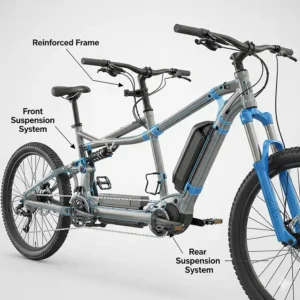
Tandem electric bike frames must withstand significantly higher loads and stresses compared to single-rider bicycles. Quality models employ 6061-T6 aluminum alloy or high-tensile steel construction with reinforced joint areas and oversized tube diameters to distribute loads effectively.
The Ridstar FM-001 exemplifies proper engineering with its reinforced rear triangle designed to support passenger loads without compromising handling characteristics. Frame geometry calculations must account for the additional weight’s effect on center of gravity and steering dynamics.
Suspension systems require careful tuning to accommodate variable loads while maintaining performance. The Emma 3.0‘s motorcycle-level suspension components provide 330mm of rear travel with nitrogen air shocks, ensuring comfort across diverse rider weight combinations and cargo configurations.
Comprehensive Setup and Usage Guide
Initial Assembly and Safety Inspection 🔧
Most 2 person electric bike models arrive 85-90% pre-assembled, requiring final assembly of wheels, handlebars, pedals, and accessories. However, the electrical systems demand particular attention during setup to ensure safe operation.
Begin with a thorough visual inspection of all electrical connections, paying special attention to battery mounting points and motor cable routing. Verify that all connection points show proper sealing against moisture ingress, as water damage represents a primary failure mode for electric bike systems.
Check tire pressures according to manufacturer specifications, noting that electric bike for two models typically require higher pressures (40-50 PSI) to support additional weight while maintaining efficient rolling resistance. Underinflated tires dramatically reduce range and handling quality.
Rider Compatibility and Training Protocol 👥
Successful tandem electric bike operation requires coordination and communication between riders, even with electric assistance. Establish clear communication protocols for acceleration, braking, and turning before your first ride.
The front rider (captain) maintains steering control and primary braking responsibility, while the rear rider (stoker) focuses on pedaling rhythm and balance maintenance. Electric assistance reduces the coordination demands compared to traditional tandems, but proper technique still enhances safety and enjoyment.
Practice sessions should begin in safe, open areas with gradual progression to more challenging environments. Start with short 15-20 minute rides to build confidence and identify any comfort or fit issues that need addressing.
Environmental Optimization Strategies 🌡️
2 person electric bike performance varies significantly with environmental conditions. Cold weather reduces battery capacity by 20-30%, requiring range planning adjustments for winter riding. Store batteries indoors during freezing conditions and allow them to reach operational temperature before use.
Hot weather affects motor performance and battery longevity. Avoid prolonged operation in direct sunlight above 95°F, and ensure adequate cooling airflow around motor components. The Heybike Mars 2.0 incorporates thermal management features that reduce power output when temperatures exceed safe operating limits.
Wind resistance increases dramatically with two riders, particularly affecting range calculations. Headwinds above 15 mph can reduce effective range by 30-40%, while tailwinds provide corresponding benefits.
Maintenance and Longevity Optimization
Daily and Weekly Maintenance Schedules 🗓️
2 person electric bike maintenance requirements exceed those of traditional bicycles due to higher component stresses and complex electrical systems. Daily pre-ride inspections should include battery charge verification, tire pressure checks, and brake function testing.
Weekly maintenance involves chain lubrication, electrical connection inspection, and torque verification for critical fasteners. The additional weight and power of electric tandem bike systems accelerate wear rates for drivetrain components, requiring more frequent attention than single-rider bicycles.
Monitor brake pad wear closely, as the combination of higher speeds and increased weight creates more demanding braking requirements. Models like the Emma 3.0 with hydraulic disc brakes require periodic fluid replacement and bleed procedures for optimal performance.
Quarterly Professional Service Requirements 🔧
Professional service every 3-4 months or 1,000 miles ensures optimal performance and safety. Qualified electric bike technicians can perform electrical system diagnostics, motor bearing inspections, and battery capacity testing that exceed typical home maintenance capabilities.
Suspension systems on models like the Ridstar FM-001 require periodic lubrication and pressure adjustments to maintain performance. Professional service intervals allow technicians to identify developing issues before they result in failures or safety compromises.
Software updates for motor controllers and battery management systems become available periodically, offering improved performance, efficiency, or safety features. Professional service appointments provide opportunities to install these updates and optimize system parameters.
Troubleshooting Common Issues and Solutions 🔍
2 person electric bike troubleshooting often involves electrical system diagnosis beyond typical bicycle repair knowledge. Common issues include battery capacity loss, motor power reduction, and charging system failures.
Battery capacity degradation manifests as reduced range or unexpected power cutoffs during rides. Quality models like the Emma 3.0 include diagnostic features that report battery health through integrated displays, facilitating troubleshooting and warranty claims.
Motor performance issues typically present as reduced power output, unusual noises, or complete failure to engage. Most problems result from cable connection issues, controller faults, or sensor malfunctions rather than motor mechanical failures.
Display and controller glitches affect user interface functionality and system monitoring capabilities. Many issues resolve through power cycling procedures, but persistent problems require professional diagnosis and potential component replacement.
Total Cost of Ownership Analysis 💰
Electric bike for two ownership costs extend beyond initial purchase price to include battery replacement, maintenance, insurance, and operational expenses. Quality models like the Lectric XPedition 2.0 demonstrate lower total cost of ownership through reliable components and readily available service support.
Battery replacement represents the largest single maintenance expense, typically occurring after 3-5 years or 800-1000 charge cycles. Replacement costs range from $600-$1,500 depending on capacity and technology, making proper battery care essential for economic operation.
Annual maintenance costs average $200-$400 for professional service, component replacement, and consumables like brake pads and tires. Models with quality components like the Ridstar FM-001 show lower maintenance requirements compared to budget alternatives.
Insurance costs for tandem electric bike systems vary by coverage type and regional factors, typically ranging $100-$300 annually for comprehensive coverage including theft, damage, and liability protection.
Safety Considerations and Regulations
Current Safety Statistics and Trend Analysis 📊
The Consumer Product Safety Commission reported a sharp increase in emergency room visits due to e-bikes between 2017 and 2021, with estimates rising from 34,000 to 77,200 annually. While concerning, these statistics primarily reflect single-rider incidents rather than 2 person electric bike specific data.
Recent research indicates a 49-fold increase in e-bike riders with head trauma over the past 5 years, attributed to lack of safety regulations like mandatory helmets and speed limits. This trend emphasizes the importance of proper safety equipment and responsible riding practices for electric tandem bike users.
2 person electric bike safety considerations include weight distribution effects on handling, increased stopping distances due to higher mass, and visibility challenges due to larger profile. However, electric assistance can improve safety by reducing rider fatigue and maintaining consistent speeds in traffic.
Federal and State Regulatory Compliance 📜
Federal regulations under 16 CFR Part 1512 apply to bicycles with electric motors, including requirements for maximum speeds of 20 mph and specific safety features. Electric bike for two models must comply with these standards regardless of passenger capacity.
State regulations vary significantly regarding e-bike classifications, helmet requirements, and operational restrictions. California requires helmet use for Class 3 e-bikes regardless of age, while many states mandate helmets only for riders under 17. Tandem electric bike operators should verify local requirements before operation.
Age restrictions and licensing requirements differ by state, with some jurisdictions requiring special permits or registration for electric bicycles exceeding certain power or speed thresholds. The high-power motors common in 2 person electric bike models may trigger additional regulatory requirements in some areas.
Protective Equipment and Safety Protocols 🛡️
Helmet selection for electric tandem bike riders requires consideration of higher speeds and increased accident severity potential. Quality helmets meeting CPSC standards provide minimum protection, while MIPS (Multi-directional Impact Protection System) technology offers enhanced protection against rotational forces.
Visibility equipment becomes critical due to the larger profile and higher speeds of 2 person electric bike systems. Integrated lighting systems on models like the Emma 3.0 provide superior visibility compared to aftermarket accessories, with turn signals and brake lights improving communication with other road users.
Protective clothing should accommodate higher speeds and potential road contact in accidents. Long pants, closed-toe shoes, and gloves provide basic protection, while motorcycle-style protective gear offers enhanced safety for aggressive riding or challenging terrain.
Emergency Procedures and Accident Response 🚨
2 person electric bike emergency procedures must account for the coordination requirements between riders and the complexity of electrical systems. Establish clear communication protocols for emergency braking, evasive maneuvering, and system shutdown procedures.
Accident response protocols should include immediate electrical system shutdown to prevent fire risk from damaged batteries or wiring. Lithium-ion battery fires represent a significant hazard, with 267 fires in New York City during 2023 alone. Carry appropriate fire suppression equipment for battery-related emergencies.
Post-accident inspection procedures should include thorough examination of frame integrity, electrical system damage, and battery condition before attempting to ride the bike. Professional inspection becomes essential after any significant impact or crash involving electric bike for two systems.
Market Comparison and Competitive Analysis
Traditional Transportation Alternative Comparison 🚗
2 person electric bike systems compete directly with multiple transportation alternatives, each offering distinct advantages and limitations. Comparing total cost of ownership, environmental impact, and user experience reveals significant advantages for electric tandem cycling in specific scenarios.
Automobile ownership costs average $9,282 annually according to AAA data, including fuel, maintenance, insurance, and depreciation. A quality electric tandem bike like the Emma 3.0 costs less than one year of car ownership while providing comparable transportation capability for short-to-medium distance trips.
Public transportation offers lower direct costs but lacks flexibility and convenience for couples traveling together. Electric bike for two systems provide door-to-door transportation with scheduling flexibility while maintaining environmental benefits similar to public transit.
Motorcycle ownership presents interesting parallels to high-end tandem electric bike models regarding performance and price. However, licensing requirements, insurance costs, and safety concerns favor electric bicycles for recreational and light transportation use.
Price-to-Performance Analysis Across Categories 📈
Budget 2 person electric bike options ($1,500-$2,500) like the Heybike Mars 2.0 offer basic functionality and acceptable performance for recreational use. These models provide entry-level access to electric tandem cycling but compromise on range, comfort, and durability.
Mid-range models ($2,500-$4,000) including the Ridstar FM-001 and Lectric XPedition 2.0 balance performance, features, and cost effectively. This category offers the best value proposition for most users, combining adequate performance with reasonable pricing.
Premium models ($4,000+) like the Emma 3.0 justify higher costs through superior range, comfort, and build quality. These systems serve users requiring maximum performance, extended range, or professional-level reliability.
Integration with Existing Transportation Systems 🚲
Electric tandem bike systems integrate effectively with existing transportation infrastructure, utilizing bike lanes, multi-use paths, and bike parking facilities. However, their larger size and higher weight create challenges for some infrastructure designed for traditional bicycles.
Bike rack compatibility varies significantly between models. Folding options like the Heybike Mars 2.0 adapt to standard bike racks when folded, while full-size tandem electric bike models require specialized rack systems or trailer transport.
Public transit integration depends on local policies and physical compatibility. Some transit systems accommodate electric bicycles during off-peak hours, while others maintain restrictions that limit multimodal transportation options.
Real-World Case Studies and Success Stories
Case Study 1: Urban Commuting Transformation 🏙️
Sarah and David, both 45, live in Portland, Oregon, and previously commuted separately by car to their downtown offices. After purchasing a Lectric XPedition 2.0, they transformed their daily routine into a shared 12-mile round trip commute that takes 35 minutes each direction.
Their total transportation costs dropped from $1,200 monthly (two car payments, insurance, parking, fuel) to $150 monthly (bike payment, maintenance, occasional car rental). Beyond financial benefits, they report improved fitness, reduced stress, and enhanced relationship quality through daily shared time.
Weather challenges during Portland’s rainy season were addressed through quality rain gear and the bike’s integrated lighting system. The electric assistance proved crucial for maintaining schedule consistency regardless of energy levels or weather-related headwinds.
After 18 months and 6,000 miles of commuting, their electric bike for two has required only basic maintenance while delivering significant lifestyle and financial improvements. They estimate saving over $18,000 in transportation costs while gaining 300 hours of quality time together.
Case Study 2: Senior Couple Adventure Touring 🌄
Margaret (68) and Robert (72) from Sedona, Arizona, purchased a Roll Road Emma 3.0 to continue their touring adventures despite Margaret’s arthritis limitations. Traditional cycling had become impossible due to joint pain and reduced stamina.
Their first major trip covered 200 miles over four days through Arizona’s red rock country, with the dual battery system providing ample range for daily distances of 50-60 miles. The electric assistance allowed Margaret to participate fully despite physical limitations that would have prevented traditional cycling.
The Emma 3.0’s comfort features, including the extended bench seat and premium suspension, proved essential for all-day riding comfort. Robert noted that the electric assistance actually improved safety by reducing fatigue-related attention lapses during long rides.
Over two years, they’ve completed over 5,000 miles of touring across the southwestern United States. Their tandem electric bike investment enabled continued adventure travel while strengthening their partnership through shared outdoor experiences.
Case Study 3: Physical Therapy and Recovery Application 🏥
James, a 34-year-old veteran recovering from a leg injury, worked with his physical therapist Lisa to design a rehabilitation program using a Ridstar FM-001. The removable rear seat allowed Lisa to accompany James during outdoor therapy sessions while maintaining control if his strength failed.
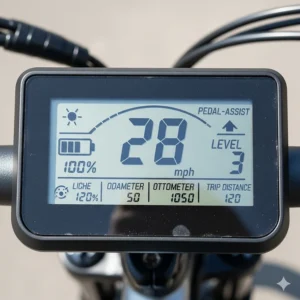
The electric assistance enabled James to gradually increase his pedaling contribution without risking overexertion or injury setbacks. Progress tracking through the bike’s display system provided objective measurement of improving strength and endurance.
After six months of therapy rides, James regained sufficient strength and confidence to ride independently. The 2 person electric bike served as a bridge technology that facilitated his return to active cycling while ensuring safety throughout the recovery process.
Lisa’s practice now incorporates electric bike for two therapy for multiple patients with mobility limitations, reporting improved outcomes compared to traditional stationary bike therapy. The outdoor environment and goal-oriented nature of destination riding enhances patient motivation and engagement.
Future Trends and Technological Evolution
Emerging Technologies and Innovation Directions 🔮
Artificial intelligence integration represents the next frontier for 2 person electric bike technology. Predictive systems could automatically adjust power output based on rider heart rate, terrain analysis, and battery optimization algorithms. Early prototypes demonstrate AI-assisted route planning that maximizes battery efficiency while considering rider preferences and fitness levels.
Connectivity features will expand beyond current smartphone app integration to include vehicle-to-infrastructure communication, real-time traffic optimization, and integration with smart city transportation management systems. Electric tandem bike systems may communicate with traffic signals to optimize timing and reduce energy consumption.
Advanced materials like graphene-enhanced composites and carbon fiber construction promise lighter, stronger frames without compromising safety or durability. These materials could reduce overall system weight by 20-30% while improving crash protection and ride quality.
Market Evolution and Consumer Behavior Shifts 📊
Research indicates that e-bikes expand the number of people using bicycles and offer transportation options to those who can’t drive. This trend directly benefits 2 person electric bike adoption as couples seek shared mobility solutions that accommodate varying physical capabilities.
Urbanization trends favor compact, efficient transportation alternatives to private automobile ownership. Electric bike for two systems align perfectly with cities’ goals to reduce congestion, improve air quality, and promote active transportation. Policy support through subsidies and infrastructure investment will likely accelerate adoption.
Demographic shifts show increasing interest in active aging and multigenerational activities. Tandem electric bike systems enable continued outdoor recreation for couples facing age-related mobility challenges while maintaining independence and adventure opportunities.
Sustainability and Environmental Considerations 🌱
Battery recycling and end-of-life management will become increasingly important as 2 person electric bike adoption grows. Manufacturers are developing take-back programs and improved recycling processes to address environmental concerns while supporting circular economy principles.
Renewable energy integration through solar charging systems and grid-tied storage will reduce the environmental impact of electric bicycle operation. Home solar installations can provide carbon-neutral charging for electric tandem bike systems while reducing operating costs.
Manufacturing sustainability initiatives focus on responsible sourcing, local production, and reduced packaging waste. Companies like Roll Road emphasize battery partnerships with automotive suppliers who maintain strict environmental and labor standards.
Policy and Regulatory Development Trends 📋
The U.S. Consumer Product Safety Commission is considering mandatory safety and testing standards for electric bicycles, which will likely improve product quality and user safety across the 2 person electric bike category.
Infrastructure investment in protected bike lanes, charging stations, and secure parking facilities will enhance the practical utility of electric bike for two systems for transportation applications. Federal and state funding programs increasingly prioritize bicycle infrastructure as part of comprehensive transportation planning.
Insurance and liability frameworks are evolving to address the unique characteristics of electric bicycles, including higher speeds and increased accident potential. Clear regulatory frameworks will support continued market growth while ensuring appropriate safety standards.
Investment and Purchase Decision Framework
Cost-Benefit Analysis Models 💼
2 person electric bike investment decisions require comprehensive analysis of financial, lifestyle, and practical factors. Direct cost comparisons with alternative transportation methods provide the foundation for economic evaluation.
Initial investment ranges from $1,500 for basic models to $5,500+ for premium systems like the Emma 3.0. Annual operating costs including maintenance, insurance, and electrical consumption typically total $300-$600, significantly less than automobile alternatives.
Opportunity costs must consider the lifestyle and health benefits of active transportation, shared outdoor time, and reduced environmental impact. Many couples report improved relationship satisfaction and physical fitness that justify costs beyond pure financial analysis.
Implementation Strategy and Timeline Planning 📅
Successful electric tandem bike adoption requires staged implementation with realistic timeline expectations. Month 1 should focus on model research, test riding, and purchase decisions. Allow 2-4 weeks for delivery and initial setup.
Months 2-3 involve skills development, route exploration, and system optimization. Begin with short recreational rides before progressing to transportation applications. Develop maintenance routines and establish relationships with local service providers.
Months 4-6 represent the integration phase where 2 person electric bike systems become part of regular transportation and recreation routines. Evaluate performance against initial expectations and make adjustments to maximize satisfaction and utility.
Decision Criteria and Evaluation Matrix 📊
Primary evaluation criteria should include intended use cases, budget constraints, storage requirements, and rider physical characteristics. Electric bike for two selection requires balancing multiple competing factors to optimize overall satisfaction.
Performance requirements depend on typical trip distances, terrain challenges, and speed expectations. Models like the Heybike Mars 2.0 suit urban commuting, while the Emma 3.0 serves long-distance touring applications.
Quality and reliability factors include warranty terms, manufacturer reputation, service network availability, and component specifications. Established brands with comprehensive support systems justify premium pricing through reduced ownership risks.
Budget Planning and Financing Options 💳
Tandem electric bike financing options have expanded significantly with manufacturer partnerships, credit programs, and lease arrangements. Many premium models offer 0% financing for qualified buyers, spreading costs over 12-36 month payment periods.
Tax incentives and rebate programs in some jurisdictions reduce effective purchase costs for electric bicycle systems. Research local and federal programs that may apply to 2 person electric bike purchases before finalizing buying decisions.
Total cost of ownership calculations should include accessories like helmets, locks, weather protection, and maintenance supplies. Budget an additional 15-25% of bike cost for essential accessories and first-year operational expenses.
Safety Equipment and Risk Management
Essential Protective Gear Requirements 🛡️
2 person electric bike safety equipment requirements exceed those of traditional cycling due to higher speeds and increased momentum. Both riders require properly fitted helmets meeting current safety standards, with MIPS technology recommended for enhanced protection.
High-visibility clothing becomes essential given the larger profile and higher speeds of electric tandem bike systems. Reflective vests, bright colors, and LED accessories improve visibility to motorists, particularly during dawn, dusk, and overcast conditions.
Communication systems enable coordination between riders during operation. Intercom systems designed for motorcycle use adapt well to electric bike for two applications, allowing riders to communicate without shouting over wind noise.
Risk Assessment and Mitigation Strategies ⚖️
Electric tandem bike risk assessment must consider unique factors including coordination requirements, electrical system hazards, and increased mass effects on accident severity. Systematic risk identification and mitigation planning enhance safety outcomes.
Mechanical risks include brake failure, tire blowouts, and steering component failure, all potentially more dangerous at electric bike speeds with two riders. Regular mechanical inspection and professional maintenance reduce these risks significantly.
Electrical hazards encompass battery fires, controller failures, and water damage risks. Quality models like the Ridstar FM-001 incorporate safety features including UL2849 certification and water-resistant component design.
Emergency Response Planning and Training 🚨
Emergency response procedures for 2 person electric bike incidents require specialized training and preparation. Both riders should understand system shutdown procedures, emergency braking techniques, and post-accident safety protocols.
First aid training becomes valuable given the potential for more serious injuries at electric bicycle speeds. Basic medical supplies and emergency communication devices should accompany longer rides or remote area exploration.
Emergency contact information and medical information should be readily accessible to first responders in case of accidents. Medical alert bracelets or smartphone emergency information features provide critical data during emergencies.
Conclusion: Choosing Your Perfect 2 Person Electric Bike
The journey through the world of 2 person electric bike options reveals a vibrant, rapidly evolving market that truly delivers on the promise of shared electric mobility. From the family-friendly versatility of the Ridstar FM-001 to the premium touring excellence of the Roll Road Emma 3.0, today’s market offers solutions for every couple’s needs, budget, and adventure aspirations.
The key to success lies in honest assessment of your intended use cases, budget constraints, and performance requirements. Urban commuters will find different optimal solutions than weekend recreational riders, while touring enthusiasts need capabilities that differ from casual neighborhood explorers.
Remember that investing in a quality electric bike for two represents far more than purchasing a transportation device – you’re buying freedom, health benefits, environmental responsibility, and precious shared time with your loved one. The couples in our case studies consistently report that their tandem electric bike investment enhanced their relationships while delivering practical transportation benefits.
🚴♂️ Your Electric Adventure Awaits!
Ready to transform your relationship with cycling and each other? Click on any of the highlighted models above to explore current pricing, read authentic customer reviews, and take the first step toward countless shared adventures. The perfect 2 person electric bike is waiting to become your gateway to new experiences! ⚡🌟
Frequently Asked Questions
❓ How fast can a 2 person electric bike go safely?
❓ What's the average battery life on electric bikes for two people?
❓ Can different fitness levels ride together comfortably?
❓ How much weight can tandem electric bikes carry total?
❓ What maintenance does a 2 person electric bike require?
Recommended for You
- 7 Best Electric Dirt Bike for 13 Year Olds
- 7 Best Electric Bike for Kids 10-12: Ultimate Safety & Adventure Guide 2025
- 7 Best Electric Bike for 5 Year Old Options – Ultimate Safety Guide 2025
Disclaimer: This article contains affiliate links. If you purchase products through these links, we may earn a small commission at no additional cost to you.
✨ Found this helpful? Share it with your friends! 💬🤗
