

In This Article
A half helmet for cruiser riders is a minimalist, DOT-certified lid that covers the crown, sides, and rear of the skull while leaving the face and ears open. It trades protection for airflow, visibility, and classic style, and it must still meet the federal FMVSS 218 standard to be legal in most states.

That trade-off is the whole story. It’s why picking a half helmet for cruiser riders deserves more thought than grabbing the first matte-black beanie on the shelf. Plenty of riders love the wind on their face and the clean sightlines. Plenty also learn, too late, that a cheap shell perched on their head like a bowl on a bowling ball looks silly, fits badly, and may never have been certified at all. Federal regulators have long warned that novelty helmets sold with separate or counterfeit DOT stickers circulate in the market, so a sticker alone proves nothing.
Here’s what this guide does. It compares seven real models by shell, weight, visor setup, and head shape. It explains DOT certification labels, shell size and head shape fit, and helmet coverage differences in plain English. It also shows how to find a low profile half helmet for cruisers without the mushroom-cap look, and what to know before buying a DOT approved open face helmet with visor.
One honest note: this is a research-based guide, not a hands-on test. Everything here comes from published specs, independent reviews, and aggregated retailer review data at the time of research (October 2026). Two of the seven picks are technically three-quarter open-face helmets, included as low-profile alternatives for riders who want a bit more coverage.
Quick Comparison: 7 Half Helmet for Cruiser Riders Options at a Glance
Before the deep dives, here’s the lay of the land. Weights come from retailer or reviewer listings and are approximate. Prices are ranges only, so check current price before buying.
| Helmet | Style | Visor Setup | Listed Weight | Price Range | Best For |
|---|---|---|---|---|---|
| Bell Pit Boss | Half | Drop-down visor | ~2.44 lbs | Mid-$100s | Highway riders who want a dial-adjust fit |
| LS2 Rebellion | Half | Drop-down sun shield + short peak | ~2.1 lbs (XL, one reviewer’s scale) | $120-$150 | Value with Bluetooth readiness |
| HJC IS-Cruiser | Half | Retractable smoke shield + peak | ~2.64 lbs (retailer listing) | $100-$130 | Budget all-rounder |
| Biltwell Bonanza | Open face | None included (3-snap) | ~2.35 lbs | $130-$150 | Retro minimalists who add their own visor |
| Bell Custom 500 | Open face | Snaps for a separate shield | ~2.41 lbs | $145-$205 | Smaller-looking shell, five shell sizes |
| Highway 21 9mm | German beanie | None | Not listed | $60-$100 | Ultra-low-profile budget builds |
| VCAN Cruiser | Half | Drop-down visor + removable peak | Not verified | Budget tier (check current price) | Cost-conscious buyers wanting a built-in visor |
Looking at the table, the Bell Pit Boss and LS2 Rebellion bundle the most “ride-ready” features, while the Highway 21 9mm wins on sheer minimalism. If you wear glasses, the built-in drop-down visors on the LS2 Rebellion and HJC IS-Cruiser deserve a closer look before you commit. Riders who want the smallest silhouette should weigh the Bell Custom 500 against the Highway 21 9mm, since they get small in different ways.
💬 Just one click — help others make better buying decisions too!😊
Top 7 Half Helmet for Cruiser Riders: Expert Analysis
Every pick below follows the same logic: what the spec means in practice, who it suits, and what verified review data says. Where an independent review base is thin, I say so rather than guess.
1. Bell Pit Boss — slim shell with a rear-dial fit
The headline feature is adjustability. The Bell Pit Boss uses a TriMatrix composite shell and Bell’s Speed Dial rear wheel, which tightens the cradle around your skull and is meant to keep open-face helmets from lifting in the wind.
At roughly 2.44 lbs, it’s light enough that your neck won’t complain on a two-hour slab ride. Add a drop-down visor, a removable neck curtain for cold mornings, speaker pockets for comm units, and a five-year warranty. On paper, that makes it the most complete package here, with fewer add-on purchases needed. It suits riders who spend real time at highway speeds and worry about the helmet shifting.
Retailer pages show roughly 4.5 out of 5 across 800+ reviews. Buyers generally praise the free, unrestricted feel. One published roundup notes the visor can sit close for riders with longer noses, which is worth checking against your own face.
Pros:
- ✅ Rear dial dials in fit quickly
- ✅ Neck curtain and speaker pockets included
- ✅ Five-year warranty backs the build
Cons:
- ❌ Visor may sit close on some faces
- ❌ Costs more than entry-level beanies
Price range: mid-$100s, which is fair value if you’ll use the dial, curtain, and visor.

2. LS2 Rebellion — Bluetooth-ready with a two-stage sun shield
The LS2 Rebellion earns its spot with a Kinetic Polymer Alloy shell, a short peak, and a Twin Shield drop-down sun shield that locks halfway or fully down. One independent reviewer weighed an XL at just 2.1 lbs, which is featherweight for a helmet with this feature list.
Flow-through venting, a micrometric quick-release strap, and readiness for LS2’s LinkIn Bluetooth system round it out. There are only two shell sizes (XS-LG and XL-2XL), so riders in the middle of each range may get a slightly bigger-looking shell than the number suggests.
Sizing opinions vary, and retailers say it runs large, so size down if you’re between sizes. Retailer pages show about 4.5 out of 5 over 300 reviews. Reviewers praise comfort and padding. The recurring complaints are that the dark shield blurs optics and can brush eyeglasses as it comes down.
Pros:
- ✅ Very light for its feature set
- ✅ Two-stage drop-down sun shield
- ✅ Bluetooth-ready with quick-release strap
Cons:
- ❌ Dark shield optics can feel blurry
- ❌ Shield may brush eyeglasses
Price range: $120-$150, strong value if you want built-in shade.
3. HJC IS-Cruiser — budget all-rounder with a retractable shield
The HJC IS-Cruiser is the safe, sensible choice. It uses an advanced polycarbonate composite shell, an intermediate oval fit (the most common head shape), and an integrated light-smoke shield that slides up and down, plus a peak.
Retailer listings put weight between about 2.45 and 2.64 lbs depending on size, which is a touch heavier than the LS2 Rebellion on paper. One independent reviewer notes it offers protection further over the ears and back of the head than most half helmets, which matters for the coverage conversation later in this guide. The liner is removable and washable.
Shoppers have rated it roughly 4.5 out of 5 across nearly 1,000 retailer reviews, a deep and reassuring sample. The light-smoke shield is gentler than a dark one, though bright midday glare may still call for sunglasses.
Pros:
- ✅ Intermediate oval suits most heads
- ✅ Extra coverage over ears and rear
- ✅ Washable liner and integrated shield
Cons:
- ❌ Heavier than the LS2 Rebellion on paper
- ❌ Light-smoke shield may not cut bright glare
Price range: $100-$130, which is excellent value for what you get.
4. Biltwell Bonanza — retro minimalism that takes any visor
The Biltwell Bonanza is for riders who want the look first. It combines an injection-molded ABS shell with an EPS safety liner and a traditional D-ring strap, wrapped in a classic open-face shape. A three-snap setup on top accepts nearly any standard visor or peak, so you choose the style yourself.
A listed weight of about 2.35 lbs keeps it comfortable. One independent reviewer rates the finish as better than some helmets costing twice as much. The catch: it carries DOT certification only, so it isn’t legal for European riding, and no visor is included.
The review base is thin at some retailers, so I’d lean on independent coverage here rather than star counts. The takeaway is a well-built, no-frills lid. Budget for a visor or goggles separately.
Pros:
- ✅ Quality finish for the price tier
- ✅ Three-snap visor mounting
- ✅ Lightweight ABS shell
Cons:
- ❌ No visor included
- ❌ DOT only, no European certification
Price range: roughly $130-$150, varying by finish, so check current price.
5. Bell Custom 500 — five shell sizes for a true low profile
The Bell Custom 500 is the benchmark for a smaller-looking classic. It’s a three-quarter open-face helmet with a thin-profile fiberglass shell and five shell and EPS sizes, so the shell scales with your head instead of ballooning.
That is why riders chasing a low profile half helmet for cruisers keep coming back to it. It’s an intermediate oval fit at about 2.41 lbs, with snaps for a separate shield or visor and a five-year warranty. Retailers say it runs slightly small, so order the larger size if you’re between sizes.
It shows about 4.5 out of 5 across 460+ retailer reviews. Fit is the recurring theme. Buyers who sized by their other helmets sometimes found it too tight, and several reviewers report Bell’s own snap-on visors needing trimming or aligning to fit the latest version.
Pros:
- ✅ Five shell sizes keep the profile small
- ✅ Intermediate oval suits most heads
- ✅ Light, with snaps for add-on shields
Cons:
- ❌ Runs small, so sizing needs care
- ❌ Visor snap alignment complaints
Price range: $145-$205 depending on graphics, worth it if shell proportion matters most to you.
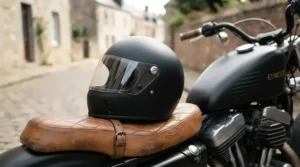
6. Highway 21 9mm — German beanie for the smallest profile
The Highway 21 9mm is the minimalist’s helmet. A lightweight ABS shell, an EPS liner, a diamond-stitched Coolmax liner, and a dual D-ring strap come with a protective helmet bag, all at a price that barely registers.
The small, rounded shape gives you an old-school silhouette with almost no overhang. The trade-off: it’s a round head shape, so it has more room on the sides and less front to back, and retailers say it fits big, so size down if between sizes. A long-oval head will feel pressure at the forehead and back.
Shoppers rate it about 4 out of 5 across roughly 170 retailer reviews, a solid but not stellar average. It has no visor, so pair it with goggles or sunglasses.
Pros:
- ✅ Tiny, classic German-beanie silhouette
- ✅ Washable, removable Coolmax liner
- ✅ Very affordable
Cons:
- ❌ Round shape punishes long-oval heads
- ❌ No built-in sun or eye protection
Price range: $60-$100, which is outstanding value for a short-trip bobber lid.
7. VCAN Cruiser — built-in visor and removable peak on a budget
The VCAN Cruiser targets riders who want an integrated drop-down visor, a removable peak, and a quick-release buckle without paying mid-tier prices. Its listing describes an ABS shell and DOT approval.
Here’s the honest part: independent reviews of this model are scarce, and I couldn’t verify shell sizes or weight. A quick-release buckle is convenient for stop-and-go riding, though some riders prefer a D-ring for security, which is a personal call. The spec sheet looks right for the money. Before you trust any budget helmet, confirm the DOT certification labels on the actual product (covered below).
Affiliate roundups rate it about 4.5 out of 5, but I can’t independently confirm that review base, so treat it as a promising budget option rather than a proven one.
Pros:
- ✅ Drop-down visor plus removable peak
- ✅ Quick-release buckle for convenience
- ✅ Budget-friendly positioning
Cons:
- ❌ Thin independent review base
- ❌ Sparse verified specs
Price range: budget tier, so check current price, and judge it on label verification and fit.
Spec and Value Comparison
| Helmet | Shell Sizes | Head Shape / Fit Note | Rating Source | Best For |
|---|---|---|---|---|
| Bell Pit Boss | Not verified | Dial-adjust fit | ~4.5/5, 800+ retailer reviews | Highway comfort |
| LS2 Rebellion | 2 | Runs large per retailers | ~4.5/5, 300+ retailer reviews | Value with shade |
| HJC IS-Cruiser | Not verified | Intermediate oval | ~4.5/5, ~1,000 retailer reviews | Budget all-rounder |
| Biltwell Bonanza | Not verified | Not stated | Thin retailer sample | Retro looks |
| Bell Custom 500 | 5 | Intermediate oval, runs small | ~4.5/5, 460+ retailer reviews | Smallest silhouette |
| Highway 21 9mm | Not verified | Round, fits big | ~4/5, ~170 retailer reviews | Short bobber trips |
| VCAN Cruiser | Not verified | Not verified | Unverified | Budget visor buyers |
The data points to a clear split. The HJC IS-Cruiser and Bell Custom 500 have the deepest, most reassuring review bases. The Highway 21 9mm wins on price but costs you in fit versatility. The VCAN Cruiser is the riskiest recommendation because so little independent data exists, so a retailer with an easy return policy matters more there than anywhere else.
Practical Usage Guide: Your First 30 Days With a New Half Helmet for Cruiser Riders
Buying the helmet is half the job. Here’s the rollout that Amazon listings don’t give you.
- Day zero: inspect. Find the DOT label on the back and the manufacturer’s label inside. If either is missing or looks off, return it.
- Set the position. The front edge should sit low on your forehead, roughly one to two finger widths above your eyebrows. A helmet pushed back exposes your forehead, which defeats the point.
- Do the roll-off test. Fasten the strap, tuck your chin, and have someone gently try to roll the helmet forward off your head from behind. It shouldn’t budge. If it does, size down or tighten the dial or strap.
- Give it a week. Padding compresses slightly, so a snug fit on day one often feels right by day seven. Pressure points that don’t ease are a shape mismatch, not break-in.
- Keep it clean. Wash the liner when it’s removable, and wipe the shell with mild soap. Skip solvents and adhesive stickers on the shell.
- Avoid the paint trap. Federal guidance notes that DOT labels sometimes vanish when owners repaint a helmet, so never cover or remove yours.
The most common first-month mistakes are a loose strap, a visor that blocks your sightline, and ignoring a hot spot until it becomes a headache. Fix those early and a half helmet for cruiser riders becomes the most comfortable gear you own.
Real-World Scenarios: Matching a Half Helmet for Cruiser Riders to Your Ride
Specs mean nothing until you attach them to a real life. Here are three rider profiles, with the reasoning for each.
The Sunday highway rider. Imagine a bagger rider logging 150 miles most weekends at 65 mph, mostly on slab. The priority is stability and fit, not looks. The Bell Pit Boss and its rear dial are the logical start, since lift at speed is the main worry for this rider. The LS2 Rebellion is the alternative if Bluetooth matters, though glasses wearers should note that shield-to-lens contact.
The short-hop bobber builder. Picture a rider doing 20-minute evening runs to the diner on a stripped-down bike, with a tight budget. The Highway 21 9mm delivers the smallest silhouette for the least money, paired with goggles. Check head shape first, because a long-oval head makes that round shell a bad bet.
The sun-and-sunglasses rider. Someone riding mid-day in strong sun wants shade but dislikes tinted drop-downs. The HJC IS-Cruiser adds a gentle smoke shield, while the Bell Custom 500 pairs with an aftermarket bubble shield or sunglasses. Frequent daily use favors the HJC IS-Cruiser for its deep review base and lower price.
Helmet Coverage Differences: Half, Open Face, and Full Face Compared
The most important helmet coverage differences come down to what each style leaves exposed. A half helmet covers the top and rear of the skull but leaves the ears and lower back of the head open. An open-face (three-quarter) helmet extends coverage lower over the temples and rear. A full-face adds the chin bar and face protection.
| Style | What It Covers | Strength | Trade-off | Best For |
|---|---|---|---|---|
| Half helmet | Crown, sides, upper rear | Airflow, visibility, classic look | Least coverage | Slow cruising, warm weather |
| Open face (3/4) | Crown, sides, rear, temples | More coverage, still open | No chin or face protection | All-round cruising |
| Full face | Entire head and face | Most protection, less noise | Warmer, less open feel | Highway, long rides |
The honest summary is that no one disputes the safety ranking. A review of crash studies on PubMed Central found that full-face helmets were associated with lower head and cervical injury than half-coverage helmets. Facial injury is also a real consideration when the face is exposed. Still, a half helmet beats no helmet at all, and many riders accept the trade-off for comfort and visibility.
Reading the table, the practical middle ground is the three-quarter style, as with the Bell Custom 500 and Biltwell Bonanza. You keep the open feel while gaining coverage over the temples and rear. If most of your miles are highway miles, weigh these helmet coverage differences seriously before settling on the thinnest beanie.
How to Choose a Half Helmet for Cruiser Riders (Step by Step)
Use this sequence and you’ll avoid the expensive mistakes.
- Verify the certification first. A helmet without proper DOT certification labels is a non-starter, whatever the price or look.
- Identify your head shape. Most riders in the U.S. are intermediate oval, but a round or long-oval head changes which models will feel right.
- Measure your head. Wrap a soft tape around the widest part, just above the eyebrows, then compare against the brand’s own chart, because sizing varies by manufacturer.
- Decide on visor needs. Do you want a built-in drop-down, a snap-on peak, or none and goggles instead?
- Check weight and retention. Lighter is easier on your neck over long rides, and a dial or secure D-ring keeps the shell from lifting.
- Match coverage to your riding. Slow town loops suit a half shell, while sustained highway riding argues for more coverage.
- Buy where returns are easy. Fit is personal, and the best fit test is wearing it for at least a few minutes at home.
DOT Certification Labels: How to Tell a Real One From a Fake
DOT certification labels are the baseline, but they are the manufacturer’s own certification, not a government stamp of approval. Under the federal standard (FMVSS 218) in the Code of Federal Regulations, each helmet must carry a permanent, legible label with the “DOT” symbol in letters at least 0.38 inch high, with “FMVSS No. 218” centered beneath it.
NHTSA guidance adds the details that matter at the shop counter. Helmets made on or after May 13, 2013 carry the updated DOT label on the back, with the brand, “FMVSS No. 218 CERTIFIED,” and the model. There should also be an inside label listing the manufacturer, model, size, month and year of manufacture, and construction materials. A helmet without that inside label does not meet the standard.
Be careful with counterfeits. Some novelty sellers supply DOT stickers separately, which makes the sticker invalid. A Snell or ANSI label inside is a good additional indicator. Other tells include a spiky or heavily protruding shell (FMVSS 218 limits projections to about 0.20 inch) and chin straps with flimsy rivets. When in doubt, buy from an established retailer, not an anonymous marketplace listing.
Shell Size and Head Shape Fit: Why the Right Size Isn’t Enough
Shell size and head shape fit is the part of buying that no spec sheet fully captures. Helmets come in three basic head shapes: round oval, intermediate oval, and long oval. Intermediate oval is the most common shape in the U.S., and most helmets default to it. Take a top-down photo of your head with your hair flattened to see where you fall.
A mismatch shows up as hot spots. A long-oval head in a round shell feels tight front and back with gaps at the sides. A round head in a narrow shell feels pinched at the temples. Then there’s the shell size itself. The Bell Custom 500 offers five shell sizes, while the LS2 Rebellion offers just two, so the same head circumference can look quite different in each.
Brands also run differently. Retailers report the Bell Custom 500 runs slightly small, the Highway 21 9mm and LS2 Rebellion run large, and the HJC IS-Cruiser is listed as intermediate oval. If you fall between sizes, a common rule is to choose the smaller size for a snug fit, then adjust for each brand’s known tendencies. Getting shell size and head shape fit right matters more than any feature on the box.
Low Profile Half Helmet for Cruisers: How to Dodge the Mushroom Look
Every cruiser rider has seen it: a helmet so oversized it looks like a mushroom cap. A low profile half helmet for cruisers avoids this through shell proportion, not magic. The less foam and shell sit above your skull, the smaller the silhouette.
Three things control the look. First, the number of shell sizes. More sizes mean a shell scaled closer to your head, which is why the Bell Custom 500 has such a strong reputation here. Second, the base design. German-style beanies like the Highway 21 9mm are inherently compact. Third, the fit itself. A snug helmet sits lower and looks smaller than a loose one.
The honest trade-off is that smaller usually means less coverage or fewer features. The Highway 21 9mm has no visor, and the Bell Custom 500 relies on add-on shields. If you want both a low profile half helmet for cruisers and built-in shade, accept a slightly larger shell, as on the HJC IS-Cruiser or LS2 Rebellion. Try on at least two shell sizes if the retailer allows it, and compare photos from the side to judge the profile.
DOT Approved Open Face Helmet With Visor: Sun Shields, Peaks, and Snap-On Options
Shopping for a DOT approved open face helmet with visor means choosing between three setups. A built-in drop-down shield, as on the Bell Pit Boss, LS2 Rebellion, and HJC IS-Cruiser, deploys with a finger. A fixed or removable peak, as on the VCAN Cruiser, shades the brow. Snap-on visors and bubble shields, as on the Biltwell Bonanza and Bell Custom 500, offer the most style freedom.
Each has trade-offs. Built-in shields add convenience but can blur optics, and some riders report them brushing eyeglasses. Snap-on options let you choose the look but can be fussy. Reviewers report Bell’s snap-on visors needing trimming to align with the latest Bell Custom 500, and a misaligned snap can flap at speed.
One safety point: a visor isn’t eye protection like a rated shield. At highway speeds, wind and debris still reach your eyes, so goggles or glasses make sense for a DOT approved open face helmet with visor. Choose a visor for shade and style, not as a substitute for real eye protection.
Features That Actually Matter (And Those That Don’t)
Marketing sheets bury the useful in the trivial. Here’s my filter.
Features that matter: a verified certification label, a fit that matches your head shape, a secure retention system, low weight, and a washable liner. These affect safety and comfort on every ride.
Features that are nice to have: a drop-down shield, speaker pockets, a neck curtain, and Bluetooth readiness. The Bell Pit Boss and LS2 Rebellion bundle these, and they’re genuinely useful if you ride long or in changing weather.
Features that rarely matter: exotic graphics, chrome trim, and brand-name hype. They change the price more than the protection.
Weight deserves a special mention. The listed range across these seven runs from about 2.1 to 2.64 lbs, a small gap on a scale but a noticeable one over a three-hour ride. When two helmets fit equally well, pick the lighter one. And when one has a visor you’ll never use, skip paying for it.
Long-Term Cost and Maintenance
The cheapest helmet isn’t always the cheapest to own. A $60-$100 Highway 21 9mm replaced every few years costs less than a premium pick, but only if it fits well enough that you actually wear it. A helmet that causes headaches ends up in the closet.
Build total cost around four items: the helmet itself, a visor or goggles, any comm system, and replacement. The Bell Pit Boss and Bell Custom 500 carry five-year warranties, which signals the maker expects the helmet to last about that long. Many manufacturers suggest replacing a helmet after about five years of regular use, and always after any significant impact. Always check the maker’s guidance for your specific model.
Maintenance is cheap. Wash the liner, wipe the shell, keep the helmet out of hot cars and away from solvents, and store it in a bag. Done consistently, that keeps foam and padding in good shape. Treat the helmet as consumable safety gear, not a heirloom.
Frequently Asked Questions
❓ Is a half helmet for cruiser riders legal in every state?
❓ How much should I spend on a half helmet for cruiser riders?
❓ Can I add a visor to a half helmet that doesn't include one?
❓ How tight should a half helmet fit?
❓ How long does a half helmet last before replacement?
Conclusion
The best half helmet for cruiser riders is the one that is genuinely certified, genuinely fits your head, and actually matches how you ride. For most people, that points to the HJC IS-Cruiser for value, the LS2 Rebellion for built-in shade and Bluetooth readiness, and the Bell Pit Boss for a secure, adjustable fit on longer rides.
If silhouette is your top priority, the Bell Custom 500 and Highway 21 9mm deliver the smallest look in different ways, and the Biltwell Bonanza suits riders who want to choose their own visor. The VCAN Cruiser is a budget option worth considering, but verify its certification labels and rely on a retailer with easy returns, since independent reviews are limited.
Remember the helmet coverage differences, too. A half shell trades protection for freedom, and a three-quarter style gives you more coverage while keeping the open feel. Be honest about your riding, check the DOT certification labels, nail the shell size and head shape fit, and you’ll end up with a lid you’ll gladly wear every ride.
✨ Ready to Find Your Fit?
🔍 Compare the seven helmets above, check current pricing and availability, and choose the one that matches your head, your bike, and your miles. Ride smart, and ride in style!
Recommended for You
- Bobber Style Electric Moped: 7 Best Picks For 2026
- Motorcycle Windshield For Long Distance Touring: 7 Best Picks 2026
- Motorcycle Saddlebags For Touring Cruisers: 7 Best Picks 2026
Disclaimer: This article contains affiliate links. As an Amazon Associate, I earn from qualifying purchases. If you purchase products through these links, we may earn a small commission at no additional cost to you.
✨ Found this helpful? Share it with your friends! 💬🤗
