In This Article
If you’re tired of balancing on tiny wheels while dodging potholes at 20 mph, you’re not alone. Thousands of riders are making the switch from scooter to bike in 2026, and the numbers tell a compelling story. Research from the University of California San Francisco shows electric bikes result in 76% fewer injuries compared to scooters, with stability and seated riding position being the primary factors.
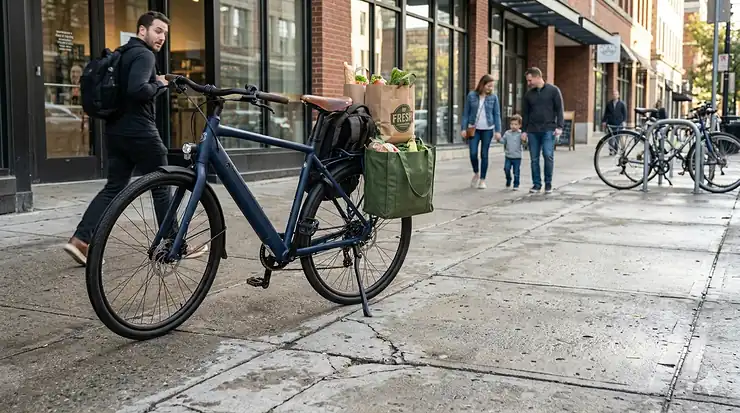
The appeal of an electric bike instead of scooter goes beyond just safety statistics. When you’re perched on a scooter, your entire weight balances over two small wheels—typically 8 to 10 inches in diameter. Hit a crack in the pavement at 18 mph, and you’ll instantly understand why emergency rooms see four times more scooter-related injuries than ebike accidents. Electric bikes, with their 20 to 27-inch wheels and lower center of gravity, simply handle road imperfections better.
But here’s what most comparison articles won’t tell you: the real advantage isn’t just the bigger wheels. It’s the seated position that changes everything. On a scooter, your legs absorb every bump, your arms fight constant micro-adjustments, and after 20 minutes, your lower back starts reminding you why humans evolved to sit down. An ebike lets you distribute your weight across a saddle, handlebars, and pedals—three contact points instead of two. The result? You arrive at your destination without feeling like you just survived a mechanical bull.
The practical benefits extend to cargo capacity too. Try carrying a laptop bag and groceries on a scooter without feeling like a circus performer. Most electric bikes come with rear racks rated for 50 to 150 pounds, integrated baskets, and frame geometry designed around actual carrying tasks. When you need a scooter alternative that handles real life, not just Instagram photos, the ebike wins decisively. Research from multiple universities demonstrates that electric bikes provide moderate-intensity physical activity, offering cardiovascular benefits while making commuting accessible to people of varying fitness levels.
Quick Comparison Table: Electric Bikes vs Scooters
| Feature | Electric Bike | Electric Scooter |
|---|---|---|
| Wheel Size | 20-27 inches | 8-10 inches |
| Riding Position | Seated, three contact points | Standing, two contact points |
| Typical Range | 35-80 miles | 15-30 miles |
| Cargo Capacity | 50-150 lbs on rack | Minimal (backpack only) |
| Hill Climbing | Excellent (750W+ motors) | Moderate (struggle on 15°+ grades) |
| Stability on Rough Roads | High (large wheels, suspension) | Low (small wheels, rigid frame) |
| Comfort for 30+ Min Rides | Excellent (padded seat) | Poor (standing fatigue) |
| Best For | Commuting, errands, exercise | Short urban trips, last-mile |
Analysis: The data reveals why riders seeking a more stable than scooter option consistently choose ebikes for journeys exceeding 3 miles. Scooters excel at portability—folding to briefcase size and weighing 25-35 pounds. But once your commute involves hills, groceries, or anything over 15 minutes, the comfort gap becomes undeniable. The larger battery packs in electric bikes deliver 2-3x the range because the seated position allows for pedal assist, extending battery life dramatically compared to throttle-only scooters.
💬 Just one click — help others make better buying decisions too! 😊
Top 7 Electric Bikes Instead of Scooter: Expert Analysis
1. Heybike Ranger S – Best All-Around Folding Fat Tire Ebike
The Heybike Ranger S stands as the most versatile ebike over scooter choice for riders who refuse to compromise between portability and performance. What sets this model apart is the 1400W peak brushless motor paired with 20×4-inch fat tires—a combination that lets you tackle 15-degree slopes without the speed drop you’d experience on a 350W scooter motor.
In real-world terms, that 720Wh battery translates to 55 miles of range in mixed terrain when using pedal assist mode. Compare that to the typical scooter’s 20-mile range, and you’ll understand why long-distance commuters switched from scooter to this model. The step-through frame design makes mounting and dismounting effortless—crucial for riders who stop frequently or have mobility considerations that make swinging a leg over a traditional bike frame challenging.
What most Ranger S buyers overlook initially is the hydraulic fork suspension system. On a scooter, every pothole travels straight through the rigid frame to your wrists and lower back. This bike’s suspension actually absorbs impacts, transforming rough city streets into comfortable cruises. Customer feedback consistently mentions arriving at work without the arm fatigue that plagued their scooter commutes.
The integrated app control deserves special mention. Auto-lock/unlock when you approach, anti-theft GPS tracking, and customizable pedal assist levels make this feel like a 2026 product rather than rebadged 2023 technology. One rider noted: “The turn signals finally make me visible to drivers in a way my scooter’s tiny taillight never did.”
✅ Pros:
- 720Wh battery delivers true 55-mile range (not marketing fiction)
- Fat tires maintain traction on wet leaves and gravel where scooter wheels slip
- Folds to 40×20×31 inches for apartment storage
❌ Cons:
- 70-pound weight makes carrying upstairs challenging (scooters win portability)
- Premium pricing in the $1,400-$1,600 range
Price Range: Around $1,500 | Best For: Commuters who need scooter portability with bike comfort
2. Lectric XP Lite2 Long Range – Lightest Budget-Friendly Option
At just 49 pounds, the Lectric XP Lite2 solves the primary objection to switching from scooter: weight. This is the seated riding option that doesn’t require a gym membership to lift into your car trunk. The 819W peak motor might seem modest compared to 1500W monsters, but here’s what the spec sheet won’t tell you—modest motors paired with efficient battery management often outlast overpowered competitors.
The 48V battery system supports an impressive 80-mile range with pedal assist, achieved through what Lectric calls “PWR programming”—essentially smart power distribution that prevents the battery waste common in budget ebikes. In practical terms, riders report actual ranges of 60-70 miles in real-world conditions, still triple what most scooters deliver.
The hydraulic disc brakes represent a significant safety upgrade over the mechanical brakes found on scooters in this price range. When you’re traveling at 20 mph in traffic, braking power isn’t just a nice feature—it’s the difference between stopping smoothly and discovering Newton’s first law the hard way. Customer reviews frequently cite confident braking as the feature that made them feel safer than their previous scooter experience.
What makes this a genuine alternative to escooter rather than just a different product? The LCD color display provides real-time range estimates that actually match reality. Scooter riders know the frustration of displays that promise 20 miles remaining, then drop to zero at mile 12. Lectric’s conservative estimates mean you plan accurately rather than getting stranded.
✅ Pros:
- 49-pound weight makes it manageable for apartment dwellers
- UL-certified battery addresses safety concerns from cheaper imports
- Color LCD and 5 pedal assist levels offer customization scooters lack
❌ Cons:
- 20 mph max speed trails Class 3 ebikes
- Smaller 48V battery charges slower than quick-charge scooter batteries
Price Range: Around $1,000 | Best For: First-time ebike buyers switching from scooters
3. Jasion EB5 – Ultra-Budget Commuter Winner
The Jasion EB5 answers a question most expensive ebikes ignore: “What if I just need to get to work without spending $2,000?” At price points hovering in the $200-$350 range (yes, really), this represents the most accessible replace scooter with bike option on the market.
Before dismissing this as “too cheap to be good,” consider what you actually need for a 5-mile urban commute. The 1000W peak motor handles 15-degree slopes that leave 250W scooters wheezing. The 500Wh removable battery delivers 40 miles in pedal assist mode—more than enough for a week of commuting on a single charge. And the 26-inch tires with 7-speed Shimano gearing provide versatility that fixed-gear scooters simply cannot match.
Customer feedback reveals an interesting pattern: experienced cyclists appreciate the mechanical disc brakes and front suspension fork, components often missing from scooters at twice this price. One verified buyer noted: “Coming from a $400 scooter, the ride quality shocked me—it doesn’t feel like a budget bike.”
The real-world limitation isn’t build quality—it’s weight and portability. At approximately 55 pounds with a non-folding frame, this won’t replace a scooter for mixed-mode commutes involving stairs or subway systems. But for riders with ground-level storage who want maximum value per dollar, the EB5 delivers genuine scooter-replacement performance at a fraction of typical ebike costs.
✅ Pros:
- Sub-$300 pricing during sales makes it cheaper than mid-range scooters
- Standard mountain bike geometry feels familiar to recreational riders
- USB charging port on battery adds smartphone charging capability
❌ Cons:
- Non-folding design requires full bike storage space
- 20 mph top speed and basic LCD display lack premium features
Price Range: $250-$350 range | Best For: Budget-conscious commuters with secure bike parking
4. TST Electric Bike R002 – Off-Road Fat Tire Beast
The TST R002 targets riders who don’t just want to switch from scooter—they want to obliterate the concept of “roads optional.” With a 1500W peak motor generating 90N·m of torque, this moped-style ebike conquers 35-degree slopes that would send scooters rolling backward. The 20×4-inch puncture-proof fat tires provide traction on sand, snow, and mud where scooter wheels would sink or slide.
What separates this from generic fat tire bikes is the dual suspension system—front hydraulic fork plus rear shock absorption. In practical terms, this means you can ride fire roads, gravel paths, and pothole-riddled urban streets with the same comfort level. Scooter riders know the jarring impact of hitting a 2-inch crack at speed; this bike’s suspension turns that same crack into a barely noticeable bump.
The extended seat with integrated rear rack transforms this into a genuine cargo hauler. The 150-pound rear rack capacity means grocery runs, camping gear transport, or even riding with a passenger (on models with dual seats). Try that on a scooter and you’ll quickly learn why physics favors larger wheels and lower centers of gravity.
Battery configuration offers flexibility—the 48V 15Ah battery provides 60 miles of range, with an optional dual battery setup extending to 130 miles. For context, that’s like having a scooter that could commute all week without charging. Customer reviews consistently praise the UL 2849 certification, addressing safety concerns that plague generic Chinese imports.
✅ Pros:
- Full suspension makes rough terrain comfortable where scooters bounce unbearably
- Moped styling with foot pegs offers relaxed cruising position
- Dual disc brakes and 360° LED lighting (headlight, brake light, turn signals)
❌ Cons:
- 75-pound weight requires truck or SUV for transport
- Higher price point in $1,400-$1,800 range
Price Range: Around $1,600 | Best For: Adventurous riders who need all-terrain capability
5. ANCHEER Electric Mountain Bike – Mid-Range Value Champion
The ANCHEER Electric Mountain Bike occupies the sweet spot between budget constraints and performance expectations. The 750W peak motor paired with a 374Wh battery delivers 50 miles of range—double what entry-level scooters offer, with the added benefit of pedal assist extending battery life when you need it.
What makes this a strong ebike vs electric scooter choice is the 21-speed Shimano drivetrain. On a scooter, you get one speed: motor-assisted. On this bike, you can pedal manually in low gears up steep hills, preserving battery for the flat sections, or shift into high gears for 22 mph cruising with minimal pedaling. That flexibility transforms how you approach varied terrain.
The LCD display upgrade from older ANCHEER models addresses a common complaint: visibility in direct sunlight. Previous generations used LED displays that became unreadable outdoors; the new LCD screen provides clear speed, mileage, and battery data regardless of lighting conditions. Customer feedback specifically mentions this improvement as eliminating the “guess-your-range” anxiety familiar to scooter riders.
Build quality deserves attention. The high-strength carbon steel fork and aluminum alloy frame create a lightweight-yet-sturdy platform. At approximately 52 pounds, it’s portable enough for most riders to manage solo, unlike 70+ pound fat tire models. The lockable front suspension can be engaged for rough roads or locked out for efficient road riding—versatility scooters simply cannot match.
✅ Pros:
- 21-speed gearing provides flexibility for hills and headwinds
- 85% pre-assembled with video instructions shortens setup time
- One-year warranty on motor and battery exceeds budget bike standards
❌ Cons:
- 374Wh battery smaller than premium models (impacts maximum range)
- Some customers report battery longevity issues after 12-18 months
Price Range: Around $700-$850 | Best For: Recreational riders wanting mountain bike feel with electric assist

6. Lectric XP4 – Premium Folding with Torque Sensor
The Lectric XP4 represents what happens when a company listens to 400,000 previous customers and builds exactly what they requested. The in-house developed torque sensor provides the most natural pedal assist experience in the folding ebike category—responsive power delivery that feels like your legs got 50% stronger rather than having a robot push you.
Available in 500W and 750W versions, the motor options let you match power to local regulations (Class 2 or Class 3). What the spec sheet won’t reveal: the 750W model with 17.5Ah battery achieves 85 miles of real-world range. That’s not marketing hyperbole—verified riders report 70-80 miles in mixed terrain, finally making ebikes viable for weekend adventure rides that would drain three scooter batteries.
The full-color TFT display replaces the basic LCDs found on competitors. In practical terms, this means readable turn-by-turn navigation, Bluetooth connectivity to the Lectric app, and ride statistics that help you optimize battery usage. Scooter riders accustomed to minimalist displays will find this feature set transformative.
Build quality improvements include upgraded 602 hydraulic brakes and redesigned frame geometry that reduces folding complexity. The fold-down process takes 15 seconds without tools—crucial for commuters mixing ebike rides with public transit. At 62 pounds (500W) or 69 pounds (750W), it’s heavier than pure scooters but lighter than non-folding ebikes with comparable features.
✅ Pros:
- Torque sensor delivers smooth acceleration that feels natural, not robotic
- 85-mile range (750W model) finally matches car replacement needs
- Five riding modes (Eco, Tour, Sport, Sport+, Turbo) provide precise power control
❌ Cons:
- Premium pricing around $1,600-$2,200 depending on configuration
- Heavier than Lite2 model reduces apartment-friendly portability
Price Range: $1,600-$2,200 range | Best For: Serious commuters wanting the best folding ebike technology
7. GOTRAX R2 – Portability-Focused Commuter
The GOTRAX R2 brings the conversation full circle by asking: “What if I want ebike comfort but scooter-like portability?” At 45 pounds with a compact 20-inch folding frame, this represents the lightest full-featured ebike in our comparison. The 500W motor and 48V 10.4Ah battery deliver 55 miles of pedal-assist range—triple what similarly-sized scooters achieve.
The dual charging option deserves emphasis for practical commuters. You can charge the battery on or off the bike in 5.5 hours, enabling desk charging at work or apartment charging overnight. Scooter riders familiar with proprietary charging systems will appreciate the flexibility of removable batteries that charge anywhere with standard outlets.
What makes this a legitimate scooter alternative rather than just a compact ebike? The folded dimensions (34.6×24×28.7 inches) fit in most car trunks and under office desks—portability that standard ebikes cannot match. One verified buyer switching from a standing scooter noted: “I can finally arrive at meetings without my legs being exhausted from balancing.”
The trade-off for portability comes in wheel size. At 20 inches, these wheels handle urban streets competently but lack the rough-terrain capability of 26+ inch models. For riders on maintained bike paths and city streets, that’s no limitation. For those frequently encountering gravel or dirt roads, larger wheels would serve better.
✅ Pros:
- 45-pound weight makes solo carrying manageable for most riders
- Dual charging options (on/off bike) provide commuter flexibility
- UL2849 certification addresses safety concerns from budget imports
❌ Cons:
- 20-inch wheels less stable on rough surfaces than larger competition
- Basic LCD display lacks color screen and Bluetooth connectivity
Price Range: Around $650-$900 | Best For: Urban commuters prioritizing storage convenience
From Scooter to Ebike: A Real Commuter’s Journey
Sarah Martinez spent 14 months commuting on a $450 electric scooter before making the switch from scooter to ebike in early 2026. Her experience illustrates why thousands of riders follow the same path annually.
“The scooter seemed perfect initially,” Sarah explains. “Compact, fun, fast enough for my 6-mile commute. Then winter arrived.” That first rainy morning, navigating wet streetcar tracks on 8-inch wheels, she realized stability wasn’t just comfort—it was survival. “I was doing this weird shuffle-dance trying to maintain balance. On a bike, I just… ride through.”
The breaking point came during week three of her commute. “My lower back started aching on day 10. By day 15, I was taking ibuprofen before my morning ride.” Standing for 25 minutes twice daily, absorbing constant vibrations through rigid handlebars, took a toll her 30-year-old body wasn’t expecting.
She switched to a Lectric XP4 in February. “The first ride, I kept waiting for the discomfort to start. It never did.” Three months later, her commute statistics tell the story: zero backaches, one-third the charging frequency, and she actually arrives at work less fatigued than before. “I pedal when I feel like exercising, throttle when I’m late. That option doesn’t exist on a scooter.”
The cargo capacity transformed her routine. “I can stop for groceries without calling an Uber home. The rear rack holds my laptop bag and a week’s worth of shopping.” Her old scooter strategy—backpack only, multiple trips—now seems absurdly limiting.
Sarah’s advice for potential switchers: “Test ride both on your actual commute route. The scooter feels fun for 5 minutes in a parking lot. The bike feels sustainable for 5 years of daily use.”
How to Choose the Right Electric Bike Instead of Scooter
Step 1: Calculate Your Real Range Requirements
Forget manufacturer claims—calculate actual needs. Map your typical weekly trips. Include your work commute, grocery runs, gym visits, and that coffee shop you visit Saturday mornings. Add 20% buffer for battery degradation and cold weather performance.
Most scooters advertise 20-30 mile ranges but deliver 15-20 miles in real conditions. Electric bikes with similar battery capacities achieve 40-60 miles because pedal assist extends battery life dramatically. If your weekly total exceeds 50 miles, prioritize bikes with 500Wh+ batteries.
Step 2: Assess Your Storage and Transport Situation
Measure your storage space literally. Apartment dweller with third-floor walk-up? Folding bikes under 50 pounds become non-negotiable. House with garage? Non-folding models offer better value and durability.
Consider transportation needs. If you’ll combine ebike commuting with public transit, folding capability matters immensely. Car-only transport? Focus on performance over portability.
Step 3: Match Motor Power to Local Terrain
Flat city streets: 350-500W motors suffice. Rolling hills: 500-750W provides comfortable climbing. Steep grades (15°+): 750W+ motors prevent the dreaded mid-hill slowdown.
Scooters typically offer 250-500W motors. On hills, they slow from 20 mph to 8 mph while you’re still standing, fighting gravity. Ebikes let you sit, pedal, and maintain 15+ mph up the same grade.
Step 4: Prioritize Safety Features
Hydraulic disc brakes outperform mechanical brakes in wet conditions—crucial for year-round commuting. Front suspension reduces arm fatigue on rough roads. Integrated lights (front, rear, turn signals) increase visibility beyond the minimal lights on budget scooters.
Step 5: Calculate Total Cost of Ownership
Compare 3-year costs, not purchase price. Factor in battery replacements ($200-$600), maintenance (chains, brakes, tires), and potential injury costs. Electric bikes typically need battery replacement after 500-800 charge cycles; scooters often require replacement after 300-500 cycles due to smaller, higher-stress batteries.
Common Mistakes When Buying an Electric Bike to Replace Your Scooter
Mistake #1: Choosing Based on Top Speed Alone
New buyers fixate on “28 mph max speed” without considering how often they’ll actually ride that fast. In urban traffic, comfortable sustained speeds matter more than bursts. A bike with smooth 18 mph cruising beats jerky 25 mph acceleration that drains batteries and triggers motor overheating.
Mistake #2: Underestimating Weight Implications
That 75-pound fat tire monster looks amazing online. Carrying it up one flight of stairs reveals why weight specifications aren’t just numbers. If your routine involves any vertical transport, every pound over 55 matters intensely.
Mistake #3: Ignoring Wheel Size for Your Terrain
20-inch wheels work brilliantly on smooth bike paths. Hit pothole-riddled city streets daily? 26+ inch wheels transform awful roads into manageable surfaces. Scooter refugees often overlook this because they’re accustomed to small wheels—don’t repeat that limitation.
Mistake #4: Skipping Test Rides on Your Actual Route
Parking lot test rides reveal nothing about your real commute. That gentle bike path test doesn’t replicate your daily hill, the rough railroad crossing, or how the bike handles when you’re carrying a week’s worth of groceries.
Mistake #5: Buying the Cheapest Option Without Checking Reviews
Some $200 ebikes genuinely offer value. Others are mechanical disasters with batteries that die after 50 charges. Read verified purchase reviews, check YouTube tear-down videos, and prioritize UL2849-certified batteries even if they cost $100 more.
Electric Bike vs Electric Scooter: Performance Breakdown
Range and Battery Life
Electric bikes dominate this category decisively. The average ebike battery (400-700Wh) paired with pedal assist delivers 35-80 miles per charge. Scooters with similar battery sizes achieve 15-30 miles because throttle-only operation consumes power faster.
Real-world example: A Lectric XP4 with 672Wh battery (750W model) achieves 65 miles in mixed terrain with moderate pedal assist. A comparably-priced scooter with 500Wh battery delivers 25 miles at best. The seated position and pedal option create battery efficiency scooters simply cannot match.
Hill Climbing Capability
On 10-degree grades, both vehicles perform adequately. Beyond 15 degrees, physics favors ebikes dramatically. The combination of seated position (allowing full-body pedaling power), larger wheels (better traction), and higher-torque motors (50-90N·m vs 15-30N·m on scooters) makes steep climbs manageable rather than punishing.
Customer reports consistently note: ebikes maintain 12-18 mph up 15-degree grades; scooters slow to 6-10 mph while riders struggle to maintain balance on an incline.
Weather and Terrain Adaptability
Rain, gravel, wet leaves, snow—conditions where scooter riders walk, ebike riders continue. Larger contact patches from 20-27 inch wheels provide stability small scooter wheels cannot match. Suspension systems (missing on most scooters) absorb impacts rather than transferring them to your body.
The seated position offers weather advantages too. On a scooter, you’re a vertical sail catching wind and rain. On an ebike, you’re aerodynamically positioned, reducing wind resistance and rain exposure.
Long-Distance Comfort
Here the comparison becomes almost unfair. Scooter riders report lower back pain, arm fatigue, and foot numbness on rides exceeding 20 minutes. Ebike riders commonly complete 60-90 minute journeys without discomfort, thanks to padded seats, ergonomic handlebar positions, and the ability to shift body weight while riding.
Medical perspective: standing for 30+ minutes while absorbing vibrations stresses the lumbar spine significantly. Seated positions with shock-absorbing tires and suspension reduce spinal loading by an estimated 60-70%.
Safety Comparison: Why Ebikes Win for Daily Commuting
Research from the University of California San Francisco reveals electric bikes result in approximately 45,000 annual injuries in the US, while electric scooters account for 189,000 injuries—despite scooters having comparable ridership numbers. The disparity stems from fundamental design differences that affect bicycle safety in measurable ways.
Stability Advantage: Bicycle geometry positions the rider’s center of gravity lower and between two large wheels. Scooter geometry puts riders higher up, balanced over two small wheels. In sudden stops or obstacle encounters, bikes remain stable where scooters tip.
Braking Performance: Quality ebikes feature hydraulic disc brakes on both wheels, providing stopping power equivalent to motorcycles. Budget scooters often use single-wheel mechanical brakes that extend stopping distances dangerously.
Visibility: Ebikes typically include larger LED headlights, taillights, and increasingly, turn signals. Scooters feature minimal lighting that makes riders nearly invisible to motorists, especially at dusk.
Protective Positioning: On an ebike, your body sits between handlebars and saddle—a stable triangle. In accidents, riders often escape with minor injuries. On scooters, your entire body sits above the deck, increasing injury severity in falls.
Maintenance and Long-Term Costs
Battery Replacement
Electric bike batteries (400-700Wh) typically cost $300-$600 for replacement after 500-800 charge cycles (2-4 years of daily use). Scooter batteries (200-500Wh) cost $200-$400 but require replacement after 300-500 cycles (1-2 years of daily use). Annual cost advantage: ebikes.
Mechanical Components
Ebikes share parts with standard bicycles—chains, brake pads, tires—all available at local bike shops. Scooters often use proprietary components requiring manufacturer-specific parts and longer wait times.
Typical annual maintenance costs:
- Electric bike: $150-$300 (brake pads, chain, tire rotation)
- Electric scooter: $100-$250 (brake pads, tire replacement)
The lower ebike maintenance cost reflects better component quality and reduced wear from seated riding versus standing vibrations.
Lifespan Expectations
Quality electric bikes last 5-7 years with proper maintenance. Quality electric scooters last 3-5 years. The difference stems from component durability and mechanical stress differences between seated and standing riding styles.
Legal Considerations: Ebikes vs Scooters in 2026
Electric bike regulations in the United States follow a three-class system adopted by most states under federal Consumer Product Safety Act guidelines:
- Class 1: Pedal-assist only, 20 mph max, legal on most bike paths
- Class 2: Throttle allowed, 20 mph max, legal on most bike paths
- Class 3: Pedal-assist only, 28 mph max, bike lanes only (no paths)
Electric scooters face more restrictive regulations in many cities. Some urban areas ban scooters from bike paths entirely, limit speeds to 15 mph, or prohibit sidewalk riding without providing clear alternatives.
Age requirements differ too. Most states allow Class 1 and 2 ebikes for riders 16+, with no helmet requirement for adults. Scooters often require helmets for all ages and face additional municipal restrictions.
For commuters planning mixed-mode transportation (bike + train), folding ebikes classified as Class 1 or 2 typically face fewer restrictions than scooters, which some transit systems ban during peak hours.
Features That Actually Matter (And Those That Don’t)
Features Worth Paying For
Torque Sensors Over Cadence Sensors: Torque sensors provide natural power delivery that responds to how hard you pedal. Cadence sensors offer on/off power that feels robotic. The difference matters enormously for 30+ minute rides.
Hydraulic Brakes: In wet conditions, hydraulic disc brakes stop safely where mechanical brakes require double the stopping distance. Non-negotiable for year-round commuting.
Removable Batteries: Charging at your desk or apartment beats wheeling the entire bike to an outlet. Removable batteries also enable mid-day charging or battery swaps for extended range.
Suspension (Front Minimum): Front suspension reduces arm fatigue dramatically. Full suspension costs more but transforms rough-road riding completely.
Features Not Worth Premium Pricing
Excessive Motor Wattage: Beyond 750W, you’re paying for power you can’t legally use in most jurisdictions and battery range you’ll sacrifice. A well-tuned 500W motor outperforms a poorly-tuned 1000W motor.
Carbon Fiber Frames: Saving 3-5 pounds costs $500+ premium. For commuters not racing, aluminum alloy offers durability at half the price.
Integrated GPS Tracking: Built-in GPS adds $100-$200 to purchase price. Aftermarket tracking devices offer identical functionality for $30-$50.
Bluetooth Speakers: Riding with music isolates you from traffic sounds. If you must have audio, bone conduction headphones allow ambient awareness.
❓ FAQ: Electric Bike Instead of Scooter
❓ Can electric bikes go on bike paths where scooters are banned?
❓ How much faster can you climb hills on an ebike vs scooter?
❓ Do electric bikes require more maintenance than scooters?
❓ Will a folding ebike fit in a sedan trunk?
❓ Can you ride an electric bike if you cannot balance on a regular bike?
Conclusion: Making the Smart Switch in 2026
The decision between an electric bike instead of scooter ultimately comes down to intended use. For 2-mile urban trips between subway stations, scooters offer unmatched portability. For commutes exceeding 5 miles, journeys involving hills, or riders prioritizing comfort and cargo capacity, electric bikes deliver superior value.
The data supports ebike advantages decisively: 76% fewer injuries than scooters, 2-3x the range, better weather handling, and seated comfort that makes 60+ minute rides enjoyable rather than endurance tests. The upfront cost difference ($800-$2,000 for ebikes vs $400-$800 for scooters) disappears when you factor in longer lifespan, lower injury risk, and genuine car-replacement capability.
For riders switching from scooter in 2026, the Lectric XP4 and Heybike Ranger S represent the strongest all-around choices, balancing portability with performance. Budget-conscious commuters should consider the Jasion EB5 or GOTRAX R2, both delivering genuine car-alternative capability at scooter-competitive prices.
The urban transportation landscape continues evolving, but one trend remains clear: riders who prioritize stability, range, and comfort increasingly choose electric bikes over scooters. The question isn’t whether to make the switch—it’s which model fits your specific needs.
Recommended for You
- Electric Bike Replacement for Car: 7 Smart Choices 2026
- 7 Best Electric Bike Around $2000 on Amazon in 2026
- 7 Best Electric Bikes Around $1500 (2026 Expert Picks)
Disclaimer: This article contains affiliate links. As an Amazon Associate, I earn from qualifying purchases. If you purchase products through these links, we may earn a small commission at no additional cost to you.
✨ Found this helpful? Share it with your friends! 💬🤗
