
In This Article
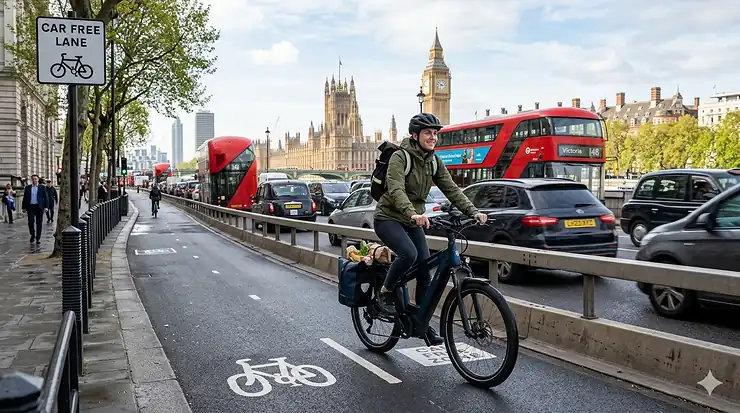
The morning commute doesn’t have to involve traffic jams and $4-per-gallon gas. What most people don’t realize is that switching to an electric bike replacement for car trips can save the average household around $8,500 annually when factoring in fuel, insurance, parking, and maintenance costs. According to research from the University of British Columbia, households that adopted ebikes reduced their car use by 20% within the first year, with many eventually ditching their second vehicle entirely.
This shift makes practical sense when you consider that nearly 60% of car trips in the United States cover distances under 6 miles—a perfect range for modern electric bikes. Today’s ebikes aren’t the underpowered novelties from a decade ago. With motors delivering 750W or more, batteries providing 40-60 mile ranges, and features like cargo capacity up to 400 pounds, these machines genuinely function as automobile replacement vehicles for daily driver ebike needs. The 2026 models we’re examining represent the sweet spot where affordability meets car-substitute bike capability, making car-free commuting not just possible but genuinely enjoyable.
Quick Comparison: Top Electric Bike Replacement for Car Models
| Model | Motor Power | Range | Price Range | Best For |
|---|---|---|---|---|
| Lectric XP 3.0 | 500W (1000W peak) | 40-45 miles | Around $1,000 | Budget-conscious commuters |
| Aventon Level 2 | 500W | Up to 60 miles | $1,500-$2,000 | Torque sensor enthusiasts |
| RadRunner Plus | 750W | 45-55 miles | $1,700-$2,000 | Cargo haulers |
| Heybike Ranger S | 750W (1400W peak) | 40-55 miles | $1,200-$1,500 | All-terrain versatility |
| Jasion EB7 2.0 | 500W (1200W peak) | 22-45 miles | $600-$900 | Compact folding solution |
| Ancheer Rover L | 750W (1200W peak) | 40-60 miles | $900-$1,300 | Fat tire adventures |
| Schwinn Coston DX | 250W | 35-45 miles | $1,200-$2,000 | Traditional brand reliability |
Looking at this data, the market clearly segments into three tiers. Budget buyers gravitating toward the Jasion EB7 2.0 sacrifice some range but gain portability—critical for apartment dwellers or mixed-mode commuters who need subway compatibility. Mid-range options like the Heybike Ranger S deliver the best power-to-price ratio for those tackling hilly terrain daily. Premium picks such as the Aventon Level 2 justify their cost through refined torque sensors that make the riding experience feel more bicycle than moped, extending the comfortable pedaling range before fatigue sets in.
💬 Just one click — help others make better buying decisions too!😊
Top 7 Electric Bike Replacement for Car Options: Expert Analysis
1. Lectric XP 3.0 – The Budget Champion That Punches Above Its Weight
The Lectric XP 3.0 represents perhaps the most significant value proposition in the entire ebike market right now. This folding fat-tire electric bike has sold over 400,000 units since launch, making Lectric the brand behind one in five ebikes sold in the United States. What makes this achievement remarkable isn’t just the sales numbers—it’s that they’ve maintained a sub-$1,000 price point while upgrading to hydraulic disc brakes, a feature typically reserved for bikes costing twice as much.
Under the compact 20-inch fat tire design sits a 500W rear hub motor (1000W peak) that handles 15-degree inclines without the speed drop you’d experience on lower-powered alternatives. The 48V 499Wh battery delivers 40-45 miles in mixed conditions, which translates to a full week of 8-mile roundtrip commutes before you need to plug in. For car alternative electric bike purposes, the folding mechanism (though admittedly stiff on early models) means you can toss it in a trunk for multi-modal trips or tuck it under your desk rather than worrying about outdoor theft.
Customer feedback consistently praises the Lectric XP 3.0’s punch-above-its-weight performance. One verified buyer logged 2,000 miles over three years before needing any maintenance beyond brake pad replacement, while others note the surprisingly comfortable ride quality despite the smaller wheel diameter. The main criticism centers on assembly—some buyers found the instruction manual unclear, particularly around the folding mechanism.
Pros:
✅ Exceptional value at around $1,000
✅ Hydraulic disc brakes (rare in this price class)
✅ Proven reliability with massive user base
Cons:
❌ Folding mechanism can be stiff initially
❌ 20-inch wheels feel less stable above 20 mph
For anyone exploring electric bike replacement for car trips on a tight budget, the Lectric XP 3.0 eliminates the usual compromises between price and performance. Expect to find this in the $999-$1,305 range depending on package options.

2. Aventon Level 2 – The Torque Sensor Difference Matters More Than You Think
When Aventon launched the original Level 2 in 2022, they disrupted the market by being the first sub-$2,000 commuter with a torque sensor as standard equipment. That distinction matters more than most buyers realize. While cadence sensors simply detect pedaling (giving you full motor power whether you’re barely turning the cranks or pushing hard), torque sensors measure actual pedal pressure and modulate assistance proportionally. This creates a riding experience that feels like a supercharged version of your own legs rather than a moped with pedals attached.
The Level 2 backs this refined experience with practical car-substitute bike features: integrated 720Wh battery (higher capacity than competitors), front suspension fork, four integrated lights, pre-installed fenders, and a rear rack. The 500W rear hub motor delivers assistance up to 28 mph in Class 3 mode, making it legally rideable on most bike paths while still keeping pace with urban traffic flow. Real-world testing by multiple outlets confirmed 45-60 mile ranges depending on assist level, with one Irish reviewer logging 1,850 miles over eight months while using it as his primary “leave the car at home” tool for school runs and grocery trips.
The torque sensor’s advantage becomes clearest on longer rides. Because it rewards harder pedaling with proportional assistance rather than delivering constant full power, riders report less fatigue and more natural handling through corners and traffic. Customer reviews specifically call out the Level 2’s confidence-inspiring stability and the way the motor “disappears” into the background rather than making its presence constantly felt.
Pros:
✅ Torque sensor delivers bicycle-like natural feel
✅ 60-mile range handles even extended commutes
✅ Fully equipped with lights, fenders, rack out of box
Cons:
❌ Heavier than budget alternatives at 62 lbs
❌ Discontinued in favor of Level 3, stock limited
Aventon Level 2 pricing has fluctuated between $1,499-$1,899, with some flash sales dropping to $999. If you find one at that price point, grab it—that’s the best value in the commuter category right now.
3. RadRunner Plus – When You Need to Replace a Car’s Cargo Capacity
Most electric bikes ask you to choose between passenger capability and cargo hauling. The RadRunner Plus refuses that compromise. With a 350-pound total payload capacity (275 lb rider + 75 lb cargo), this utility bike handles the grocery runs, hardware store trips, and kid transport that typically require a car trunk. Add the optional passenger package (seat pad and footpegs) and suddenly you’ve got a car alternative electric bike that works for two-person errands around town.
The RadRunner Plus builds on Rad Power’s reputation for rugged utility bikes with some smart upgrades. The 750W geared hub motor (65Nm torque) provides strong acceleration from stops even when fully loaded—critical when you’re merging into traffic with a week’s worth of groceries on the rear rack. The 48V 14Ah battery (672Wh) delivers a realistic 45-55 miles depending on load and terrain, though expect that to drop by 20-30% when carrying a passenger or heavy cargo. The compact 20-inch wheel format keeps the cargo deck low to the ground for easier loading stability.
Real-world buyers consistently praise the RadRunner’s “just works” reliability. Multiple long-term reviews from delivery riders and cargo haulers report 5,000+ miles with minimal maintenance beyond chain lubrication and brake adjustments. The hydraulic disc brakes (a recent upgrade from mechanical) provide confident stopping power even when fully loaded, something cheaper cargo bikes struggle with.
Pros:
✅ 350 lb payload capacity handles serious cargo
✅ Optional passenger kit makes it family-friendly
✅ Proven reliability from established brand
Cons:
❌ Heavy at 73 lbs makes lifting into storage challenging
❌ Smaller 20-inch wheels less efficient on longer trips
For families considering ditching a second car or delivery drivers seeking daily driver ebike reliability, the RadRunner Plus delivers in the $1,700-$2,000 range. It’s not the cheapest option, but it’s the one most likely to actually replace car trips rather than supplement them.
4. Heybike Ranger S – The All-Terrain Vehicle Alternative Hidden in Plain Sight
The Heybike Ranger S takes the popular folding format and pumps it full of steroids. That 750W motor (1400W peak) isn’t marketing fluff—it translates to genuine 28 mph capability and the ability to conquer 25-30 degree slopes that would stall lesser bikes. Combined with 20″ x 4″ fat tires and dual suspension (80mm front fork + rear seat suspension), this becomes one of the few folding bikes that genuinely handles as both urban commuter and weekend trail explorer.
What separates the Ranger S from budget competitors is the attention to safety features that matter for automobile replacement duties. Hydraulic disc brakes provide fade-resistant stopping power in all conditions. The smart light system automatically activates in low-light conditions, while integrated turn signals (controlled via handlebar buttons) clearly communicate your intentions to drivers—features you’d expect on a motorcycle, not a sub-$1,500 ebike. The horn button placement suggests Heybike understands this bike will be navigating traffic, not just bike paths.
The 48V 14.4Ah battery (691Wh) supports a claimed 40-55 mile range, with real-world testing confirming 35-45 miles in mixed conditions with moderate throttle use. The step-through frame design makes it accessible for riders who’d struggle with traditional high-top-tube bikes, while the folding mechanism allows apartment storage or trunk transport for trail access. Customer feedback particularly praises the Ranger S for its composed handling when loaded—the low center of gravity from the fat tires makes fully-loaded grocery runs feel stable rather than sketchy.
Pros:
✅ 1400W peak power tackles steep terrain easily
✅ Turn signals and auto-lighting enhance safety
✅ Folding design doesn’t sacrifice ride quality
Cons:
❌ Folded size larger than compact folders like Jasion
❌ Fat tires increase rolling resistance on pavement
For riders splitting time between urban car-free commuting and weekend adventures, the Heybike Ranger S delivers remarkable versatility in the $1,200-$1,500 range. It’s the bike that convinces skeptics that electric bike replacement for car transportation doesn’t mean giving up weekend fun.
5. Jasion EB7 2.0 – Proof That Compact Can Still Mean Capable
Don’t let the sub-$900 price fool you. The Jasion EB7 2.0 has moved over 100,000 units because it solved a problem other budget bikes ignored: genuine portability without sacrificing all performance. At 59 pounds with a folded size of 36″x21″x29″, this actually fits in a car trunk, on a subway, or behind your office door—something most “folding” ebikes only pretend to do.
The EB7 2.0 packs a surprising amount of capability into that compact package. The 500W motor (1200W peak) provides enough grunt to handle moderate hills, while the dual suspension system (80mm front fork + rear seat shock) smooths out road imperfections that smaller wheels typically amplify. The 48V 10Ah battery (480Wh) delivers a realistic 25-35 miles in mixed riding, which covers most daily commutes with margin to spare. What you’re trading for this compact format is top speed—it maxes at 20 mph rather than 28, making it a Class 2 rather than Class 3 bike.
Where the Jasion EB7 2.0 excels is as a last-mile solution for mixed-mode commuters. If your replace car with ebike strategy involves train or bus portions, this is the bike that won’t get you kicked off public transit for being too bulky. The low 17-inch step-over height makes it genuinely accessible for seniors, shorter riders, and anyone intimidated by traditional bike mounting. Long-term owners report solid reliability, with most maintenance involving basic brake adjustments rather than motor or battery issues.
Pros:
✅ Actually portable at 59 lbs and compact fold
✅ Dual suspension smooths rough pavement
✅ Ultra-low step-over height improves accessibility
Cons:
❌ 20 mph top speed feels slow on open roads
❌ Mechanical disc brakes less refined than hydraulics
For urban apartment dwellers exploring vehicle alternative options on a tight budget, the Jasion EB7 2.0 delivers genuine car-replacement capability in the $600-$900 range. It’s the bike you can actually take with you rather than worrying about theft.
6. Ancheer Rover L – Fat Tire Power Without the Premium Price
The Ancheer Rover L occupies an interesting niche: it delivers fat-tire all-terrain capability and serious power at a price point that undercuts most competitors by 30-40%. The 750W motor (1200W peak) paired with 26″ x 4″ fat tires creates a platform that genuinely handles sand, snow, gravel, and urban streets with equal confidence. The step-through frame design makes it accessible, while the 48V 15Ah battery (720Wh) provides a realistic 40-50 mile range in mixed conditions.
What you need to understand about Ancheer bikes is the trade-off they’re making. To hit aggressive price points (typically $900-$1,300), they use direct-from-manufacturer distribution and specify components that meet functional requirements without brand-name premiums. The Shimano 7-speed drivetrain works reliably. The 180mm dual disc brakes provide adequate stopping power. The frame construction feels solid under load. None of it screams “premium,” but all of it works for the intended purpose of daily driver ebike duty.
Real-world buyer feedback splits into two camps. Riders who perform basic assembly and maintenance themselves love the value proposition—they’re getting 80% of the performance of $2,000 bikes for 40% of the cost. Less mechanically-inclined buyers sometimes struggle with out-of-box setup and adjustment, as Ancheer’s assembly instructions lean toward minimalist. Independent shops report the bikes use standard parts, making service straightforward.
Pros:
✅ 750W motor with 1200W peak handles terrain
✅ 26″ x 4″ fat tires excel in varied conditions
✅ 720Wh battery competes with premium models
Cons:
❌ Assembly requires mechanical confidence
❌ Component quality trades premium feel for value
For DIY-comfortable riders seeking automobile replacement capability on a budget, the Ancheer Rover L delivers legitimate all-terrain performance in the $900-$1,300 range. It’s not boutique, but it gets the job done.
7. Schwinn Coston DX – When Brand Heritage Matters to Your Decision
The Schwinn Coston DX represents what happens when a 130-year-old bicycle brand takes electric bike replacement for car transportation seriously. Unlike newer direct-to-consumer competitors, Schwinn benefits from an established dealer network for assembly and service—something first-time ebike buyers often undervalue until they need it. The Coston DX comes in traditional step-over and step-through formats, with integrated downtube battery featuring LED light strips that enhance visibility from the sides.
The 250W geared hub motor might seem underpowered compared to 750W competitors, but Schwinn tuned this system for efficiency over raw speed. It comfortably maintains 20 mph with pedal assist while delivering up to 45 miles from the 360Wh battery—not class-leading, but adequate for most commutes. The bike comes fully equipped with aluminum fenders, rear rack, front and rear lights, and a 7-speed Shimano drivetrain. Mechanical disc brakes provide reliable stopping, though they require more frequent adjustment than hydraulic systems.
Where Schwinn differentiates itself is in the complete package. Buyers at Dick’s Sporting Goods or local bike shops often get complimentary assembly and a first-year service checkup included in the purchase price. For less mechanically-inclined riders or those who value local support over the lowest price, this ecosystem matters. Customer reviews consistently mention the confidence that comes from buying a known brand with local service options.
Pros:
✅ Established dealer network for service/support
✅ Fully equipped commuter package out of box
✅ Integrated battery with side LED visibility
Cons:
❌ 250W motor struggles on steeper climbs
❌ 360Wh battery falls short of competitors
For buyers prioritizing brand familiarity and local service access over maximum specifications, the Schwinn Coston DX provides peace of mind in the $1,200-$2,000 range. It’s the conservative choice that won’t leave you stranded without support.
Real-World Scenario: Matching Your Lifestyle to the Right Car Alternative Electric Bike
The Urban Apartment Commuter (3-8 miles each way): You need something that climbs four flights of stairs or fits in a cramped storage closet. The Jasion EB7 2.0 or Lectric XP 3.0 solve this with genuine compact folding. Choose Jasion if you’ll mix with public transit regularly; choose Lectric if your route includes significant hills and you want more power.
The Suburban Family Replacing a Second Car (5-15 miles daily): You’re hauling kids, groceries, and weekend gear. The RadRunner Plus with passenger package handles school drop-offs and Costco runs that actually justify keeping a car. Its 350 lb capacity means you stop making compromises about what you can transport.
The All-Weather Commuter (10-20 miles with hills): You need reliability through snow, rain, and steep terrain without breaking the bank. The Heybike Ranger S combines fat tires for traction, powerful motor for climbs, and weatherproof construction for year-round daily driver ebike duty. The turn signals and auto-lighting make you visible to drivers who aren’t expecting bikes in bad weather.
The Corporate Commuter Seeking Refinement (8-15 miles): You want the ebike experience to feel premium, not utilitarian. The Aventon Level 2 with its torque sensor and integrated design delivers a riding experience that won’t embarrass you rolling up to the office. The longer 60-mile range means you’re never calculating whether you have enough juice to make it home.
How to Choose the Right Electric Bike Replacement for Car Needs
Calculate Your Realistic Daily Mileage. Most people overestimate this. Track your car’s trip computer for a week—you’ll likely find your daily driving averages 10-15 miles total, not the 30+ you imagined. Any ebike with 40+ mile range covers this with comfortable margin, even accounting for battery degradation over time. The exception is if you’re planning to replace car with ebike for occasional longer trips; in that case, prioritize 50+ mile ranges or bikes with removable batteries for mid-ride swaps.
Match Motor Power to Your Terrain, Not Your Ego. That 1400W peak rating sounds impressive until you realize most riding happens at 250-350W continuous output. What matters more is torque rating and gearing. A 500W motor with 60Nm torque and proper gearing out-climbs a poorly-tuned 750W motor with 55Nm. If your commute includes sustained grades above 10%, prioritize motors rated 750W continuous or higher. For flat terrain, 500W suffices.
Cargo Capacity Determines True Car Replacement Viability. Can you carry a week’s groceries? Transport a bag of dog food? Handle a Home Depot run for light bulbs and cleaning supplies? Most standard ebikes top out around 275 lb total weight (rider + cargo), which restricts you to backpack loads. If you need genuine car-substitute bike capability, look for 300+ lb ratings and sturdy rear racks rated for 50+ pounds.
Consider the Assembly and Service Reality. Direct-to-consumer bikes save 20-30% on retail markup but arrive 85-95% assembled, requiring mechanical confidence for brake adjustment, derailleur tuning, and torque specifications. First-time ebike buyers often underestimate this complexity. If you lack bike maintenance experience, factor in $100-150 for shop assembly and setup, or choose brands like Schwinn with dealer networks. The cheapest bike isn’t cheap if you pay a shop $200 to make it rideable.
Test Ride If Possible, But Know Most Can’t. Direct-to-consumer dominance means most sales happen online without test rides. Prioritize brands with generous return policies (30+ days) and read multiple reviews focusing on comfort complaints. Frame geometry varies dramatically—what feels perfect to a 5’10” rider might be cramped for someone 6’2″. Step-through designs generally accommodate a wider height range, making them safer choices for multi-rider households exploring vehicle alternative options.
Common Mistakes When Buying an Electric Bike Replacement for Car
Prioritizing Top Speed Over Real-World Range. That 28 mph Class 3 capability sounds appealing until you realize running full throttle drains the battery in 15-20 miles. Most riders settle into 16-20 mph cruise speeds that balance efficiency with keeping up with traffic. The bike that advertises 28 mph top speed but only delivers 30 miles of range at that speed is less useful than the one that does 20 mph for 50 miles. For car-free commuting, consistency beats occasional bursts of speed.
Ignoring the Weight of “Portable” Bikes. Marketing loves the word “portable,” but physics doesn’t negotiate. A 65 lb folding ebike is portable in the same way a suitcase full of bowling balls is portable—technically possible, practically exhausting. If your replace car with ebike strategy involves stairs, consider how often you’ll actually face those 65 lbs. Third-floor walkup apartments make even the lightest ebikes a workout. Ground-floor storage or elevator access changes this equation entirely.
Buying for the Rider You Want to Be, Not the Rider You Are. Be honest: will you really take this on 50-mile weekend adventures, or are you using that to justify buying the expensive model when a budget option would handle your actual 5-mile commute perfectly? The most common regret among ebike buyers isn’t that they bought too little bike—it’s that they bought features they never use. Start with adequate, upgrade later if needed. You’re replacing a car, not joining the Tour de France.
Underestimating Theft Risk and Security Costs. That $1,500 ebike parked at the train station becomes a $0 ebike when someone with bolt cutters has 30 seconds of privacy. Budget $100-150 for a proper U-lock or chain system, and add “securable indoor storage at destination” to your vehicle alternative planning. Some employers offer bike lockers; many don’t. Knowing this before buying saves the painful experience of choosing between paranoia and loss.
Forgetting That Batteries Are Consumables. After 500-800 charge cycles (typically 2-3 years of daily use), battery capacity drops to 70-80% of original. Replacement batteries cost $400-600 for name brands, $200-300 for budget models—IF they’re still available. Companies go out of business. Models get discontinued. That smoking deal on a 2022 model might become expensive if the battery dies in 2026 with no replacements available. Major brands like Rad Power, Lectric, and Aventon have track records of supporting older models; newer names are gambling.
Long-Term Cost Analysis: Electric Bike Replacement for Car Savings
Let’s walk through actual numbers because this decision isn’t just about reducing carbon footprints—it’s about keeping more money in your checking account. The average American car costs $10,728 annually according to AAA’s 2025 data (includes depreciation, fuel, insurance, maintenance, registration). An ebike’s annual operating cost runs $150-300 depending on electricity rates and how much you ride.
Year One Break-Even Math: Buy a $1,500 mid-range ebike. Add $150 for a solid lock, $100 for rain gear, and $50 for a rear rack and panniers. Total upfront: $1,800. If this replaces 60% of your car trips (a realistic target based on University of British Columbia research showing 20% reduction even among dual-car households), you’re driving 40% less. At $400 monthly car costs, that’s $160 monthly savings, or $1,920 annually. You break even in month 11.
Year Two Reality: Your car doesn’t disappear, but driving 60% less means oil changes every 10 months instead of every 5, tires lasting 4+ years instead of 2-3, and brake pads going 80,000 miles instead of 40,000. Insurance companies offer low-mileage discounts; State Farm cuts premiums 20% for under 7,500 annual miles. Between reduced maintenance and lower insurance, year two saves roughly $2,400 while you’ve spent maybe $100 on ebike maintenance (chain, brake pads, tune-up).
Year Three and Beyond: This is where car-free commuting pays dividends. That 2019 Honda you’ve been driving might now have 45,000 miles instead of 75,000, extending its useful life by 2-3 years before major repairs or replacement. The ebike battery needs replacement (budget $400), but you’re still net positive $2,000+ annually. Over a five-year period, replacing 60% of car trips with an ebike saves the average household $11,000-13,000 even accounting for battery replacement.
The Second Car Elimination Scenario: This is the holy grail of automobile replacement. If your household can genuinely ditch car #2 entirely, you cut $10,000+ annual costs while keeping the ebike’s $200-300 operating expenses. Even expensive $3,000+ ebikes pay for themselves within 4 months in this scenario. Multiple reader testimonials report families that bought two cargo ebikes for $3,500 combined, sold their second car for $8,000, and pocketed $4,500 while maintaining mobility. The challenge isn’t financial—it’s psychological comfort with car-free living.

Safety Regulations and Legal Considerations for Daily Driver Ebike Use
Understanding what’s legal where matters more than most new riders realize. Federal law classifies ebikes into three categories, but states and municipalities overlay their own restrictions. Class 1 (pedal-assist only, 20 mph max) is legal on most bike paths and trails. Class 2 (throttle-capable, 20 mph max) faces more restrictions, with some trails banning throttle use. Class 3 (pedal-assist to 28 mph) is often prohibited from multi-use paths, limiting you to roads and designated bike lanes.
California, New York, and Colorado have comprehensive statewide frameworks. Texas and Florida leave it to cities, creating a patchwork where what’s legal in Austin might be prohibited in Dallas. Before buying, verify local regulations—that 28 mph Heybike Ranger S loses much of its appeal if your city restricts Class 3 bikes from your preferred routes. Some regions require registration, insurance, or helmets for Class 3 bikes; others treat all ebikes identically.
The practical safety consideration most people ignore is visibility and assertiveness in traffic. Ebikes accelerate faster than traditional bikes but slower than cars, creating a mismatch in traffic flow. That gap between car following distance expectations and ebike acceleration capability causes close calls. Integrated lights, turn signals (like on the Heybike Ranger S), and high-visibility clothing aren’t optional extras—they’re essential safety equipment for automobile replacement use. Studies from the European Cyclists’ Federation show ebike accident rates correlate strongly with visibility, not speed.
Features That Actually Matter (And Those That Don’t) for Car Substitute Bikes
Critical Features Worth Paying For: Hydraulic disc brakes make emergency stops shorter and more predictable—worth $200-300 premium over mechanical systems when you’re navigating car traffic daily. Torque sensors (like the Aventon Level 2) transform longer rides from exhausting to enjoyable—worth $300-400 premium for commutes over 10 miles. Integrated lighting systems keep you visible without remembering to charge separate lights—worth $100 premium for safety.
Useful But Not Essential: Front suspension smooths rough pavement but adds weight and complexity. Unless your route includes serious potholes or gravel, save the $150-200 and buy better tires instead. Rear racks from the factory cost $50-100 in parts and labor if you add them aftermarket, making factory-equipped bikes like the Schwinn Coston DX attractive if you need cargo capacity. But if you’re never hauling more than a backpack, it’s wasted money.
Marketing Gimmicks That Don’t Justify Premium Pricing: “Peak” wattage ratings (those “1400W peak” claims) measure brief bursts during acceleration, not sustained power. A 750W continuous motor with 1200W peak performs nearly identically to an 800W continuous motor with 1400W peak—the continuous rating matters. Smartphone app connectivity sounds slick until you realize you’re checking battery level and trip distance via the handlebar display anyway. Carbon fiber components on sub-$2,000 bikes are typically low-grade carbon that’s heavier and less durable than equivalent aluminum—pure aesthetics, zero functional benefit.
The Overlooked Essential: Test the bike loaded with cargo or a passenger before committing to car-free commuting. Most reviews test unloaded performance, but that extra 40 lbs of groceries or a child passenger transforms handling, braking distance, and battery consumption. If the bike feels sketchy at capacity, it’s not a genuine vehicle alternative regardless of specs on paper.
FAQ: Electric Bike Replacement for Car Questions Answered
❓ How much does it cost to charge an electric bike vs filling a car's gas tank?
❓ Can electric bikes handle steep hills that would require a car?
❓ What happens to electric bike range in cold weather vs summer?
❓ Are electric bikes safe to ride in rain and snow like a car would be?
❓ How long do electric bike batteries last before replacement is needed?
The Bottom Line: Making Electric Bike Replacement for Car Work for You
The data doesn’t lie: electric bikes can reduce car use by up to 19% in households with both vehicles, with many families eventually eliminating their second car entirely. Research published in ScienceDirect from a study in Shanghai confirms that e-bikes can lead to a 19% reduction in car mode share in dual-mode ownership households compared to car-only households. These aren’t fringe environmentalists or extreme fitness enthusiasts—these are regular families who discovered that modern ebikes genuinely work as automobile replacement vehicles for daily errands, commuting, and local transportation.
The seven models examined here span every realistic budget and use case. The Lectric XP 3.0 proves you don’t need $2,000 to join the car-free commuting movement. The Aventon Level 2 demonstrates that premium feel doesn’t require premium pricing. The RadRunner Plus shows how cargo capacity makes daily driver ebike functionality legitimate. Each fills a specific niche; the question isn’t “which is best” but rather “which matches my actual needs and budget.”
The most successful electric bike replacement for car transitions share common elements: realistic expectations about weather limitations, commitment to finding secure storage at destinations, and honest assessment of which trips truly require a car versus which are habit. You’re not abandoning automobiles entirely—you’re deploying them strategically for the 20-30% of trips where they’re genuinely necessary while using a more efficient tool for everything else. That shift saves thousands annually, reduces parking stress, improves fitness, and often makes the commute more enjoyable than sitting in traffic.
Start with one car trip category—maybe the morning coffee run or the afternoon school pickup. Prove to yourself that vehicle alternative transportation works for that specific use case. Success breeds confidence to expand. Within three months, most riders report surprise at how many trips they’ve shifted without feeling deprived. That’s when electric bike replacement for car stops feeling like a sacrifice and starts feeling like the obvious choice you should have made years ago.
Recommended for You
- 7 Best Electric Bike Around $2000 on Amazon in 2026
- 7 Best Electric Bikes Around $1500 (2026 Expert Picks)
- 7 Best Electric Bike Under $5000 in 2026 | Premium Performance
Disclaimer: This article contains affiliate links. As an Amazon Associate, I earn from qualifying purchases. If you purchase products through these links, we may earn a small commission at no additional cost to you.
✨ Found this helpful? Share it with your friends! 💬🤗
