
In This Article
There’s a particular kind of grin that shows up the first time you sit down, twist a throttle, and glide off without pedaling a single crank. That’s the appeal of a moped style electric scooter in one sentence — it borrows the seated, laid-back posture of a classic Vespa and swaps the gas tank for a battery pack. No clutch, no oil changes, no trip to the gas station on a Tuesday night. Just a seat, a throttle, and a design language that looks like it rolled out of 1962 with a modern electric drivetrain hiding underneath.
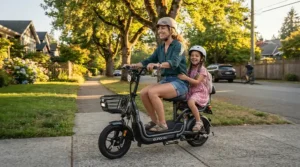
What is a moped style electric scooter? It’s a battery-powered, throttle-controlled personal vehicle built with a bench or bucket seat, moped-inspired bodywork, and step-through access — distinct from stand-up kick scooters and from pedal-assist e-bikes. Most fall into a gray zone of local regulation somewhere between a bicycle and a low-speed motorcycle, which is exactly why picking the right one matters.
This guide breaks down seven real, currently available models spanning bargain-bin pricing to genuine flagship territory, with honest analysis of what each one actually delivers versus what the spec sheet promises. We’ll compare an electric moped scooter against its gas-powered ancestor, dig into what storage compartment capacity really buys you day-to-day, and explain why moped-style handling feels so different from a stand-up scooter the first time you lean into a turn. Whether you’re shopping for a first commuter or hunting for a genuine electric scooter that looks like a moped and rides like one too, there’s a build here that fits your budget and your street.
Quick Comparison Table
| Model | Price Range | Top Speed | Range | Best For |
|---|---|---|---|---|
| GoTrax A5 | Under $400 | ~15.5 mph | ~16 miles | First-time buyers on a tight budget |
| GlareWheel EB-C1 | $600-$700 range | ~20 mph | ~20-25 miles | Retro looks without a big price tag |
| isinwheel H7 | $650-$750 range | ~20 mph | ~40+ miles | Long commutes without premium pricing |
| X-Treme Cabo Cruiser Elite | $1,300-$1,500 range | ~12 mph | ~20-25 miles | Two-up cruising and neighborhood errands |
| EMOVE RoadRunner V3 | $1,600-$1,900 range | ~34-36 mph | ~32-40 miles | Riders who want motorcycle-level thrill |
| JackRabbit XG Pro | $2,200-$2,300 range | ~20-24 mph | ~48 miles | Apartment dwellers needing a foldable footprint |
| EMOVE RoadRunner Pro V2 | $3,500-$3,700 range | Up to 60 mph | ~55-75 miles | Buyers who want the fastest, longest-range option |
Looking at this spread, the price gap between the GoTrax A5 and the EMOVE RoadRunner Pro V2 is enormous — over $3,000 — and that gap maps almost perfectly onto motor output and battery capacity. Riders chasing pure commuting range and speed should scan the middle of the table, where the isinwheel H7 and EMOVE RoadRunner V3 deliver a disproportionate amount of performance for the money, while the top and bottom rows serve very specific use cases (short errands versus genuine highway-adjacent thrill-seeking).
Bookmark this table now — you’ll want to compare it against the deep-dive sections below before you commit.
Top 7 Moped Style Electric Scooters: Expert Analysis
1. GoTrax A5 — cheapest real seated scooter setup
The GoTrax A5 exists to answer one question: how little can you spend and still get a genuine sit-down ride? Its 400W motor (peaking around 550W) tops out near 15.5 mph with roughly 16 miles of range, numbers that put it firmly in neighborhood-cruiser territory rather than highway-adjacent commuting.
That output pairs with 12-inch pneumatic tires and dual suspension, which matters more than the motor number does — cheap seated scooters often skimp on cushioning, and this one doesn’t feel punishing over cracked sidewalks. Based on the spec comparison against other sub-$400 models, the A5 earns its price by nailing the basics rather than chasing a headline top speed.
What most buyers overlook about this class of scooter is that the included rear basket and handlebar hook aren’t afterthoughts — they turn a toy-adjacent scooter into something you’d actually run errands on. Reviewers consistently report that the padded seat and 20-minute assembly are the standout wins, while the multi-hour charge time is the most common gripe. This is the right pick for a teenager’s first ride, a dorm-to-campus commuter, or anyone testing whether the seated format suits them before spending real money.
Pros:
- ✅ Lowest price point of any seated model on this list
- ✅ Comfortable padded seat with dual suspension
- ✅ Simple 20-minute assembly out of the box
Cons:
- ❌ Limited 16-mile range caps longer commutes
- ❌ Charges slowly compared to pricier models
At around $300-$380, the GoTrax A5 is the easiest entry point into moped-style riding, and for short, flat routes it’s genuinely good value.
2. GlareWheel EB-C1 — vintage look on a budget frame
The GlareWheel EB-C1 leans hardest into the “looks like a moped” side of this category, with rounded bodywork, a fender-mounted headlight, and a bench seat that visually reads far closer to a classic Italian scooter than most of its budget competitors. Based on the spec comparison, its output sits a notch above entry-level stand-up scooters, and the styling does real work here — this is the model to point to if a friend asks what a moped style scooter for adults actually looks like on the street.
What the spec sheet won’t tell you, but user reports suggest, is that the retro paneling adds a bit of wind resistance and weight versus a bare-bones commuter scooter, a fair trade for anyone shopping on aesthetics as much as range. It’s built around a step-through frame, so getting on and off in regular clothes — skirts, work slacks, whatever — is far easier than swinging a leg over a bicycle-style seat. This is a strong fit for someone who wants a head-turning ride for short trips and doesn’t need triple-digit mileage.
Pros:
- ✅ Genuine retro moped styling, not just a seat bolted on
- ✅ Step-through frame simplifies mounting and dismounting
- ✅ Integrated fender headlight improves nighttime visibility
Cons:
- ❌ Heavier than stripped-down commuter scooters in its price class
- ❌ Range trails behind less style-focused competitors
Priced in the $600-$700 range, the EB-C1 is the pick for riders who care as much about turning heads as clocking miles.
3. isinwheel H7 — big-scooter feel without the big-scooter bill
The isinwheel H7 is where this category starts to feel serious. Its motor is rated at 1,000W (with a Pro variant pushing higher), enough to hit roughly 20 mph while carrying a claimed 43-mile range — a genuinely long leash for a scooter priced well under $800. Based on the spec comparison, that range figure is the single biggest reason this model punches above its price: most sub-$800 seated scooters top out at half that distance.
The H7 backs its numbers with hydraulic front suspension, dual disc brakes, and 12-inch off-road-capable tires, hardware you’d normally expect on something twice the price. Reviewers consistently note that the ride feels substantial — some describe it as feeling closer to a lightweight motorcycle than a typical commuter scooter — while a common complaint in user reviews is that the sheer size and roughly 111-pound curb weight make it awkward to carry up stairs or squeeze into a small trunk. This is the scooter for someone commuting 8-15 miles daily who wants real range without spending flagship money.
Pros:
- ✅ Long claimed range near 43 miles on a single charge
- ✅ Hydraulic suspension and disc brakes at a mid-range price
- ✅ Solid 330-pound weight capacity for larger riders
Cons:
- ❌ Heavy at roughly 111 pounds — not easy to lift or store
- ❌ Bulkier footprint than compact commuter scooters
In the $650-$750 range, the isinwheel H7 is the value pick for anyone whose daily route is longer than a quick errand.
4. X-Treme Cabo Cruiser Elite — two-seat retro cruiser with real storage
If the phrase “electric moped scooter” conjures an image of a rounded, chrome-accented cruiser with a passenger seat, the X-Treme Cabo Cruiser Elite is exactly that picture. Its 48V battery pack (four 12V cells) drives a rear hub motor to roughly 12 mph with a 20-25 mile range — modest numbers, but that’s not really the point of this machine.
Based on the spec comparison, the Cabo Cruiser trades outright speed for size, comfort, and genuine two-rider capacity, something almost nothing else on this list offers. What most buyers overlook about this model is the storage: it ships with a large under-seat compartment plus a separate rear trunk, giving it real cargo room rather than a token basket.
Its 16-inch wheels on a roughly 300-pound frame make it feel planted at low speed, and the oversized bench seat is genuinely built for two adults rather than a driver-plus-backpack setup. This is squarely a neighborhood cruiser — think beachside communities, gated retirement neighborhoods, and college towns with low speed limits — not a highway-adjacent commuter.
Pros:
- ✅ True two-passenger seating with oversized bench
- ✅ Large under-seat compartment plus separate rear trunk
- ✅ Classic retro citycoco-style bodywork and chrome details
Cons:
- ❌ Low 12 mph top speed limits it to slow zones
- ❌ Heavy build makes it impractical to carry or store indoors
At $1,300-$1,500, the Cabo Cruiser Elite is the pick for slow-speed, two-up cruising rather than daily point-A-to-B commuting.
5. EMOVE RoadRunner V3 — scooter-bike hybrid with motorcycle nerve
The EMOVE RoadRunner V3 is arguably the model that defined this category’s premium tier. Dual 500W hub motors (one front, one rear) push it to a tested top speed north of 34 mph, and independent testing has recorded acceleration from zero to 30 mph in roughly 14 seconds — genuinely quick for anything without a motorcycle license requirement.
Based on the spec comparison, the V3’s 1,124Wh removable battery is the standout upgrade over its predecessor, delivering a real-world range that testers have clocked between roughly 33 and 40 miles depending on riding style. What the spec sheet won’t tell you, but reviewers note, is how smooth the power delivery feels; testers have described it as deceptively fast because the dual-motor setup and full suspension mask how quickly it’s actually moving.
It also ships with optional pedals, which won’t turn it into a real e-bike but do offer a legal fallback gesture in areas with ambiguous classification rules. Reliability testing has flagged the lack of an official IP water-resistance rating as its most notable weak spot.
Pros:
- ✅ Genuinely quick, tested acceleration and a 34+ mph top speed
- ✅ Removable 1,124Wh battery simplifies charging and swaps
- ✅ Full front-and-rear suspension smooths rough pavement
Cons:
- ❌ No official IP water-resistance rating
- ❌ Heavier and pricier than commuter-class alternatives
At $1,600-$1,900, the RoadRunner V3 is the sweet spot for riders who want a genuinely thrilling ride without stepping into flagship pricing.
6. JackRabbit XG Pro — featherweight moped that folds into a trunk
The JackRabbit XG Pro takes the opposite approach from everything else on this list: instead of maximizing power-per-dollar, it maximizes portability. At roughly 37 pounds with a 749W motor, dual 360Wh RangeBuster batteries, and a claimed 48-plus mile range from the swappable pack setup, it folds down to about 51 inches long and 7 inches wide — small enough to slide into a car trunk, a boat locker, or a closet that a 100-pound scooter simply won’t fit into.
Based on the spec comparison, its 20 mph standard top speed (up to 24 mph in off-road mode) is modest next to the RoadRunner V3, but that’s the trade-off for a build this light. What most buyers overlook about the XG Pro is that its high-rise, rotatable handlebars and BMX-inspired geometry make it feel more like riding a compact motorcycle than a typical scooter, which is exactly the moped-style handling feel some riders are chasing.
Reviewers note it isn’t built for long touring rides — the short wheelbase trades stability for maneuverability — but for last-mile transit connections or weekend errands, that trade-off rarely matters.
Pros:
- ✅ Remarkably light at roughly 37 pounds for a seated ride
- ✅ Folds compact enough for car trunks and small apartments
- ✅ Dual swappable batteries extend real-world range
Cons:
- ❌ Premium pricing relative to its power output
- ❌ Short wheelbase feels twitchy on longer, faster rides
At $2,200-$2,300, the XG Pro justifies its price for buyers who genuinely need portability more than raw performance.
7. EMOVE RoadRunner Pro V2 — flagship power for those who want it all
At the top of this list sits the EMOVE RoadRunner Pro V2, a machine that reviewers describe less as a scooter and more as “a seated scooter with an e-moto’s heart.” Dual motors deliver a combined 4,000W nominal (8.4kW peak) output, a 72V battery pack scaling up to 4,320Wh, and a claimed 60 mph top speed with 55-75 mile range depending on conditions.
Based on the spec comparison, this isn’t a subtle step up from the V3 — it’s a different class of machine, built around a 3mm double-reinforced tubular frame and true DOT-rated hydraulic brakes on 203mm rotors, hardware that belongs on a small motorcycle rather than a typical scooter.
What most buyers overlook about a machine at this power level is licensing and local classification; a 60 mph seated electric vehicle frequently falls outside standard e-scooter regulations, so checking your state’s rules before riding is not optional. Owner reviews highlight the pothole-absorbing wheel size and thrill factor, with a common wish being front turn signals and an audible turn-signal click, both minor gripes against an otherwise flagship-grade build.
Pros:
- ✅ Class-leading 60 mph top speed and 8.4kW peak power
- ✅ True DOT hydraulic brakes for genuine stopping power
- ✅ Massive 55-75 mile range on the largest battery option
Cons:
- ❌ Premium price puts it out of reach for casual buyers
- ❌ Speed and classification may exceed local e-scooter rules
At $3,500-$3,700, the RoadRunner Pro V2 is the pick for riders who’ve outgrown everything else on this list and want the fastest, longest-range option available.
Practical Usage Guide: Getting the Most From Your First Weeks
Bringing home a moped style electric scooter is only step one — how you treat it in the first month sets the tone for years of reliable riding. Start with tire pressure: pneumatic tires lose a few PSI over time even without a puncture, and underinflated tires quietly eat into both range and handling precision, especially on models with moped-style handling geometry like the JackRabbit XG Pro. Check pressure weekly for the first month until you know your scooter’s baseline.
Charging habits matter more than most new owners realize. Unplug the charger once the battery reaches full rather than leaving it topped off overnight — most lithium packs degrade faster from prolonged full-charge storage than from regular use. If your model has a removable battery, like the EMOVE RoadRunner V3, bring the battery indoors to charge in a climate-controlled space rather than leaving the whole scooter out in extreme heat or cold.
A common first-30-days mistake is ignoring the drivetrain hardware — bolts on hub motors and suspension linkages settle after the first dozen rides, so a quick torque check after week one catches loosening before it becomes a rattle or a safety issue. Finally, learn your throttle’s low-speed response in an empty parking lot before hitting traffic; every model on this list handles differently at walking speed, and that’s the range where most new-rider mishaps happen.

Real-World Scenarios: Matching the Right Scooter to Your Life
The Campus Commuter: A student living a mile and a half from class, on a tight budget, riding mostly on flat sidewalks and bike lanes — this is the GoTrax A5’s exact use case. Its modest 16-mile range covers several round trips before a recharge, and its low price tolerates the inevitable dorm-hallway scuffs.
The Suburban Daily Rider: Someone commuting 10-12 miles each way to a job with secure parking wants range and comfort over raw speed. Here, the isinwheel H7’s near-43-mile claimed range and suspended ride make far more sense than a flashier, shorter-range option — and its price still lands well under $800.
The Weekend Thrill-Seeker With a Small Apartment: A rider who wants genuine speed and excitement but lives in a third-floor walk-up needs something that folds. The JackRabbit XG Pro’s 37-pound folding frame solves the storage problem, while the EMOVE RoadRunner V3 solves the thrill problem if elevator access makes weight less of an issue.
How to Choose a Moped Style Electric Scooter
- Match top speed to your local classification. Many states cap “low-speed” personal vehicles at 20 mph before requiring registration or a license — check before buying anything approaching the RoadRunner Pro V2’s 60 mph ceiling.
- Prioritize range over headline motor wattage. A 1,000W motor with a small battery can still leave you stranded; the isinwheel H7’s large battery matters more day-to-day than its motor number alone.
- Weigh portability against power honestly. If you’re carrying the scooter up stairs regularly, the JackRabbit XG Pro’s 37 pounds beats the isinwheel H7’s 111 pounds regardless of range specs.
- Test the seat and riding position if at all possible. Moped-style handling varies wildly between a low bench seat and a higher, motorcycle-style perch.
- Check storage compartment capacity against your actual needs. A grocery run needs different cargo space than a daily backpack commute.
- Confirm brake type matters for your terrain. Hydraulic disc brakes, like those on the isinwheel H7 and RoadRunner Pro V2, outperform drum brakes on hills and wet pavement.
- Read the warranty fine print. Battery warranties often run shorter than frame warranties — know which component actually fails first on your chosen model.
Moped Style Electric Scooter vs Traditional Gas Moped
The comparison between an electric moped scooter and its gas-powered ancestor comes down to three practical differences: running cost, maintenance, and regulation. A gas moped needs oil changes, spark plug replacement, and fuel — ongoing costs that an electric equivalent simply doesn’t have, since charging a battery costs a fraction of a gallon of gasoline per equivalent mile. On the maintenance side, traditional mopeds have historically required more frequent mechanical upkeep than a comparably built electric scooter, which typically has far fewer moving parts to fail.
Where gas mopeds still hold an edge is range and refuel speed — filling a tank takes under a minute, while even fast-charging electric models like the EMOVE RoadRunner V3 need hours for a full charge. Regulation is genuinely messier for electric models too: a 49cc gas moped usually fits a well-established legal category, while a 60 mph electric scooter like the RoadRunner Pro V2 can land in a regulatory gray zone that varies wildly by city and state. For riders prioritizing low running costs and simplicity over ultimate range, the electric side wins; for those who need to refuel in seconds and travel farther between stops, gas still has a niche.
Retro Design Aesthetics: Why Look Matters as Much as Specs
It would be easy to treat retro design aesthetics as a cosmetic afterthought, but for a meaningful share of buyers in this category, the look is the entire point of choosing an electric scooter that looks like a moped instead of a generic stand-up commuter. Rounded fenders, chrome accents, and bench seating do more than photograph well — they signal a slower, more relaxed riding style that pairs naturally with the lower top speeds most of these vehicles offer anyway. The GlareWheel EB-C1 and X-Treme Cabo Cruiser Elite both lean hard into this territory, prioritizing visual character over aggressive performance numbers.
What most buyers overlook is that retro bodywork often adds real functional benefits alongside the style: fuller fenders reduce road spray, and enclosed panels can shield the motor and wiring from grit better than an exposed commuter-scooter frame. The trade-off is weight and, occasionally, a slightly higher price for the same underlying motor and battery specs you’d find on a plainer-looking competitor — a fair exchange for anyone who genuinely wants their ride to turn heads on the way to brunch.
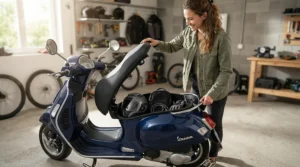
Storage Compartment Capacity: What You Actually Get
Storage compartment capacity is one of the most underrated specs in this entire category, and it varies enormously between models. A budget commuter like the GoTrax A5 offers a small rear basket rated for a modest load plus a lightweight handlebar hook — enough for a takeout order or a light bag, not much more. Step up to the X-Treme Cabo Cruiser Elite, and the picture changes completely: its large under-seat compartment plus separate rear trunk can genuinely swallow a full grocery run or a change of clothes for work.
Here’s what the spec sheet won’t tell you: under-seat storage on performance-focused models like the EMOVE RoadRunner V3 is often sacrificed for battery placement, since the removable battery pack occupies space that would otherwise hold cargo. If daily storage matters more to you than top speed, weigh that trade-off carefully — the fastest scooter on this list isn’t necessarily the most practical one for a grocery trip.
Moped-Style Handling: What to Expect on the Road
Moped-style handling differs from both a stand-up kick scooter and a traditional bicycle in a way that’s hard to appreciate until you’ve ridden one. Sitting down lowers your center of gravity, which makes low-speed balance genuinely easier than standing scooters — a real advantage for nervous first-time riders. But the wider, heavier frames on models like the isinwheel H7 or Cabo Cruiser Elite also mean tighter turns require more deliberate countersteering than a bicycle-style lean.
Compact, BMX-geometry models like the JackRabbit XG Pro sit at the opposite extreme: their short wheelbase makes them nimble enough to turn in a hallway, according to hands-on testing, but that same trait makes them feel twitchy at higher speeds compared to the more planted, motorcycle-inspired stance of the EMOVE RoadRunner V3. Reviewers consistently note that riders coming from bicycles need a short adjustment period to get comfortable with throttle-only acceleration and no pedal-brake muscle memory to fall back on.
Common Mistakes When Buying a Moped Style Scooter for Adults
The most frequent mistake buyers make is chasing top speed numbers without checking their local classification rules — a scooter capable of 34-60 mph can require registration, insurance, or a license depending on the state, turning an impulse buy into a legal headache. A close second is underestimating weight: a 100-plus-pound scooter like the isinwheel H7 is fantastic for range but genuinely difficult to carry up stairs or lift into a car trunk without a ramp.
Buyers also commonly overlook battery removability. Charging an entire 100-pound scooter because the battery is fixed in place is far less convenient than pulling a removable pack, like the one on the EMOVE RoadRunner V3, and charging it at a desk. Finally, many first-time shoppers skip test-sitting entirely — seat height, legroom, and handlebar reach vary enough between these seven models that a size that feels great for one rider can feel cramped for another.
Long-Term Cost & Maintenance
Total cost of ownership on a moped style electric scooter extends well past the sticker price. Battery replacement is the single largest future expense — a pack on a flagship model like the EMOVE RoadRunner Pro V2 costs meaningfully more to replace than the compact pack in a JackRabbit XG Pro, simply due to raw cell count. Tires are the next recurring cost: pneumatic tires on models like the isinwheel H7 need periodic replacement, especially for riders logging daily mileage on rough pavement.
Warranty length is worth comparing carefully rather than assuming longer is always better — a 3-year warranty on a Juiced Scrambler-class vehicle covers different components than a 1-year limited warranty on a budget cruiser like the X-Treme Cabo Cruiser Elite. Riders on a tight long-term budget should favor models with swappable, individually replaceable batteries, since replacing one pack out of two is cheaper than replacing a single large fixed unit.
Safety, Regulations & Compliance Guide
Battery safety deserves serious attention with any lithium-powered vehicle. The U.S. Consumer Product Safety Commission has documented a rise in injuries and fatalities tied to e-scooter and e-bike batteries, and its core guidance is straightforward: charge with the original charger only, never charge unattended overnight, and never use a modified or repurposed battery pack. That advice applies across every model on this list, from the compact GoTrax A5 to the high-capacity RoadRunner Pro V2.
Regulation is the second piece riders often skip. Local classification for a “moped-style scooter” ranges from treating it like a bicycle, to requiring a moped license, to banning higher-speed models from public roads entirely. Before buying anything near the top-speed range of the EMOVE RoadRunner V3 or Pro V2, check your state DMV’s classification rules — a scooter that’s perfectly legal on a bike path in one city can require full registration two counties over.

FAQ
❓ Are moped style electric scooters street legal?
❓ How far can an electric moped scooter travel on one charge?
❓ Do moped style scooters need a license?
❓ What's the difference between a moped style scooter and a regular e-scooter?
❓ How much storage does a moped style electric scooter typically offer?
Conclusion
Choosing among these seven models really comes down to matching your riding reality to the right trade-off. If budget is tight and your commute is short, the GoTrax A5 gets you into the seated riding experience without much financial risk. If range matters more than flash, the isinwheel H7 delivers genuinely impressive mileage for its price. Riders chasing style points should look hard at the GlareWheel EB-C1 or the two-seat X-Treme Cabo Cruiser Elite, while anyone craving real performance has a clear ladder to climb from the EMOVE RoadRunner V3 up to the flagship Pro V2. The JackRabbit XG Pro remains the outlier worth remembering if storage space, not speed, is your real constraint.
Every model here earns its spot in the moped style electric scooter category for a different reason, and none of them is objectively “best” outside the context of your specific commute, storage situation, and local regulations. Take the comparison table back to the top of this guide, match it against your daily route, and you’ll land on the right pick faster than you’d think.
Recommended for You
- Best Mobility Scooter For Outdoor Use: 7 Rugged Picks (2026)
- Electric Mobility Scooter For Seniors: 7 Best Picks For Independence In 2026
- Seated Electric Scooter For Adults: 7 Comfortable Picks (2026)
Disclaimer: This article contains affiliate links. As an Amazon Associate, I earn from qualifying purchases. If you purchase products through these links, we may earn a small commission at no additional cost to you.
✨ Found this helpful? Share it with your friends! 💬🤗
