
In This Article
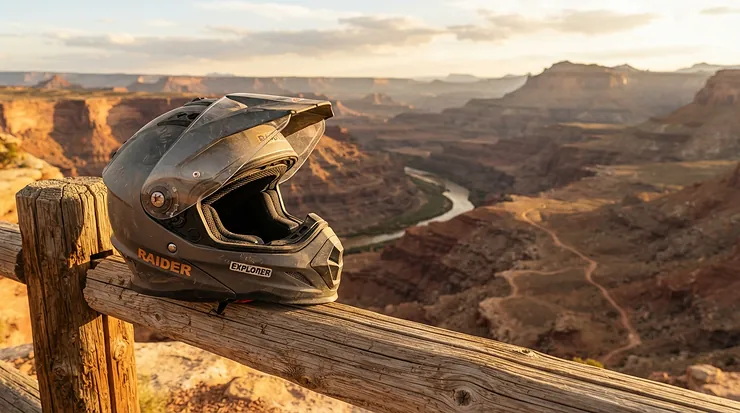
What is an adventure helmet with sun peak? It is a full-face motorcycle helmet that borrows the extended brow visor of a dirt helmet and pairs it with a street-style face shield. The peak blocks low sun and roost, the shield blocks wind, and a wide eyeport lets you swap in goggles when the trail turns dusty.
Picture this. You’re rolling west on a two-lane highway at 6 p.m., the sun is sitting exactly at windshield height, and your regular full-face helmet is no help at all. A peak fixes that the way a ball cap does, and it costs you nothing in effort. That’s the whole appeal of this category: one lid that handles pavement, gravel and the long slog between them.
The catch is that “adventure helmet” covers a lot of ground. Prices run from the low $100s to over $1,000. Some models carry rotational-impact liners, some use carbon shells, and some flip their entire chinbar upward. Rules about what a helmet must pass differ by market, and the Wikipedia overview of motorcycle helmets is a good primer on the DOT, ECE and Snell standards you’ll see on spec sheets.
I built this guide from published specs, retailer review data and independent reviewer findings, not from claims of personal testing. Every pick below gets honest analysis of what its numbers mean in practice. I’ve also covered the features buyers search for most: a dual sport helmet with flip up visor, MIPS technology, a goggle compatible eyeport, effective ventilation channels, and a lightweight adventure helmet for long rides.
Quick Comparison: Adventure Helmet With Sun Peak at a Glance
Weights are approximate and vary by size and source. Prices are ranges at the time of research and change often, so check current pricing before you buy.
| Helmet | Type | Approx. Weight | Key Protection Tech | Price Range | Best For |
|---|---|---|---|---|---|
| ILM WS902 | Fixed chinbar, dual visor | ~3.6-4 lb (listings vary) | ABS shell, DOT | Around $100-$150 | ILM WS902: first-time buyers |
| Bell MX-9 Adventure MIPS | Fixed chinbar | ~3.7 lb (medium) | MIPS, DOT/ECE | ~$190-$300 | Bell MX-9 Adventure MIPS: best value with rotational protection |
| Fly Racing Odyssey Adventure Modular | Modular flip-up | ~3.9-4.3 lb | DOT/ECE | ~$140-$290 (closeouts common) | Fly Racing Odyssey Adventure Modular: street-heavy riders |
| Scorpion EXO-AT960 | Modular flip-up | ~4.1 lb | DOT/ECE 22.06 | ~$270-$330 | Scorpion EXO-AT960: riders who stop often |
| Klim Krios Pro | Fixed chinbar, carbon | ~3.0-3.4 lb | Koroyd, DOT/ECE | ~$500-$750 | Klim Krios Pro: long-distance comfort |
| Shoei Hornet X2 | Fixed chinbar | ~3.9-4 lb | Snell M2020D, DOT | ~$700-$820 | Shoei Hornet X2: quiet highway touring |
| Arai XD-5 | Fixed chinbar | ~3.7-3.8 lb | Snell M2025, DOT | ~$900-$1,050 | Arai XD-5: premium all-rounder |
Read the table in two layers. Under about $330, you’re choosing between protection features (Bell MX-9 Adventure MIPS) and convenience features (Scorpion EXO-AT960, Fly Racing Odyssey Adventure Modular). Above $500, you’re paying for shell materials, noise control and refinement. The Klim Krios Pro wins on weight, while the Shoei Hornet X2 and Arai XD-5 win on quiet, stable highway manners.
💬 Just one click — help others make better buying decisions too!😊
Top 7 Adventure Helmet With Sun Peak Picks: Expert Analysis
1. ILM WS902 — widest budget eyeport, seven-position vents
The ILM WS902 is the cheapest way into this category, and its roomy opening makes it the easiest budget lid to pair with goggles. Specs first: an ABS shell over EPS foam, DOT certification, a dual visor setup with an internal drop-down sun shield, and seven adjustable vent positions. In practice, ABS is heavier and less refined than composite shells, so expect legal-baseline protection rather than all-day pampering. Claimed weights range from about 3.6 pounds to roughly 4 pounds depending on the source, so treat any single figure cautiously.
Based on the spec comparison, this helmet suits new riders, weekend trail users and anyone who needs a second helmet for a loaner bike. Buyer comments on retail listings tend to praise fit and airflow for the money. Common complaints are snug cheek pads and the usual budget compromises. I couldn’t verify a clean review count from one authoritative source, so read that as a general pattern, not a rating.
Pros:
- ✅ Huge eyeport that clears most goggles
- ✅ Internal sun shield plus outer shield
- ✅ Very low entry price
Cons:
- ❌ No MIPS or other rotational layer
- ❌ Heavier and louder than premium shells
Expect to pay around $100-$150, which is strong value if you accept the entry-level trade-offs.
2. Bell MX-9 Adventure MIPS — cheapest way to get a rotational liner
The Bell MX-9 Adventure MIPS is the helmet most roundups use as the value benchmark. Bell lists a medium at roughly 1,700 grams, with three shell and EPS sizes, an integrated anti-fog shield and a peak that detaches with a few thumb screws. Three shell sizes matter more than they sound. A small head isn’t forced into a bulky shell, which keeps the helmet balanced instead of top-heavy.
The honest take: it’s a dirt-first design dressed for the street. One long-term rider review, covering about three years and 30,000 km, praised its durability but flagged wind noise and weight on longer highway stretches. Another reviewer wished for a built-in drop-down sun shade. The usual caveat applies: this is a mid-weight helmet, not a featherweight. Owner comments I found are mostly positive on value and fit, with some noting it runs noisy compared with pricier lids.
For riders who want Bell MX-9 Adventure MIPS protection with a photochromic shield, the DLX version typically lands in the mid-$300s.
Pros:
- ✅ MIPS liner at a budget-friendly price
- ✅ Three shell sizes for better fit
- ✅ Easy tool-light peak removal
Cons:
- ❌ Noticeable wind noise at highway speed
- ❌ No built-in drop-down sun shade
Typical street pricing is roughly $190-$300, which makes it the best value on this list.
3. Fly Racing Odyssey Adventure Modular — two-mode design for street-heavy riding
The Fly Racing Odyssey Adventure Modular is the wild card. It’s a flip-up modular that runs in ADV mode with the peak on, or street mode with block-off plates in place. It includes a drop-down sunshield, speaker pockets and a dual D-ring strap. Rider Magazine’s reviewer called it comfortable, reasonably quiet and well ventilated, but weighed a medium with the peak at 4 pounds 5 ounces, one of the heaviest modulars they’d tested.
Here’s what the spec sheet won’t tell you, but reviewers note: the chinbar release got finicky after dust exposure, and a quick rinse cleared it. That makes this a better fit for mostly paved riding with occasional gravel than for dusty enduro days. Reviews I found were limited, so treat the sentiment as thin.
Availability is the practical caveat. Several retailers list it as closeout stock, so confirm sizes before committing.
Pros:
- ✅ Flip-up chinbar for quick stops
- ✅ Peak off for road, peak on for dirt
- ✅ Included drop-down sun shield
Cons:
- ❌ Heavy for long off-road days
- ❌ Chinbar release can stick in dust
Pricing ranges widely from about $140-$290 depending on stock, which is good value when found near the lower end.
4. Scorpion EXO-AT960 — the modular many riders start with
The Scorpion EXO-AT960 evolved from the popular AT950 and is the best-known modular in this price class. It weighs about 4.1 pounds in medium, uses a polycarbonate shell, and offers a drop-down Speedview sun visor, removable peak and Bluetooth-ready speaker pockets. WebBikeWorld’s reviewer called the weight noticeable but bearable, and specifically praised the eyeport size for goggle use.
What most buyers overlook is how much the flip-up chinbar changes daily riding. Fuel stops, trailhead chats and checking a map all get easier when you don’t have to remove your helmet. The trade-off is that moving parts add weight and a small amount of wind noise. Retailer ratings sit around 4 out of 5 across roughly 180 reviews, and one buyer comment I found said upward visibility is more limited than in their previous helmet.
Pros:
- ✅ True flip-up chinbar with 5-year warranty
- ✅ Drop-down sun visor included
- ✅ Wide eyeport accepts goggles
Cons:
- ❌ Heavy compared with fixed-chin rivals
- ❌ No MIPS or comparable rotational liner
Expect roughly $270-$330, which is fair value if the modular design matches how you ride.
5. Klim Krios Pro — carbon shell, Koroyd energy absorption
The Klim Krios Pro is the weight champion here. It combines a carbon shell with Koroyd, a straw-like structure that crushes to absorb impact and is mostly air, which also helps airflow. Retail listings give about 3.4 pounds, and one retailer Q&A cites 2.97 pounds for XS-MD sizes. The visor system includes a photochromic shield and a Fidlock magnetic strap.
Read that weight as neck insurance. Over a 400-mile day, a few ounces off your head is the difference between relaxed shoulders and a stiff neck. GearJunkie’s reviewer scored comfort at 9.5 out of 10 and said goggles fit easily when the shield is removed, though ventilation scored lower at 8 out of 10. Only two shell sizes are offered, which some fitters find limiting. Retail ratings land around 4 out of 5 across 145 reviews.
Pros:
- ✅ Among the lightest options at this level
- ✅ Koroyd layer adds airflow and absorbs impact
- ✅ Photochromic shield reduces visor swaps
Cons:
- ❌ Premium price for a non-MIPS helmet
- ❌ Only two shell sizes
Plan on about $500-$750 depending on sale and version, which is high-priced but justified for high-mileage riders.
6. Shoei Hornet X2 — quiet and well-built for highway-heavy ADV
The Shoei Hornet X2 is the “Goldilocks” pick for riders who spend more time on tarmac than trail. It uses Shoei’s AIM+ multi-fiber shell, a CNS-2 shield and a Pinlock-ready design, and weighs roughly 3.9-4 pounds. Reviews consistently place its noise control and ventilation among the best in the category, and the V-460 peak is designed to cut lift at speed.
Analysis: the weight is the compromise. User reports suggest it can cause neck fatigue off-road, and an older ADVpulse review noted the face shield can’t be closed over a goggle strap. For pavement-dominant touring, though, that matters far less than the quiet, plush interior and the glasses groove for prescription frames. RevZilla shows about 4.5 out of 5 across more than 180 reviews.
Pros:
- ✅ Quiet at speed for an ADV helmet
- ✅ Excellent airflow with multi-point venting
- ✅ Snell M2020D and DOT certification
Cons:
- ❌ Heavier than carbon rivals
- ❌ Non-adjustable peak limits versatility
Expect roughly $700-$820, which is fair value for riders who prize quiet and finish quality.
7. Arai XD-5 — premium shell, refined peak, goggle-friendly
The Arai XD-5 is the flagship. It uses a fiberglass PB-cLc2 shell designed to “glance off” impacts, four shell sizes, an easily removable peak and a tool-free shield system. Weight is about 3.7-3.8 pounds, and Rider Magazine’s reviewer found it average for the class but not fatiguing, with much less buffeting than the previous XD-4. Most goggles clear the shield in the raised position, which suits this review’s conclusion that it’s a true hybrid.
The commentary: you’re paying for fit finesse and shell engineering, not gadgets. There’s no drop-down sun visor, and it doesn’t carry MIPS. Retailers show about 4.5 out of 5 across roughly 85 reviews, and common complaints focus on weight and price.
Pros:
- ✅ Four shell sizes for precise fit
- ✅ Peak designed to reduce highway buffeting
- ✅ Snell M2025 and DOT certified
Cons:
- ❌ Very expensive
- ❌ No built-in sun visor
Pricing sits around $900-$1,050, a premium that only makes sense for riders who want Snell-level certification and long-term comfort.
✨ Don’t Miss These Exclusive Deals!
🔍 Take your adventure helmet with sun peak search to the next level with these carefully selected helmets. Click on any highlighted item to check current pricing and availability. These picks will help you build safer, quieter, more comfortable miles on every ride!
Practical Usage Guide: Setting Up Your Helmet in the First 30 Days
Buying the helmet is half the job. Start by measuring your head with a soft tape just above the eyebrows and ears, then use the largest reading against the maker’s chart. A new helmet should feel snug, with your cheeks gently compressed, and it will relax slightly with wear.
Next, set the peak. A steeper angle blocks more low sun but catches more wind, so many riders tilt it flatter for highway stretches and raise it for trail work. On the Bell MX-9 Adventure MIPS, the peak comes off with three thumb screws, and on the Arai XD-5 it uses one screw per side. If you’ll run goggles, practice strapping them around the helmet before your first dusty ride. A reviewer noted the Bell MX-9 Adventure MIPS has no stock goggle clip, so routing the strap under the base worked for them.
Finally, build a maintenance rhythm:
- Hand-wash the liner every few weeks in warm water.
- Check peak and shield screws before long trips.
- Clean the shield with a soft cloth only.
- Replace the helmet after any significant impact, and consider replacement around five years of use, a common manufacturer guideline.

Real-World Scenarios: Matching the Helmet to the Rider
Scenario 1: The weekend gravel explorer on a budget. You ride a mid-size dual sport on a few trails a month and spend under $300. The Bell MX-9 Adventure MIPS gives you rotational protection and an easy peak, while the ILM WS902 works if cost is the priority and you accept DOT-only protection.
Scenario 2: The commuter who also tours. You ride 15 miles daily, then take one big trip each summer. The Scorpion EXO-AT960 or Fly Racing Odyssey Adventure Modular lets you flip the chinbar up for quick stops and rides in street mode on weekdays. Accept the weight and wind noise as the price of convenience.
Scenario 3: The high-mileage adventure tourer. You log 400-mile days across mixed surfaces and keep a helmet for years. The Klim Krios Pro takes weight off your neck, the Shoei Hornet X2 gives you the quietest highway ride, and the Arai XD-5 adds Snell-level certification and a precise fit. Over a decade of riding, the cost per day shrinks quickly.
Problem → Solution Guide: Fixing Common Adventure Helmet Annoyances
Problem: the peak lifts and buffets at highway speed. Tilt it flatter or remove it entirely. The Arai XD-5 and Shoei Hornet X2 were both redesigned specifically to reduce this effect.
Problem: the shield fogs when you slow down. Fit a Pinlock insert if your helmet supports one (the Shoei Hornet X2 and Arai XD-5 are Pinlock-ready), and crack the shield to its first detent at stops.
Problem: wind noise is tiring. Earplugs help more than any helmet change. If noise is your top concern, the Shoei Hornet X2 is the pick reviewers most often call quiet.
Problem: pressure points after an hour. A pressure point usually means the shell size or head shape is off. Retailer fit data lists the Scorpion EXO-AT960 as intermediate oval, so riders with long, narrow heads should try several brands.
Problem: low sun glare under the peak. Add a drop-down sun visor (Scorpion EXO-AT960, Fly Racing Odyssey Adventure Modular) or a photochromic shield (the Klim Krios Pro, or the Bell DLX version).
How to Choose an Adventure Helmet With Sun Peak
The right adventure helmet with sun peak depends on how you split your time between pavement and dirt. Work through these steps in order:
- Confirm certification. DOT is the legal baseline in the U.S., ECE 22.06 is the newer international standard, and Snell is a voluntary racing-derived test. Higher isn’t automatically better for you, but know what the sticker means.
- Match head shape. Most brands list a shape such as intermediate oval. A helmet that’s the wrong shape causes hot spots no amount of padding fixes.
- Weigh the weight. Anything under about 3.5 pounds feels noticeably lighter over a full day.
- Check the eyeport for goggles. If you ride dirt, make sure your goggles clear the opening with the shield raised.
- Inspect the vents. Look for adjustable chin, brow and exhaust vents you can operate with gloves.
- Decide on rotational protection. If MIPS technology matters to you, only the Bell MX-9 Adventure MIPS here includes it, as covered next.
- Plan for comms. Speaker pockets simplify Bluetooth installs on the Scorpion EXO-AT960, Arai XD-5 and Bell MX-9 Adventure MIPS.
For a broader market view, WebBikeWorld’s dual sport helmet guide groups lids by price tier and is worth a skim before you commit.
MIPS Technology Explained: What It Does in an Adventure Helmet
MIPS technology adds a thin, low-friction layer between the impact foam and your head. In an angled crash, which is how most real falls happen, that layer lets the helmet rotate slightly around your head instead of twisting your brain along with it. Mips explains that the head can move roughly 10-15 millimeters inside the helmet on impact.
Does it work? Cyclingnews reports the company’s claim of at least a 10 percent improvement in handling rotational forces versus the same helmet without it, but real-world results depend on the crash. It also isn’t the only approach. Of the seven helmets here, only the Bell MX-9 Adventure MIPS carries a MIPS liner. The Klim Krios Pro uses Koroyd, the Arai XD-5 relies on a smooth, rounded shell, and the Shoei Hornet X2 uses its AIM+ construction.
The honest takeaway: MIPS technology is a real, well-researched addition, but it’s one feature among several. If rotational protection is a priority at a sensible price, the Bell MX-9 Adventure MIPS is the clear answer. If you prefer a different engineering path, the premium options in this guide take it.
Dual Sport Helmet With Flip Up Visor: Which Style Is Right?
“Flip up visor” means two different things, and mixing them up leads to wrong purchases. In a dual sport helmet with flip up visor, the face shield simply lifts upward out of the eyeport, like on the Bell MX-9 Adventure MIPS. In a modular helmet, the whole chinbar swings up, as on the Scorpion EXO-AT960 and Fly Racing Odyssey Adventure Modular.
The shield-only design stays lighter and simpler. It’s better for dirt, where you often swap between shield and goggles. The modular design is better for stop-and-go riding, glasses wearers and anyone who talks at fuel stops. It costs you weight, and a hinge is one more thing that dust can irritate, as Rider Magazine noted with the Fly Racing Odyssey Adventure Modular.
If you ride mostly off-road, choose a fixed chinbar. If you commute and tour, a modular chinbar’s convenience is real. And if you want the best of both on a budget, the ILM WS902 offers a dual visor system, with an outer shield and internal sun shade, without any modular hardware.
Goggle Compatible Eyeport: What to Check Before You Buy
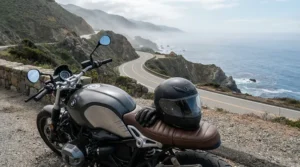
A goggle compatible eyeport is the feature that turns a street helmet into a true adventure helmet. A wide, tall opening lets goggles sit flush against your face with the shield removed or raised. Without it, goggles press on your nose or leave gaps where dust gets in.
Here’s how the helmets in this guide compare. Klim Krios Pro reviewers report that goggles fit easily with the shield removed. The Arai XD-5 is designed so most goggles clear the shield in the raised position. WebBikeWorld’s reviewer praised the Scorpion EXO-AT960 for accommodating goggles, and the ILM WS902 is marketed around a very wide opening. By contrast, an older review of the Shoei Hornet X2 noted the shield can’t close over a goggle strap.
Before buying, bring your own goggles if you can. Check that the strap sits above the shield hinge, and that the goggle frame doesn’t push the peak upward. A goggle compatible eyeport is only useful if your actual goggles fit inside it.
Ventilation Channels: How Airflow Really Works
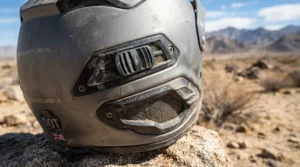
Ventilation channels are the internal passages that move air from intake vents to exhaust ports. Good ones pull cool air across your forehead and out the back; poor ones just make noise. The Klim Krios Pro adds Koroyd, which is roughly 95 percent air, to improve airflow and moisture evaporation. The Shoei Hornet X2 uses a large chin vent, brow vents and rear exhausts, and reviewers describe the airflow as excellent at highway speed.
The Arai XD-5 gives you adjustable chin, forehead, top and rear vents, plus an inner chin shutter. The Bell MX-9 Adventure MIPS uses four always-open exhaust vents, which is simple and effective but not adjustable. One reviewer found the Bell performs very well on hot days but is less comfortable in cold conditions.
What to weigh: adjustable vents are better in changing climates, while fixed vents are simpler and lighter. Ventilation channels work best at speed. At a crawl on a technical trail, even the best helmet gets warm, so a moisture-wicking liner matters as much as vent design.
Lightweight Adventure Helmet for Long Rides: Why Every Ounce Counts
A lightweight adventure helmet for long rides is less about the number on a scale and more about fatigue. Your neck supports that weight against wind, and a peak adds leverage. Reviewers of the Shoei Hornet X2 and Scorpion EXO-AT960 both note neck tiredness off-road, while the Klim Krios Pro earns its premium on exactly this point.
| Helmet | Approx. Weight | Price Range | Best For |
|---|---|---|---|
| Klim Krios Pro | ~3.0-3.4 lb | ~$500-$750 | Klim Krios Pro: all-day comfort |
| Bell MX-9 Adventure MIPS | ~3.7 lb | ~$190-$300 | Bell MX-9 Adventure MIPS: budget lightness |
| Arai XD-5 | ~3.7-3.8 lb | ~$900-$1,050 | Arai XD-5: premium fit |
| Shoei Hornet X2 | ~3.9-4 lb | ~$700-$820 | Shoei Hornet X2: quiet touring |
| Scorpion EXO-AT960 | ~4.1 lb | ~$270-$330 | Scorpion EXO-AT960: modular convenience |
This table shows a simple pattern: the lightest helmet costs a lot, while the Bell MX-9 Adventure MIPS gets surprisingly close at a fraction of the price. If a lightweight adventure helmet for long rides is your priority and budget is limited, the Bell is the practical middle path. If neck comfort is worth real money to you, the Klim Krios Pro is the specialist.
Adventure Helmet vs Other Helmet Types
Is a peak worth the trade-offs compared with other styles? Each type solves a different problem.
| Feature | Adventure Helmet With Peak | Street Full-Face | Modular Street | Motocross Helmet |
|---|---|---|---|---|
| Sun/roost protection | Excellent | Poor | Poor | Excellent |
| Highway noise | Moderate | Low | Moderate | High |
| Goggle compatibility | Yes | No | Rarely | Yes |
| Shield for rain/wind | Yes | Yes | Yes | No |
| Best For | Mixed pavement and dirt | Pure street | Touring with stops | Pure off-road |
A street full-face is quieter and often lighter, but it can’t take goggles and leaves you squinting at low sun. A motocross helmet is great in dirt and miserable on the interstate. An adventure helmet sits in the middle, and models like the Arai XD-5 and Shoei Hornet X2 narrow the noise gap considerably.
If you ride 90 percent pavement and rarely touch dirt, a street helmet is probably the more comfortable choice. If you regularly mix surfaces, the peak, wide eyeport and shield combination of a good adventure helmet with sun peak is hard to beat.
Long-Term Cost & Maintenance: Is the Premium Worth It?
Total cost of ownership matters more than sticker price. A helmet around $150 replaced every three years costs more per year than a premium lid kept for five or more. Liner wear, shield scratches and fit loosening are the usual reasons riders replace helmets early.
Consider the Bell MX-9 Adventure MIPS. One reviewer’s three-year, 30,000 km verdict in this long-term review was that it held up well but showed wind noise and weight on longer rides. That’s useful context: it’s durable and affordable, but you may spend extra on earplugs or a better shield.
| Helmet | Price Range | Value Verdict | Best For |
|---|---|---|---|
| ILM WS902 | ~$100-$150 | Cheapest entry | ILM WS902: occasional riders |
| Bell MX-9 Adventure MIPS | ~$190-$300 | Best overall value | Bell MX-9 Adventure MIPS: most riders |
| Scorpion EXO-AT960 | ~$270-$330 | Fair for modular | Scorpion EXO-AT960: frequent stoppers |
| Klim Krios Pro | ~$500-$750 | High but justified | Klim Krios Pro: high-mileage riders |
| Arai XD-5 | ~$900-$1,050 | Premium | Arai XD-5: long-term owners |
The table shows that value peaks in the middle. The Bell MX-9 Adventure MIPS delivers the best mix of protection, features and cost. Premium helmets such as the Arai XD-5 pay off only if you ride enough and keep the helmet long enough to spread the cost.
FAQ
❓ Is a peak visor loud at highway speeds?
❓ Can I wear goggles with a dual sport helmet with flip up visor?
❓ Is MIPS worth paying extra for in an adventure helmet?
❓ How often should I replace an adventure helmet?
❓ Which is the best adventure helmet with sun peak under $300?
Conclusion
The best adventure helmet with sun peak is the one that matches how you actually ride, not the one with the longest spec sheet. If you want rotational protection without overspending, the Bell MX-9 Adventure MIPS is the clear all-rounder. If a flip-up chinbar suits your riding, the Scorpion EXO-AT960 and Fly Racing Odyssey Adventure Modular make stops easy at the cost of weight. The ILM WS902 is the budget doorway, and the Klim Krios Pro, Shoei Hornet X2 and Arai XD-5 reward riders who put in serious miles.
Remember the checklist: a certified shell, a fit that matches your head shape, a goggle compatible eyeport if you ride dirt, ventilation channels you can adjust with gloves, and a weight you can live with for a full day. Prices shift constantly and some models, like the Fly Racing Odyssey Adventure Modular, may be on closeout, so check current availability before you decide.
Recommended for You
- Off-Road Riding Boots For Trail Riders: 7 Best Rugged Picks 2026
- Knee Braces For Enduro Riders On A Budget: 7 Smart Picks 2026
- Waterproof Panniers For Dual Sport Motorcycles: 7 Best Picks 2026
Disclaimer: This article contains affiliate links. As an Amazon Associate, I earn from qualifying purchases. If you purchase products through these links, we may earn a small commission at no additional cost to you.
✨ Found this helpful? Share it with your friends! 💬🤗
