
In This Article
What are off-road riding boots for trail riders? They are tall, armored boots built for dirt singletrack and backcountry trails. They pair rigid shin and ankle protection with a stiff, supportive sole and secure buckle closure systems. They also have enough tread to walk, push, and scramble when the bike stops cooperating. Think of a motorcycle boot with a hiking-boot attitude.
Here’s the uncomfortable truth about trails: they don’t care about your skill level. A buried root, a bouncing rock, or a bike tipping onto your shin at walking speed does the same damage to a first-timer as to a veteran. Your hiking boots, bless them, were never built for that conversation.
Footwear is also the most argued-over piece of trail gear, and the arguments usually miss the point. Riders obsess over colorways and skip the specs that matter: the shank under the arch, the plates over the shin, and the buckles that either hold or fail at mile twelve. This guide cuts through that.
We researched seven real boots using published expert reviews, manufacturer spec sheets, and aggregated owner feedback. Then we translated every spec into what it means on the trail. Nothing here comes from personal ownership or hands-on testing. It’s honest analysis of real data, with the gaps in that data flagged where they exist. You’ll also get dedicated breakdowns of comfortable trail riding boots for beginners, waterproof off-road motorcycle boots, steel shank support, and shin and ankle protection.
Quick Comparison: 7 Off-Road Riding Boots for Trail Riders at a Glance
Skim this table first, then dive into the full analysis below. Pay attention to the waterproof column and the shank column. They separate boots that merely look tough from boots that suit your terrain.
| Boot | Best For | Closure | Shank / Sole Support | Waterproof? | Price Range |
|---|---|---|---|---|---|
| O’Neal Element | Tight budgets, first boots | Snap-lock four buckles | Metal shank | No | $150-$180 |
| Alpinestars Tech 3 | Beginners wanting low break-in | Replaceable polymer buckles | Stainless steel shank | No (extended gaiter) | $200-$290 |
| Fox Racing Comp | Comfort-first riders | Four adjustable buckles | Composite insole board | No | $280-$320 |
| O’Neal Sierra WP Pro | Budget wet-weather riding | Metal quick-action buckles | Nylon insole with steel shank | Yes (membrane) | $230-$270 |
| Alpinestars Corozal Adventure Drystar | Mixed trail and road | Two buckles plus Velcro top | Steel-reinforced insole | Yes (Drystar) | Under $300 |
| Leatt HydraDri 7.5 | Adventure and dual-sport | Forged aluminum buckles plus SlideLock | Steel-reinforced shank | Yes (HydraDri EVO) | $330-$370 |
| Alpinestars Tech 7 Enduro Drystar | Technical enduro terrain | Aluminum buckles with memory settings | Integrated steel shank | Yes (Drystar) | $500-$550 |
The O’Neal Element is the cheapest ticket to genuine armor. The Alpinestars Tech 3 costs a little more but earns it with a stainless shank and a reputation for a short break-in. If creek crossings are on your route, only the O’Neal Sierra WP Pro, Alpinestars Corozal Adventure Drystar, Leatt HydraDri 7.5, and Alpinestars Tech 7 Enduro Drystar carry waterproof membranes. Budget buyers should note that the Fox Racing Comp trades a steel shank for a composite insole board in exchange for comfort.
💬 Just one click — help others make better buying decisions too!😊
Top 7 Off-Road Riding Boots for Trail Riders: Expert Analysis
Every pick below comes from real spec sheets and published reviews. Where customer feedback couldn’t be verified, we say so instead of guessing.
1. O’Neal Element — lowest-cost entry to real boot armor
Plenty of riders buy the O’Neal Element first, and the reason is simple: it packs a racing-boot layout into a budget price.
A snap-lock four-buckle closure lets you crank the fit over riding pants. The metal shank stops the boot folding mid-sole when you stand on the pegs, which is the difference between a supported arch and a burning one by hour three. Injection-molded plastic plates and a metal toe guard handle thrown rocks, while synthetic heat shields keep exhaust warmth off your leg. The Goodyear welt sole offers only moderate grip, so expect more slipping on wet roots than you’d get with a lugged enduro sole.
Based on the spec comparison, this boot suits dry-climate riders who want a real shank and plates instead of hiking boots. It isn’t built for long hike-a-bike sections. Aggregated owner feedback is generally positive on value and protection. Common complaints include a snug, stiff fit (wide-footed riders mention side squeeze), a few durability reports after months of use, and damp feet at the first splash.
Pros:
- ✅ Metal shank at an entry-level price
- ✅ Four snap-lock buckles adjust easily
- ✅ Metal toe guard and molded plates
Cons:
- ❌ Not waterproof at all
- ❌ Moderate sole grip on wet terrain
Price range: roughly $150-$180 (check current price). It’s strong value for a first pair if you accept the limited grip.
2. Alpinestars Tech 3 — beginner-friendly protection with little break-in
The Alpinestars Tech 3 is the boot most often handed to newcomers, and its protection list explains why.
TPU plating covers the shin, toe, heel, and calf, with medial and lateral ankle protection plus a biomechanical blade system. That system lets the ankle pivot where you shift and brake while still resisting the twist that ends seasons. A stainless steel shank (with a steel sole guard on the enduro-soled version) keeps the platform rigid on the pegs. Replaceable polymer buckles cut long-term cost, and a reviewer at webBikeWorld found them robust despite being plastic. Sizing runs up to 16 with half sizes, and the boots are resoleable.
On paper this is the sweet spot for riders who want comfortable trail riding boots for beginners without a punishing first month. Reviewers describe a short break-in and plenty of coverage for the money. The trade-off is water: it isn’t fully waterproof, though the extended gaiter helps keep splashes and dirt out.
Pros:
- ✅ Full TPU coverage on shin, toe, heel
- ✅ Stainless steel shank for peg support
- ✅ Replaceable buckles and resoleable build
Cons:
- ❌ Not fully waterproof in wet weather
- ❌ Plastic buckles feel less premium than metal
Price range: roughly $200-$290 depending on version (check current price). Excellent value for protection per dollar.
3. Fox Racing Comp — comfortable from the first ride
If your biggest fear is blisters, the Fox Racing Comp deserves a look because its whole personality is comfort.
The four adjustable buckles hold a secure fit, and a TPU shin plate, ankle, toe, and heel caps cover the usual impact zones. Burn and calf guards add heat and abrasion defense. Instead of a steel shank, an internal composite insole board provides stability. That’s lighter and usually kinder to your arch on walks, though it won’t feel quite as rock-solid as steel under heavy standing loads. Fox Positac rubber and a resoleable construction extend its life.
Here’s what to weigh: comfort and a short break-in matter more than you’d think on a trail ride, where you’ll stop, walk, and remount all day. Reviewers consistently report comfort from first wear and a durable microfiber upper. Specific customer ratings weren’t verifiable in our research, so lean on those editorial findings rather than star counts.
Pros:
- ✅ Little break-in needed
- ✅ Full TPU plating with burn guard
- ✅ Resoleable with grippy Positac rubber
Cons:
- ❌ Composite board, not steel shank
- ❌ Not waterproof
Price range: roughly $280-$320 (check current price). It’s a fair price if comfort is your top priority.
4. O’Neal Sierra WP Pro — budget-friendly waterproof leather
Waterproofing usually costs a fortune, which is why the O’Neal Sierra WP Pro is interesting.
It uses a waterproof membrane lining under a full-grain leather and suede microfiber upper. Metal quick-action buckles close the boot, and a nylon inner sole with a steel shank handles the stiffness. A TPU shin plate, internal and external TPU protection, and an anatomically shaped TPU heel cup cover the impact zones. The high-grip anti-slip rubber sole is replaceable, as are other parts, and the anti-sweat footbed is removable.
The analysis is straightforward: this is one of the cheaper routes to waterproof off-road motorcycle boots with a proper shank. The catch is positioning. It leans adventure and touring rather than pure motocross, so expect more walkability and less rigid race-style defense. We couldn’t verify a meaningful pool of aggregated owner reviews, so the picture rests on one reviewer’s spec-sheet assessment.
Pros:
- ✅ Waterproof membrane at a mid-range price
- ✅ Durable leather upper with replaceable parts
- ✅ Steel shank with metal buckles
Cons:
- ❌ Adventure-leaning, less race-rigid
- ❌ Limited verifiable owner feedback
Price range: roughly $230-$270 (check current price). Good value for dry feet on a budget.
5. Alpinestars Corozal Adventure Drystar — closest thing to armor you can walk in
The Alpinestars Corozal Adventure Drystar is the compromise Goldilocks would pick: protective enough for trails, relaxed enough for the pavement ride to the trailhead.
Two micro-ratchet buckles with quick-release (one across the foot, one mid-shin) plus a large Velcro top panel handle the closure. The polypropylene insole is reinforced with a steel shank. A breathable Drystar membrane keeps water out, and Rider Magazine reported the boots wind- and watertight in rain and cold. TPU shin, calf, toe, and ankle protection is paired with a lateral flexi-blade ankle system, and the lugged sole stays flexible enough for shifting.
Reviewers note near-instant comfort and a wide entry that makes them easy to pull on. Owners echo that, with comments about roomy fit and good walkability. Recurring drawbacks include warmth in hot weather, an occasional squeak when walking, some who say they fit small, and a sole that flexes more than a true enduro boot.
Pros:
- ✅ Needs almost no break-in
- ✅ Waterproof Drystar membrane with steel shank
- ✅ Replaceable buckles and walkable lugged sole
Cons:
- ❌ Runs warm in summer heat
- ❌ Less rigid than full enduro boots
Price range: under $300 (check current price). It’s a standout value for mixed trail and road riders.

6. Leatt HydraDri 7.5 — flex limiter plus true waterproofing
The Leatt HydraDri 7.5 brings motocross-style ankle control to an adventure boot, which is rarer than it sounds.
A Flex Limiter lockout at the ankle guards against flexion and hyperextension, and 3DF foam adds impact absorption. The nubuck leather body is waterproof-treated and lined with a HydraDri EVO membrane rated 20,000mm. A steel-reinforced shank, shin and heel impact protection, and the same CE rating (prEN 13634:2017) as Leatt’s motocross line round out the protection. Forged aluminum buckles with a stainless-steel base and a one-way SlideLock hook-and-loop top handle the buckle closure systems.
One ADVpulse reviewer reported no hot spots, a light feel, and only a light thud when rocks hit the toe and ankle. The caveat is time: long-term waterproofing was still being tested, and reader comments raised sizing concerns for very small or very large feet. Check the size chart carefully.
Pros:
- ✅ Flex Limiter lockout guards the ankle
- ✅ 20,000mm waterproof membrane
- ✅ Forged aluminum buckles, steel-reinforced shank
Cons:
- ❌ Long-term waterproofing not yet proven
- ❌ Sizing concerns at the extremes
Price range: roughly $330-$370 (check current price). A fair premium for the ankle protection plus waterproofing combo.
7. Alpinestars Tech 7 Enduro Drystar — premium armor for technical terrain
The Alpinestars Tech 7 Enduro Drystar is the heavyweight here, built for riders who want near-motocross protection with real weather resistance.
Aluminum bridge buckles with memory settings and a quick-release system anchor the closure, and an integrated steel shank resists twist. A malleolus plate system and TPU armor on the shin, calf, heel, outer ankle, and toes provide serious shin and ankle protection. An enduro-specific compound sole and a honeycomb medial insert bite into slick terrain, and both sole and buckles are replaceable. ADVpulse reported about 4 pounds 6 ounces per boot in a size 47, roughly a pound heavier than most adventure boots.
A RideApart reviewer found them very stiff out of the box and advised wearing them around the house first. After break-in the reviewer ranked them among the best boots they’d owned, kept feet dry through a rain shower, and noted that brush and trees “scrub off” harmlessly. River-crossing performance wasn’t reported.
Pros:
- ✅ Top-tier ankle, shin, and toe armor
- ✅ Drystar waterproofing with replaceable parts
- ✅ Aluminum buckles with memory settings
Cons:
- ❌ Stiff and heavy until broken in
- ❌ Highest price in this lineup
Price range: roughly $500-$550 (check current price). Expensive, but built to be repaired rather than replaced.
Price and Value at a Glance
| Tier | Boot | Price Range | Best Value As |
|---|---|---|---|
| Budget | O’Neal Element | $150-$180 | First boots for dry trails |
| Mid-range | Alpinestars Tech 3 | $200-$290 | Beginner all-rounder |
| Mid-range | O’Neal Sierra WP Pro | $230-$270 | Cheapest waterproof option |
| Mid-range | Alpinestars Corozal Adventure Drystar | Under $300 | Mixed trail-and-road |
| Mid-range | Fox Racing Comp | $280-$320 | Comfort-first pick |
| Upper | Leatt HydraDri 7.5 | $330-$370 | Ankle control plus waterproofing |
| Premium | Alpinestars Tech 7 Enduro Drystar | $500-$550 | Technical enduro terrain |
Cost per ride tells the real story. A boot at the premium end with replaceable soles and buckles can outlast several budget pairs, so the Alpinestars Tech 7 Enduro Drystar may cost less per season for frequent riders. Weekend riders will rarely wear out a Alpinestars Tech 3 or O’Neal Element, which makes the cheaper options smarter. Only pay the waterproof premium if wet crossings are part of your routine.
Practical Usage Guide: Breaking In and Caring for Your Boots
Stiffness is the point. That rigidity is the protection, so break-in is a project, not an accident. One reviewer who skipped it before a long ride reported still feeling the consequences two months later.
A simple first-week routine:
- Wear the boots around the house for several evenings with your riding socks, fully buckled.
- Practice shifting and braking motions while seated, then walk stairs to flex the ankle.
- Re-check buckle tension after your first short ride, since fit settles.
Ongoing care: Rinse mud off with gentle water, not a pressure washer, and let the boots dry away from direct heat. Inspect buckles and soles every month. Boots like the Alpinestars Tech 7 Enduro Drystar and Alpinestars Tech 3 have replaceable parts, so swapping a worn buckle beats a whole new pair.
Mistakes in the first 30 days: over-tightening the top buckle first, wearing thick cotton socks, and judging comfort after five minutes in a shop instead of an hour at home.
Real-World Scenarios: Which Boot Fits Which Rider?
Scenario 1: The dry-trail weekender. You ride twice a month on dry forest roads with about $200 to spend. The O’Neal Element or Alpinestars Tech 3 gives you a real shank and plates, and neither needs a wet-weather premium. Choose the Alpinestars Tech 3 if break-in tolerance is low.
Scenario 2: The year-round wet-climate rider. You ride three times a week through creek crossings and drizzle. The Alpinestars Tech 7 Enduro Drystar or Leatt HydraDri 7.5 fits if you can stretch the budget. The O’Neal Sierra WP Pro is the cheaper waterproof route.
Scenario 3: The dual-sport commuter. You ride fifteen miles of pavement to a trailhead, then hike a stretch. The Alpinestars Corozal Adventure Drystar balances walkability, waterproofing, and protection.
✨ Ready to Gear Up Your Trail Game?
🔍 Take your trail rides to the next level with these carefully researched boots. Click any highlighted product to check current pricing and availability. The right pair will help you ride with confidence, whatever the trail throws at you!
Problem → Solution: Four Boot Headaches Fixed
Problem 1: Stiff boots that bruise your ankles. Slow down and break them in at home. A snug-but-not-crushing fit and proper riding socks cut most early pain.
Problem 2: Buckles clogged with mud. Rinse after muddy rides and check the buckle teeth before each ride. Boots with replaceable buckles, like the Alpinestars Tech 3, make fixes cheap.
Problem 3: Wet feet in non-waterproof boots. Gaiters only slow water entry. If crossings are routine, move to a membrane boot like the O’Neal Sierra WP Pro, and carry spare socks.
Problem 4: Sore arches on long days. A shank that’s too flexible lets the pegs load your arch. Look for steel-reinforced options, or consider the Fox Racing Comp‘s cushioned comfort for shorter rides.
How to Choose Off-Road Riding Boots for Trail Riders
Choosing off-road riding boots for trail riders comes down to seven steps, in this order:
- Pick your boot category. Motocross boots are the stiffest. Enduro boots add walkability. Adventure boots favor comfort and waterproofing.
- Check certification. Look for the full EN 13634 standard code, not just “CE.” The standard defines Level 1 as the minimum useful protection.
- Inspect shin and ankle protection. Look for rigid shin plates, ankle cups, and a heel cup.
- Confirm the shank. Steel is the stiffest. Composite or nylon options trade rigidity for comfort.
- Evaluate buckles and closures. Metal and replaceable buckles last longest.
- Decide on waterproofing. Most dirt bike boots aren’t waterproof, so choose a membrane boot only if you need one.
- Size with your riding socks and pants. Fit over everything you’ll wear, and re-check the size chart.
Shin and Ankle Protection: What Actually Keeps You Off the Injury List
Shin and ankle protection does two jobs. A curved plate deflects debris thrown by the front wheel, and ankle structures keep the joint from folding past its limits.
Look for TPU shin plates, side ankle cups, and a rigid heel. A hinge or pivot lets the ankle move for shifting but stops hyperextension, as with the Leatt HydraDri 7.5‘s Flex Limiter and the Alpinestars Tech 7 Enduro Drystar‘s biomechanical pivot. Enduro boots usually add flexibility in the calf and ankle to help you walk, a trade-off worth understanding.
Don’t assume certification guarantees ankle protection. The EN 13634 standard’s ankle and shin impact tests are optional, so check what the specific boot claims. For budget riders, the O’Neal Element and Fox Racing Comp cover the essentials but lack hinge-style lockouts.
Steel Shank Support: Why a Stiff Sole Matters on the Trail
A shank is a rigid insert in the midsole that prevents the boot from bending under your weight. On a trail, you’ll stand on the pegs for long stretches, and a flimsy sole turns that into arch fatigue.
Steel shanks provide the most stiffness. The O’Neal Element, Alpinestars Tech 3, Leatt HydraDri 7.5, O’Neal Sierra WP Pro, and Alpinestars Tech 7 Enduro Drystar all use some form of steel. The Fox Racing Comp uses a composite insole board instead, which is lighter and often more comfortable for walking. Some premium boots, like Sidi’s, use nylon and argue it’s safer in a crash. So steel isn’t the only valid answer.
The trade-off is weight and walkability. A stiff sole protects, but it makes hike-a-bike sections tiring. Match the shank to how much you actually walk.
Buckle Closure Systems Explained
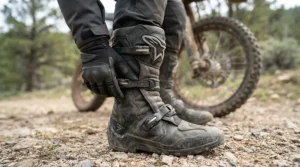
Buckle closure systems are what keep your boot’s armor aligned with your leg when things go sideways. Motocross-style boots open lengthwise for easy entry, then lock down with three or four adjustable buckles.
Plastic vs metal: Plastic buckles, like those on the Alpinestars Tech 3, cost less and can be replaced. Metal buckles, like the aluminum ones on the Alpinestars Tech 7 Enduro Drystar, offer memory settings and extra durability. The Leatt HydraDri 7.5 pairs forged aluminum buckles with a one-way SlideLock top.
Buckles vs Velcro: Adventure boots like the Alpinestars Corozal Adventure Drystar use fewer buckles plus a Velcro panel for quick adjustment.
Whatever you choose, test closure with your riding pants on. A buckle that’s hard to fasten over bulky pants will frustrate you by the third ride. Replaceable parts cut long-term cost.
Waterproof Off-Road Motorcycle Boots: Worth the Trade-Offs?
Most dirt bike boots are not waterproof, so waterproof off-road motorcycle boots are a deliberate choice. The O’Neal Sierra WP Pro, Alpinestars Corozal Adventure Drystar, Leatt HydraDri 7.5, and Alpinestars Tech 7 Enduro Drystar all use membranes.
The benefit is obvious: dry socks through rain, mud, and shallow crossings. The cost is heat. Owners of the Alpinestars Corozal Adventure Drystar mention warmth in summer, and one reviewer suggested the standard enduro boot may suit hot climates better than the Drystar version. Membranes also can’t stop water pouring over the top, so deep crossings still flood any boot.
Ask yourself how often you ride in wet conditions. If it’s most weekends, the membrane pays for itself. If it’s a few drizzly days a year, a non-waterproof boot plus spare socks is cheaper and cooler.
Comfortable Trail Riding Boots for Beginners: What to Prioritize
Comfortable trail riding boots for beginners should do three things: protect, fit, and forgive. Skip the race-level price tag until you know how you ride.
Federal off-highway safety guidance lists boots among the protective gear riders should always wear. That means real riding boots, not sneakers.
For a first pair, the O’Neal Element and Alpinestars Tech 3 deliver certified-style coverage at friendly prices, and the Fox Racing Comp is the comfort pick. Spend extra only for waterproofing if you’ll really ride in the wet.
Don’t skip fit. Try boots with your riding socks and pants, and expect some stiffness at first. A snug heel and a toe that doesn’t crush are better signs than a sneaker-soft feel.
Off-Road Riding Boots vs Adventure Boots: Benefits vs Traditional Alternatives
| Feature | Off-road / enduro boots | Adventure / dual-sport boots | Hiking or work boots |
|---|---|---|---|
| Protection | Maximum shin and ankle armor | Moderate, less rigid lateral support | Minimal motorcycle-specific protection |
| Walkability | Moderate, stiff soles | High, flexible soles | Highest |
| Waterproofing | Usually not waterproof | Often waterproof | Varies |
| Break-in | Longer, stiffer | Shorter | Short |
| Best For | Alpinestars Tech 3, O’Neal Element, Fox Racing Comp | Alpinestars Corozal Adventure Drystar, Leatt HydraDri 7.5, O’Neal Sierra WP Pro | Walking, not riding |
Off-road boots win when impact protection matters most, especially on technical terrain. Adventure boots win for mixed riding where comfort and dry feet matter. The Alpinestars Tech 7 Enduro Drystar sits in the middle with motocross-level armor plus a waterproof membrane.
Hiking boots lack the shin plates, ankle structure, and rigid soles that make riding boots protective. They’re fine for walking, not for crashing.
Frequently Asked Questions
❓ Are dirt bike boots good for trail riding, or do I need enduro boots?
❓ How much should I spend on trail riding boots?
❓ Do waterproof off-road motorcycle boots run hot?
❓ Should I size up for off-road riding boots?
❓ How long do off-road riding boots for trail riders last?
Conclusion
The best off-road riding boots for trail riders aren’t the most expensive ones. They’re the ones that match your terrain, budget, and tolerance for break-in. If you’re starting out, the O’Neal Element and Alpinestars Tech 3 deliver real protection at friendly prices, and the Fox Racing Comp is the comfort-first alternative.
If wet crossings are on your route, the O’Neal Sierra WP Pro is the budget waterproof pick, while the Alpinestars Corozal Adventure Drystar suits mixed trail and road. The Leatt HydraDri 7.5 adds ankle-control tech and a membrane, and the Alpinestars Tech 7 Enduro Drystar is the premium choice for technical enduro terrain.
Whatever you pick, prioritize shin and ankle protection, steel shank support (or a good composite alternative), and buckle closure systems you can trust. Give yourself time to break them in, and confirm the fit with your riding socks. Your future self, standing on a muddy trail with two working ankles, will be grateful.
Recommended for You
- Knee Braces For Enduro Riders On A Budget: 7 Smart Picks 2026
- Waterproof Panniers For Dual Sport Motorcycles: 7 Best Picks 2026
- Electric Dirt Bike For Adult Trail Riding: 7 Proven Picks (2026)
Disclaimer: This article contains affiliate links. As an Amazon Associate, I earn from qualifying purchases. If you purchase products through these links, we may earn a small commission at no additional cost to you.
✨ Found this helpful? Share it with your friends! 💬🤗
