In This Article
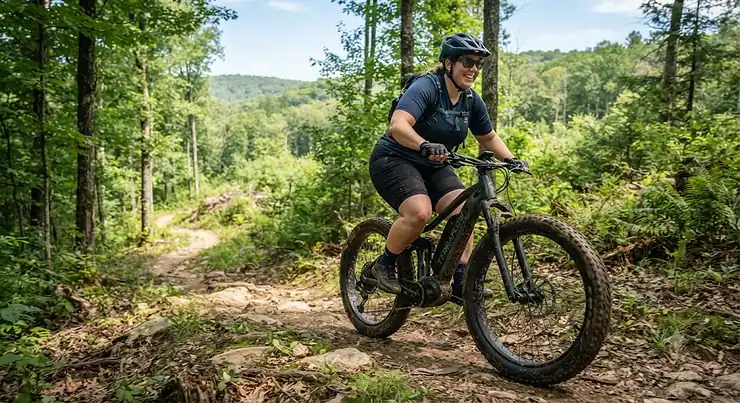
Let’s get something out of the way first: most bike shops still act like anyone over 250 pounds is an edge case. They’re not. A genuinely capable plus-size rider fat tire electric mountain bike isn’t a “special order” anymore — it’s a whole category, built around reinforced frames, four-inch tires, and motors that don’t wheeze the moment the trail tilts uphill. The difference between a bike that shrugs off your weight and one that groans under it usually comes down to a handful of engineering choices most listings bury in the fine print.
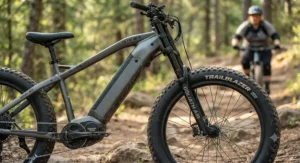
That’s the gap this guide closes. We researched real, currently listed Amazon.com models — checking published payload ratings, motor specs, and aggregated owner feedback — to find seven fat tire e-MTBs that actually hold up for heavier riders, not bikes that merely tolerate the weight, but ones engineered around it. You’ll also get straight answers on suspension types, frame durability, and the tire pressure numbers that turn a bouncy, sketchy ride into a planted one. According to the CDC’s physical activity guidance, regular movement delivers immediate benefits for how you feel, function, and sleep — and a bike that actually fits you is what makes that activity sustainable instead of a one-ride experiment.
We’ll cover budget, mid-range, and premium options, explain exactly what a “weight rating” really measures, and hand you a decision framework so you’re not guessing. No fluff, no recycled spec sheets — just what actually matters when 280+ pounds of rider hits a 15-degree climb.
Quick Comparison Table
| Bike | Category | Weight Rating | Best For |
|---|---|---|---|
| Himiway Cobra Pro | Premium | Up to 400 lbs | Full-suspension backcountry riding |
| Jasion Thunder Pro | Budget | Up to 500 lbs | Maximum payload on a tight budget |
| QuietKat Lynx | Premium | 300 lb rider / 355 lb total | Tech-forward, moto-style trail riding |
| Himiway Zebra D5 Pro ST | Mid-range | Up to 400 lbs | Easiest mounting, step-thru comfort |
| ANCHEER Speedrid | Budget | ~250-300 lbs (verify listing) | First-time buyers on a tight budget |
Look at that spread for a second. The jump from an entry-level ANCHEER’s roughly 250-300 lb capacity to the Jasion Thunder Pro‘s 500-lb rating isn’t just a bigger number on paper — it reflects a genuinely different frame gauge, spoke count, and suspension setup. Riders in the 280-350 lb range have real flexibility across nearly every price tier here, but riders above 350 lbs should treat the Jasion Thunder Pro, Himiway Cobra Pro, and QuietKat Lynx as the shortlist, since those publish the highest verified payload numbers in this lineup.
💬 Already know your budget? Jump straight to the product that fits — full breakdowns are just below.
Top 7 Fat Tire Electric Mountain Bikes for Plus-Size Riders: Expert Analysis
1. Himiway Cobra Pro — toughest for backcountry and technical trails
The Himiway Cobra Pro leads with a four-bar linkage full-suspension frame, and that’s the detail that actually changes how the bike behaves on washboard trails and root-choked singletrack rather than just sounding good on a spec sheet. What most buyers overlook about linkage-style rear suspension is that it’s not purely about comfort — it keeps the rear tire in contact with the ground through choppy terrain, which directly improves traction and braking control for a heavier rider whose momentum is harder to arrest mid-descent. Under the hood sits a 1000W motor paired with a 10-speed drivetrain, and the reinforced frame is built specifically around a 400-lb payload class, giving it enough torque reserve to handle loaded panniers or hunting gear without the strain showing. Aggregated owner feedback on Himiway’s higher-output models frequently praises stopping power and the bike’s “tank-like” stability at speed, though a recurring theme in reviews is that the substantial curb weight makes it a two-person lift into a truck bed.
Pros:
- ✅ Four-bar linkage full suspension smooths rough backcountry trails
- ✅ 400-lb payload with reinforced frame and 1000W motor
- ✅ 80-mile claimed range on a single charge
Cons:
- ❌ Heavy curb weight makes transport more difficult
- ❌ Premium pricing compared to hardtail alternatives
Pricing typically lands in the $2,300-$2,800 range at the time of research, and for riders who actually ride off-pavement rather than just commuting, the suspension upgrade alone justifies the premium over a hardtail.
2. Jasion Thunder Pro — highest payload capacity in this lineup
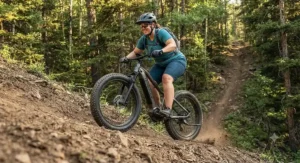
The Jasion Thunder Pro wins on a single number that matters enormously for this guide’s audience: a 500-lb payload capacity, the highest of any bike featured here. That figure isn’t just marketing — it’s backed by a full-suspension frame, a 2000W peak motor, and a 1040Wh removable battery that together deliver a claimed range of up to 90 miles with pedal assist. Based on the spec comparison, that motor output is roughly double what several hub-motor competitors in this article offer, which in practice means less strain-induced heat buildup on long climbs when the rider and cargo combined push past 300 pounds. Here’s what most buyers overlook: full suspension at this price point is genuinely rare — most bikes under $1,500 are front-fork only, so the Thunder Pro’s rear shock is a real structural advantage, not just a marketing bullet point. Reviewers describe the ride as noticeably planted at speed, a trait heavier riders often report struggling to find in lighter, less reinforced frames.
Pros:
- ✅ Highest payload rating in this roundup at 500 lbs
- ✅ Full suspension at a genuinely budget-friendly price
- ✅ Powerful 2000W peak motor with strong climbing torque
Cons:
- ❌ Newer brand with a smaller established review base
- ❌ 90-mile range claim assumes ideal, low-assist conditions
At a price range around $1,000-$1,300, the Jasion Thunder Pro delivers the best dollar-per-pound-of-payload value in this entire lineup — hard to beat if capacity is your top priority.
3. QuietKat Lynx — most tech-forward for moto-style trail riding
The QuietKat Lynx stands apart with a café-moto-inspired full-suspension frame and a 1000W two-speed hub-drive motor, and the standout feature is how that automatic two-speed transmission changes the power delivery — it shifts to preserve torque at low speed and efficiency at higher speed, rather than relying on a single fixed gear ratio like most hub-motor bikes in this category. On paper this means smoother acceleration off the line, which matters for a heavier rider who needs consistent low-end torque without the motor straining. QuietKat publishes a 300-lb maximum rider weight and a 355-lb total payload capacity (rider plus cargo), figures that reflect the brand’s background building bikes for hunters hauling heavy gear over rough terrain. What the spec sheet won’t tell you is that the app-connected GPS tracking and remote lock features, while genuinely useful for theft deterrence, add a layer of tech that some reviewers find unnecessary if you just want a straightforward trail bike.
Pros:
- ✅ Full suspension with moto-inspired handling and comfort
- ✅ Two-speed hub motor smooths power delivery at all speeds
- ✅ App connectivity adds GPS tracking and remote lock
Cons:
- ❌ 300-lb rider weight limit is lower than several rivals here
- ❌ Premium pricing puts it toward the top of this lineup
Expect to pay in the $3,800-$4,000 range depending on configuration, positioning this as the aspirational, tech-forward pick for riders under the 300-lb threshold who want a genuinely different riding experience.
4. Jasion Thunder — best value front-suspension pick
The Jasion Thunder is the more budget-conscious sibling to the Thunder Pro, and its standout feature is packing a 1800W peak motor and 400-lb payload rating into a genuinely affordable front-suspension platform. Based on the spec comparison, its 85 Nm of torque and adjustable 80mm front suspension fork handle 30-degree inclines without the strain you’d expect at this price point, and the 864Wh removable battery delivers a claimed 80-mile range with pedal assist. What most buyers overlook about this tier of bike is that dropping full suspension for front-fork-only isn’t purely a downgrade — it’s a legitimate tradeoff that keeps the price down and reduces long-term maintenance, which matters if your riding is mostly pavement, bike paths, or hardpack rather than technical singletrack. Reviewers consistently note the dual hydraulic disc brakes bring the bike to a stop quickly, a detail that matters more than usual given the added stopping distance a heavier combined weight introduces.
Pros:
- ✅ 400-lb payload capacity at a genuinely budget price
- ✅ 1800W peak motor with 85 Nm of climbing torque
- ✅ Dual hydraulic disc brakes for confident stopping power
Cons:
- ❌ Front suspension only, less capable on technical descents
- ❌ Curb weight around 82 lbs makes it awkward to lift alone
Pricing generally falls in the $900-$1,100 range, making it one of the strongest value propositions in this entire roundup for riders who don’t need full suspension.
5. Cyrusher Ranger 2.0 — smoothest full-suspension moto-style ride
The Cyrusher Ranger 2.0 brings a motorcycle-inspired full-suspension frame into a mid-range price bracket, and the standout feature is its DNM air suspension paired with a dual-crown front fork — components you’d typically expect on a bike costing considerably more. That matters because full suspension isn’t a luxury add-on for a heavier rider; it’s what keeps the rear wheel tracking the ground under impact instead of skipping, which directly affects control at speed. Cyrusher’s own published payload capacity for the Ranger 2.0 sits at 350 lbs, backed by a 750W motor with a torque sensor delivering 95 Nm and a 52V 20Ah (1040Wh) battery rated for up to 75 miles. What most buyers overlook about full-suspension e-bikes at this price is the maintenance tradeoff: more moving parts means more components to service, so budget for periodic shock and pivot maintenance that a hardtail simply doesn’t require. Aggregated review sentiment on the Ranger platform tends to praise the plush ride quality on washboard and rutted trails specifically, alongside genuinely strong stopping power from its 180mm hydraulic disc brakes.
Pros:
- ✅ True front-and-rear suspension with motorcycle-inspired styling
- ✅ Torque sensor delivers 95 Nm for confident hill climbing
- ✅ Strong hydraulic braking with 180mm rotors
Cons:
- ❌ 350-lb payload rating is lower than several rivals here
- ❌ Substantial curb weight (near 90 lbs with battery) limits portability
Pricing generally falls in the $2,300-$2,600 range, making it a strong pick for riders under the 350-lb threshold who prioritize ride smoothness and head-turning styling.
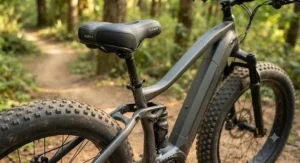
6. Himiway Zebra D5 Pro ST — easiest step-thru for confident mounting
The Himiway Zebra D5 Pro ST leads with its step-thru frame geometry, and honestly, this is the spec that gets underrated in most buying guides — a low, unobstructed step-through isn’t a “women’s bike” feature, it’s a mobility feature that makes mounting and dismounting dramatically easier for any rider managing joint stress, limited hip flexibility, or general bulk. Under the frame sits a 500W mid-drive motor with a torque sensor delivering 130 Nm, and Himiway’s 960Wh battery on this platform is rated for up to 80 miles in mixed terrain — more range headroom than most riders will use in a single outing. Here’s what the spec sheet won’t tell you, but reviewers note repeatedly: mid-drive motors like this one place weight lower and more centrally on the frame, which noticeably improves handling balance compared to rear-hub setups, especially for a heavier rider navigating tight turns. This is the bike we’d recommend to a plus-size rider who prioritizes all-day comfort and easy mounting over aggressive trail performance.
Pros:
- ✅ Low step-thru frame simplifies mounting and dismounting
- ✅ Mid-drive motor with 130 Nm improves balance and handling
- ✅ Long-range battery covers up to 80 miles
Cons:
- ❌ Front suspension only, less capable on technical descents
- ❌ Step-thru frame flexes slightly more than a high-step design
Expect a price range of roughly $1,900-$2,300, positioning it as a comfort-first mid-range pick rather than a trail-first one.
7. ANCHEER Speedrid — lowest cost entry point
The ANCHEER Speedrid exists to answer one question: what’s the cheapest legitimate way into this category? Its standout feature is a 7-speed professional transmission system that gives you real manual gearing to lean on when you want to conserve battery or just enjoy a lower-power ride, something several single-speed budget competitors skip entirely. The lockable carbon-steel front fork takes the edge off rough pavement and light trail use, though it’s a simpler unit than the coil or air forks found on the pricier bikes in this list, so don’t expect it to soak up serious rock gardens. Here’s the honest caveat: published weight capacity figures for ANCHEER’s fat-tire e-bike models generally cluster in the 250-300 lb range depending on the specific configuration, so if you’re near or above that threshold, verify the current specification sheet directly on the product listing before ordering rather than assuming consistency across model years. For riders under that threshold who mainly want pavement and light-trail commuting on a tight budget, it’s a genuinely functional starting point.
Pros:
- ✅ Lowest price point of any bike in this roundup
- ✅ 7-speed transmission adds real manual control
- ✅ Front suspension smooths pavement and light trail use
Cons:
- ❌ Lower published weight capacity than most rivals here
- ❌ Build quality feels noticeably less refined at speed
Priced in the $700-$900 range, it’s the bike to start with if you’re not yet sure how often you’ll actually ride — just don’t expect it to survive years of aggressive trail abuse.
Top 7 Products: Full Spec Comparison
| Bike | Motor | Weight Rating | Suspension | Price Range |
|---|---|---|---|---|
| Himiway Cobra Pro | 1000W hub | 400 lbs | Full (four-bar linkage) | $2,300-$2,800 |
| Jasion Thunder Pro | 2000W peak | 500 lbs | Full | $1,000-$1,300 |
| QuietKat Lynx | 1000W 2-speed hub | 300 lbs rider / 355 total | Full | $3,800-$4,000 |
| Jasion Thunder | 1800W peak | 400 lbs | Front only | $900-$1,100 |
| Cyrusher Ranger 2.0 | 750W + torque sensor | 350 lbs | Full | $2,300-$2,600 |
| Himiway Zebra D5 Pro ST | 500W mid-drive | 400 lbs | Front only | $1,900-$2,300 |
| ANCHEER Speedrid | ~500W class | ~250-300 lbs | Front only | $700-$900 |
Reading across this table, the pattern is clear: the highest payload figures show up on hub-motor builds like the Jasion Thunder Pro and Himiway Cobra Pro, while the more sophisticated mid-drive and two-speed motors on the Himiway Zebra D5 Pro ST and QuietKat Lynx trade a bit of raw payload headroom for smoother, more balanced power delivery. If your priority is raw capacity, lean toward the top of this table; if it’s ride refinement and your weight sits comfortably under 350 lbs, the mid-drive and two-speed options justify their premium.
💬 Found your match already? Check current availability before prices shift.
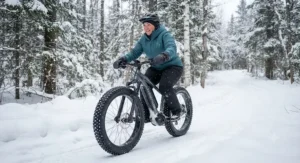
Fat Tire Electric Mountain Bike vs Traditional Mountain Bike: Benefits Comparison
| Factor | Fat Tire eMTB | Traditional Mountain Bike |
|---|---|---|
| Rider weight accommodation | Reinforced frames rated up to 500 lbs | Standard frames often rated 250-275 lbs |
| Traction on sand/snow/loose terrain | Wide contact patch floats over soft ground | Narrow tires cut in and lose grip |
| Climbing assistance | Motor offsets rider and cargo weight | Entirely rider-powered |
| Comfort over rough terrain | Tire volume absorbs impact like built-in suspension | Relies solely on frame/fork suspension |
| Upfront cost | Higher due to motor, battery, reinforced frame | Generally lower purchase price |
The core tradeoff here isn’t close for plus-size riders: a traditional mountain bike’s standard-gauge tubing and narrower tire footprint simply weren’t engineered with a 300+ lb rider profile in mind, and that shows up as flex, fatigue, and premature component wear. What most buyers overlook is that the fat tire’s added air volume itself functions as a form of passive suspension, cushioning impacts before the fork or shock even engages — which is part of why fat-tire e-MTBs feel more forgiving even on models with front-suspension-only setups like the Jasion Thunder or Himiway Zebra D5 Pro ST. The tradeoff, unsurprisingly, is weight and upfront cost, but for a rider who’s been quietly priced out of standard mountain biking geometry, that tradeoff is usually an easy one to accept.
Practical Usage Guide: Suspension Setup, First Rides & Maintenance
Getting a new fat tire electric mountain bike dialed in during the first 30 days makes a bigger difference than most new owners expect. Start with suspension sag: on a front-fork setup like the Jasion Thunder or ANCHEER Speedrid, most manufacturers recommend setting sag to roughly 15-20% of total travel for a plus-size rider, which typically means running slightly higher air pressure or a firmer coil than the factory default — check your fork’s printed sag chart against your actual riding weight, not just “adult rider” averages, since those charts are often calibrated around a 170-180 lb baseline. Full-suspension owners on bikes like the Himiway Cobra Pro, Cyrusher Ranger 2.0, QuietKat Lynx, or Jasion Thunder Pro should also check rear shock sag at the same interval, since an under-sagged rear end will feel harsh while an over-sagged one wallows and bottoms out.
A common first-30-days mistake is neglecting torque specs on bolts after the initial break-in period — vibration loosens fasteners faster under heavier loads, so a re-torque check at the 50-100 mile mark isn’t optional, it’s preventative maintenance that protects frame welds long-term. Tire pressure deserves daily attention early on, since fat tires lose pressure gradually and a soft tire under a heavier rider increases pinch-flat risk disproportionately; we cover exact PSI targets in the dedicated section below. Finally, brake bedding matters more here than on a standard bike: your first 20-30 stops should be progressive, moderate-pressure braking rather than hard stops, which seats the pads evenly and prevents the glazing that leads to reduced stopping power exactly when you need it most under a heavier combined weight.
Real-World Scenarios: Which Rider Are You?
The commuter who wants exercise, not a workout. If you’re riding 6-10 miles daily on a mix of pavement and light gravel paths, and you weigh in the 280-320 lb range, the Jasion Thunder or Himiway Zebra D5 Pro ST make the most sense — both prioritize comfort, reliable range, and consistent daily performance over aggressive trail capability you won’t use on a commute.
The weekend trail rider chasing real singletrack. If your rides involve roots, rock gardens, and technical descents, and you’re comfortable managing a higher price point, the Himiway Cobra Pro or QuietKat Lynx are worth the premium — the linkage suspension and two-speed motor, respectively, are the difference between surviving technical terrain and actually enjoying it.
The budget-conscious rider prioritizing capacity over polish. If your top priority is simply “will this hold my weight without drama” and you’re working with a tighter budget, the Jasion Thunder Pro is the clear answer — its 500-lb rating and full suspension outperform its price point on paper, even if the brand recognition is lower than some established names on this list.
How to Choose a Plus-Size Fat Tire Electric Mountain Bike
- Start with the published payload rating, not the frame size. A manufacturer’s weight rating already accounts for cargo and acceleration stress, so it’s a more reliable filter than eyeballing tube diameter in a product photo.
- Match motor wattage to your terrain, not just your weight. A heavier rider tackling flat pavement needs less torque than a lighter rider climbing steep singletrack — terrain matters as much as body weight when sizing motor power.
- Decide if full suspension is worth the maintenance tradeoff. Full suspension smooths technical terrain but adds service complexity; if you’re mostly on pavement or hardpack, front-suspension-only bikes like the Jasion Thunder deliver most of the comfort for less upkeep.
- Check frame material and payload testing, not just alloy grade. Reinforced aluminum frames with a clearly published payload rating matter more than the alloy number alone — ask retailers directly if this isn’t specified.
- Test the saddle and cockpit fit before committing to color options. Comfort at the contact points (saddle, grips, pedals) affects ride enjoyment more than almost any spec on the page.
- Understand whether a rating covers rider weight or total payload. Bikes like the QuietKat Lynx publish both a rider weight limit and a separate total payload figure — that distinction matters when you’re adding cargo or a rear rack load.
- Budget for tires and brakes as consumables, not one-time costs. Heavier loads accelerate wear on both; factor replacement costs into your total cost of ownership from day one.
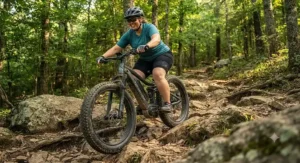
Understanding Weight Ratings on Fat Bikes
Weight ratings on fat bikes aren’t a single standardized measurement, and that inconsistency trips up more buyers than any other spec on this list. Some manufacturers publish a “rider weight limit,” which covers only the person on the bike; others publish a “payload capacity,” which includes rider plus cargo, panniers, or a rear rack load. The QuietKat Lynx illustrates this well — it publishes both a 300-lb maximum rider weight and a separate 355-lb total payload figure, which is a stricter and more precise accounting method than the single blended number most fat-tire brands use. Based on the spec comparison across this article’s lineup, that’s exactly why a bike like the Jasion Thunder Pro can advertise 500 lbs of payload while the Lynx tops out lower — they’re measuring genuinely different things, not necessarily competing on the same scale.
What most buyers overlook is that a weight rating is a structural engineering limit, not a suggestion — it reflects tested frame, wheel, and spoke tolerances, and riding meaningfully above it accelerates fatigue cracking in welds and increases spoke breakage risk over time, even if nothing fails on the first ride. Reviewers and forum threads on heavier-rider ebike communities frequently flag confusion around this exact point, with some owners reporting different weight figures listed on a manufacturer’s own site versus a retailer’s product page for the same model — which is a strong argument for confirming the current, official number directly on the Amazon listing or manufacturer site before you buy rather than trusting a single secondhand source.
Frame Durability: What Actually Holds Up
Frame durability for a heavier rider comes down to three factors that rarely get explained clearly in product listings: tubing gauge, weld quality, and dropout reinforcement. Thicker-gauge aluminum tubing at high-stress points — the bottom bracket junction, the seat tube, and the rear dropouts — resists the kind of fatigue flex that thinner budget frames develop over months of heavier loading. Reinforced aluminum frames show up repeatedly across the higher-capacity bikes in this guide, including the Himiway Cobra Pro and Jasion Thunder Pro, and that construction choice isn’t incidental to their 400-500 lb ratings.
What the spec sheet won’t tell you is that weld quality varies significantly even within the same alloy grade, and it’s genuinely difficult to assess from a product photo — this is where aggregated owner reviews become more useful than manufacturer marketing copy, since long-term owners are the ones who report cracked welds or frame flex after real mileage. Full-suspension frames like the QuietKat Lynx and Cyrusher Ranger 2.0 add pivot points that also need periodic inspection, since a worn pivot bearing can introduce play that feels like frame flex even when the frame itself is sound. Practically speaking: a heavier rider should treat frame warranty length as a genuine spec, not fine print — a manufacturer confident in their welds typically backs the frame for years, not months.
Fat Tire eMTB Tire Pressure Guide: Dialing In PSI for Traction
Getting your tire PSI for traction right matters more on a fat tire eMTB than on almost any other bike category, because these tires are engineered to run at pressures a road cyclist would consider dangerously low. As a starting reference point:
| Terrain | Recommended PSI |
|---|---|
| Pavement / hard surfaces | 18-24 PSI |
| Hard-packed dirt or gravel | 10-16 PSI |
| Packed snow | 5-10 PSI |
| Soft sand or fresh snow | 4-8 PSI |
Here’s what the spec sheet won’t tell you: these ranges assume a standard adult rider, and heavier riders should generally sit toward the higher end of each range to avoid rim strikes and tire squirm under load, then adjust downward 1-2 PSI at a time until traction improves without the tire folding under cornering pressure. Reviewers and long-time fat bike owners consistently note that the rear tire should run 1-3 PSI higher than the front, since it carries more of the rider’s weight — a detail that matters even more when that weight is on the higher end. A standard automotive gauge won’t read accurately in this single-digit-to-low-teens range, so a low-pressure gauge built specifically for fat tires is a worthwhile accessory rather than an optional upgrade — this detailed fat tire pressure breakdown is a useful reference if you want terrain-by-terrain starting points. Getting this dialed in is genuinely one of the highest-value, lowest-cost adjustments you can make — it’s free, it takes two minutes, and it changes the ride more than almost any other single variable.
🔋 Pro tip: air down before you hit soft terrain, not after you’re already stuck — trying to adjust pressure mid-ride rarely works out as well as prepping beforehand.
Fat Tire Electric Mountain Bike With Suspension: Front Fork vs Full Suspension
The suspension question splits this category cleanly into two camps, and the right answer depends heavily on where you actually ride rather than which option simply sounds more capable. Front-fork-only bikes — the Jasion Thunder, Himiway Zebra D5 Pro ST, and ANCHEER Speedrid among them — absorb impact at the front wheel while the rear triangle stays rigid, which keeps the frame simpler, lighter, and cheaper to maintain. On paper this means less to service and fewer pivot points to wear out, which matters over a multi-year ownership horizon.
Full suspension, found on the Himiway Cobra Pro, Jasion Thunder Pro, QuietKat Lynx, and Cyrusher Ranger 2.0, adds a rear shock that lets the back wheel track uneven terrain independently of the front. What most buyers overlook is that this isn’t purely a comfort feature — for a heavier rider, a rigid rear end transmits more impact force directly into the frame and the rider’s body on rough terrain, so full suspension can meaningfully reduce both fatigue and long-term joint stress on rides longer than an hour. The tradeoff is real, though: more pivots mean more bearings to service, and full-suspension frames generally cost more to repair if something does wear out. Our honest take: if your riding is mostly pavement, bike paths, or hardpack gravel, front-suspension-only is genuinely sufficient and saves you real money; if singletrack, roots, and rock gardens are a regular part of your riding, full suspension earns its premium — and the fact that the Jasion Thunder Pro now offers it at a genuinely budget price is worth noting.
Features That Actually Matter (And Those That Don’t)
Marketing copy loves to lead with top speed and peak wattage, but those numbers matter far less than buyers assume once you’re actually riding. What genuinely matters: torque sensors over basic cadence sensors, since torque-based power delivery feels dramatically smoother and more predictable, especially starting from a stop on an incline — the mid-drive torque sensor on the Himiway Zebra D5 Pro ST and the torque sensor on the Cyrusher Ranger 2.0 are good examples. Hydraulic disc brakes over mechanical ones matter enormously for a heavier rider, since stopping distance scales with combined weight and hydraulic systems modulate more precisely under hard braking. Battery capacity in real watt-hours, not just voltage, tells you actual range — a 48V battery with a small amp-hour rating can deliver less real-world range than a lower-voltage pack with a larger capacity.
What matters less than the marketing suggests: peak wattage figures, since most riding happens well below a motor’s peak output, and sustained/rated wattage is the more honest number to compare. Top speed claims matter less than most buyers assume too, since Class 3’s 28 mph ceiling is a legal limit in most states regardless of what the motor could theoretically produce unrestricted. And color options, integrated smartphone apps, and Bluetooth connectivity — like the GPS tracking on the QuietKat Lynx — are genuinely nice-to-haves; pleasant, but not worth prioritizing over frame durability, weight rating, or brake quality when your budget forces a tradeoff.
Common Mistakes When Buying a Fat Tire Electric Mountain Bike
A frequent and costly mistake is choosing a bike based purely on advertised top speed rather than payload rating — a fast bike that’s under-built for your weight will show stress before a slower, properly-rated one ever does. Another common error is skipping the step-thru option out of habit, assuming it’s a compromise; for plus-size riders managing joint stress or balance concerns while mounting, a step-thru frame like the Himiway Zebra D5 Pro ST‘s is a genuine functional upgrade, not a downgrade. Buyers also frequently underestimate shipping and assembly weight — several bikes in this category exceed 70-90 lbs fully assembled, which affects everything from home storage to whether you can lift it into a truck bed alone.
Skipping a careful read of the listing’s weight-rating fine print is another recurring regret reviewers mention — capacity figures genuinely vary between brands and even between model tiers of the same bike, and it’s not something a headline spec fully communicates. Finally, buyers commonly assume the advertised weight rating from a general product listing applies to every color, frame size, and battery configuration of a given model, when in reality some configurations shift the number slightly — always confirm the rating for the exact configuration you’re ordering, not just the model name.
Safety, Regulations & Compliance for Heavier Riders
Most fat tire electric mountain bikes fall under the federal “low-speed electric bicycle” definition, which caps motor output at 750 watts of continuous rated power and requires the motor to stop providing assistance once the bike reaches a set speed threshold, keeping the bike legally classified as a bicycle rather than a motor vehicle. On top of that federal baseline, most U.S. states layer on their own three-class classification system, which determines where a Class 1, 2, or 3 e-bike can legally be ridden — bike paths, road shoulders, or off-road trails — and whether a helmet is mandatory. Because rules vary meaningfully by state and even by local trail authority, it’s worth checking your specific jurisdiction before assuming a bike rated for off-road use is legal on every trail system near you; this matters in particular for higher-wattage models like the Jasion Thunder Pro or Jasion Thunder, whose peak output figures exceed the federal 750W continuous threshold even though their assisted speed is still electronically capped.
For plus-size riders specifically, safety comes down to matching equipment to load: hydraulic disc brakes with larger rotors (180mm or greater) handle heavier stopping loads more predictably than smaller mechanical setups, and it’s worth prioritizing that spec even if it means a smaller battery. A properly fitted helmet meeting ASTM or CPSC standards is non-negotiable regardless of class, and reflective or integrated lighting matters more at night given the added stopping distance heavier combined weight introduces. If you’re returning to regular cycling after time away, easing into longer rides gradually rather than jumping straight to max-distance outings gives your body — and the bike’s brakes and drivetrain — time to adapt together.
FAQ
❓ What is the best fat tire electric mountain bike for plus-size riders?
❓ How much weight can a fat tire electric bike hold?
❓ What PSI should I run in fat tire eMTB tires?
❓ Do I need a step-thru frame if I'm a bigger rider?
❓ How much does a fat tire electric mountain bike cost?
Conclusion
If there’s one takeaway from this guide, it’s that “weight capacity” isn’t a single universal number — it’s rider weight or total payload depending on the brand, and knowing which one you’re reading changes how you compare bikes. For most plus-size riders shopping this category in 2026, the Jasion Thunder Pro offers the strongest capacity-per-dollar with genuine full suspension, the Himiway Zebra D5 Pro ST hits the sweet spot of comfort and easy mounting, and the Himiway Cobra Pro or QuietKat Lynx reward riders who genuinely need full-suspension trail performance and are willing to pay for it.
Beyond the spec sheet, the details that actually change your riding experience — dialed-in tire PSI, correctly sagged suspension, a frame with real structural headroom above your weight — cost little or nothing extra but make the difference between a bike that feels like it was built for you and one that merely accommodates you. Whichever model you land on, treat the payload rating as a hard engineering limit rather than a marketing suggestion, and you’ll get years of reliable riding out of it.
✨ Ready to Ride? Compare Today’s Top Picks
🔍 You’ve done the research — now take the next step. Click through on any bike above to check current pricing and availability before you decide. The right fat tire electric mountain bike is out there, built for exactly the rider you are today.
Recommended for You
- Hardtail Electric Mountain Bike: 7 Best XC Picks for 2026
- Hardtail eMTB for Beginner Riders: 7 Amazon Picks for 2026
- Hardtail Emtb Under $2000: 7 Real Amazon Picks (2026)
Disclaimer: This article contains affiliate links. As an Amazon Associate, I earn from qualifying purchases. If you purchase products through these links, we may earn a small commission at no additional cost to you.
✨ Found this helpful? Share it with your friends! 💬🤗
