

In This Article
Here’s the thing nobody tells you when you start shopping for a mobility scooter for outdoor use: the specs sheet lies by omission. A scooter can boast a huge top speed and still stall out the second its front wheel meets a lip of broken sidewalk. What actually separates a “goes to the mailbox” scooter from one that handles gravel driveways, sloped parks, and cracked curbs comes down to three quiet numbers — ground clearance, tire type, and suspension travel — that most listings bury below the fold.

This guide exists to put those numbers front and center. We dug into real product specifications, aggregated review sentiment, and manufacturer engineering data to line up seven scooters that were actually built with the outdoors in mind, not just tolerant of it. You’ll find a heavy duty mobility scooter rated for riders well past 400 pounds, a couple of 3 wheel mobility scooter options prized for their tight turning radius, and at least one model with a genuinely useful mobility scooter with basket setup for grocery runs.
A mobility scooter for outdoor use is generally defined as a battery-powered, seated mobility device — as Wikipedia’s overview of mobility scooters puts it, a category that sits somewhere between a power wheelchair and a motorscooter — built with reinforced frames, larger pneumatic tires, and enough torque to climb ramps and uneven terrain without tipping.
Below, you’ll get a quick comparison table, then a full breakdown of all seven scooters, a rundown of 3 wheel versus 4 wheel stability, a deep look at all-terrain tire tread and battery range for outdoor trips, and a practical setup guide so your first month with the thing doesn’t turn into a headache. Let’s get into it.
Quick Comparison Table
Before the deep dive, here’s the 30-second version. This snapshot leans on weight capacity, tire type, and range — the three specs that matter most once pavement turns to gravel.
| Scooter | Wheels | Weight Capacity | Best For |
|---|---|---|---|
| EWheels EW-66 | 3-wheel | 600 lbs | Two riders, max power |
| Shoprider Enduro XL4 | 4-wheel | 500 lbs | Heavy duty all-terrain |
| Drive Cobra GT4 | 4-wheel | 450 lbs | Premium comfort |
| Pride Pursuit XL | 4-wheel | 400 lbs | Longest battery range |
| Golden Companion HD | 3-wheel | 500 lbs | Tight turning + basket |
| Pride Maxima Ultra HD | 3-wheel | 500 lbs | Best value with basket |
| EWheels EW-38 | 3-wheel | 500 lbs | Budget all-terrain |
Looking at this lineup, weight capacity clusters tightly around the 450-600 lb range, which tells you something important: this whole list skews toward genuinely heavy duty builds rather than lightweight folding scooters. The EWheels EW-66 stands apart because it’s engineered to carry two people at once, while the Pride Pursuit XL trades a bit of weight capacity for the single longest range in the group. If your driveway or neighborhood involves real hills or loose gravel, prioritize the 4-wheel models here — the wider stance simply resists tipping better than any 3-wheel scooter can on a hard sideways slope.
Found a scooter that already looks promising? Bookmark this table — you’ll want to compare it against the deeper breakdowns below before you decide.
Top 7 Mobility Scooters for Outdoor Use: Expert Analysis
1. EWheels EW-66 — best for two riders and maximum hauling power
The standout here isn’t subtle: this is one of the only scooters on the market genuinely built to carry a driver plus a passenger, at the same time, outdoors. A 700-watt brushless motor pushes the EW-66 to a 15 mph top speed with a 35-mile range, and its heavy-gauge steel frame is rated for a combined 600 lbs — numbers that dwarf almost every other scooter in this roundup. Front and rear shocks soak up bumps that would rattle a lighter unit apart, and the tubeless tires resist flats better than air-filled alternatives, which matters if your outdoor routes include gravel shoulders or debris-strewn trails.
Based on the spec comparison, this scooter is really built for two distinct buyers: couples who want to ride together, and larger riders who’ve been squeezed out of standard-capacity scooters. Reviewers consistently note that the second seat and extra weight capacity come at the cost of size — this is not a scooter you’re folding into a sedan trunk.
Pros:
- ✅ Massive 600 lb combined weight capacity for two riders
- ✅ 35-mile range covers long outdoor excursions easily
- ✅ Front and rear shocks smooth out rough terrain
Cons:
- ❌ Large footprint makes transport and storage harder
- ❌ Premium build pushes it toward the top of the price range
At the time of research, the EWheels EW-66 typically lists in the $3,500-$4,600 range on Amazon — always check current price and availability before buying. For anyone who wants a genuinely heavy duty mobility scooter that doubles as a two-person outdoor cruiser, it’s tough to beat.

2. Shoprider Enduro XL4 — best heavy-duty 4-wheel all-terrain option
What most buyers overlook about the Enduro XL4 is that its 500 lb weight capacity isn’t the headline feature — the full suspension system is. Paired with 14-inch pneumatic front and rear tires, that suspension is what actually determines whether a bump in the trail becomes a jolt or a non-event. The delta-style tiller houses lighting, turn signal, and horn controls in one place, and depending on the battery pack chosen, range stretches from 24 up to 37 miles per charge.
Here’s what the spec sheet won’t tell you outright: an 8-degree safe climbing angle is genuinely respectable for a scooter this size, meaning driveway inclines and gentle park slopes are well within its comfort zone. Reviewers of the broader Shoprider heavy-duty line frequently highlight the brand’s suspension tuning as a differentiator versus cheaper 4-wheel competitors that rely on tire flex alone to absorb terrain.
Pros:
- ✅ Full front-and-rear suspension smooths rough outdoor paths
- ✅ 500 lb capacity suits larger and heavier riders
- ✅ Battery options extend range up to 37 miles
Cons:
- ❌ At 323 lbs, it’s a heavy unit to transport
- ❌ Larger battery packs add meaningfully to the price
Check current price for the Shoprider Enduro XL4 — heavy duty models like this generally fall in the $2,800-$3,800 range depending on battery configuration. If outdoor stability on rougher ground is your top priority, this is one of the strongest 4-wheel candidates here.
3. Drive Cobra GT4 — best for premium comfort at higher speeds
The Cobra GT4’s calling card is speed most scooters simply don’t offer: a 10 mph top end paired with a 35-mile range, wrapped in a sport-styled captain’s seat that’s height-adjustable, swivels, and reclines. Large 14-inch pneumatic tires and full suspension are doing the real work outdoors, cushioning the ride over the kind of cracked pavement and rutted paths that would otherwise transmit straight into the rider’s spine.
What most buyers overlook about the GT4 is the 950-watt motor paired with a Dynamic Rhino II 160A controller — that’s a notably beefier drivetrain than most scooters carrying a similar 450 lb weight rating, which is exactly why it can sustain higher speeds without feeling strained on inclines up to an 8-degree grade. Based on the spec comparison, this scooter reads as the “sport sedan” of the group: faster, smoother, and more adjustable, at a real cost in size and price.
Pros:
- ✅ 10 mph top speed is class-leading for outdoor cruising
- ✅ Full suspension and large pneumatic tires ease rough rides
- ✅ Highly adjustable captain’s seat suits long outings
Cons:
- ❌ 82-inch turning radius makes tight spaces awkward
- ❌ Among the priciest options in this roundup
Prices for the Drive Cobra GT4 vary by seat width and battery choice — expect it to sit toward the upper end of the heavy duty scooter market, so it’s worth comparing current listings before committing. Riders who value speed and plush comfort over portability will get the most out of it.
4. Pride Pursuit XL — best battery range for long outdoor trips
If your outdoor days involve long stretches — a big park loop, a rural road with no charging stops — the Pride Pursuit XL earns its spot through one number: a 29-mile range on a 24-volt system, backed by dual Group 24 or Group 27 batteries depending on configuration. Thirteen-inch low-profile pneumatic tires are tuned specifically for outdoor performance, and a 180-amp microprocessor-based controller keeps power delivery smooth rather than jerky, which matters when you’re navigating a mixed surface of pavement and grass.
Based on the spec comparison, the Pursuit XL’s 400 lb weight capacity is the most conservative number in this lineup, so it’s not the pick for bariatric-range riders — but for anyone under that threshold, it trades a bit of raw capacity for meaningfully more range per charge than lighter-duty competitors offer. A full lighting package adds a genuine safety margin for early morning or dusk rides, something casual indoor-oriented scooters often skip entirely.
Pros:
- ✅ 29-mile range beats most scooters in its weight class
- ✅ 13-inch pneumatic tires built specifically for outdoor use
- ✅ Full lighting package adds visibility and safety
Cons:
- ❌ 400 lb capacity is lower than most others on this list
- ❌ Dual battery setup adds noticeable unit weight
Check current price for the Pride Pursuit XL — outdoor-focused mid-size scooters in this class commonly land in the $2,600-$3,500 range. For anyone whose outings run long and far from home, the extended range here is the deciding factor.
5. Golden Companion HD GC540 — best 3 wheel scooter for tight turning and storage
The Companion HD’s party trick is a 51-inch turning radius that’s noticeably tighter than most heavy-duty competitors, a direct benefit of its 3-wheel layout — genuinely useful for navigating tight garden paths or crowded farmers’ market aisles without a three-point turn. A 120-amp controller drives climbing performance, rear suspension takes the edge off bumps, and the whole thing rides on 10.75-inch solid, non-marking tires that never go flat, trading a slightly firmer ride for zero puncture risk.
What most buyers overlook here is the large front basket, which is standard equipment rather than a bolt-on accessory — a genuine mobility scooter with basket setup that’s ready for groceries or a bag on day one. Reviewers of Golden Technologies’ heavy-duty lineup frequently point to the brand’s LCD console, which actively displays fault codes and battery level, as a small but meaningful upgrade over scooters that rely on a single vague gauge.
Pros:
- ✅ Tight 51-inch turning radius eases navigation outdoors
- ✅ Large front basket included standard for errands
- ✅ Solid non-marking tires never go flat
Cons:
- ❌ 16-mile range trails behind most others here
- ❌ Solid tires ride firmer than pneumatic alternatives
At the time of research, the Golden Companion HD generally lists somewhere in the $3,000-$3,800 range — prices may vary by retailer and color. For outdoor trips that involve tight turns more than long distances, this is a genuinely smart pick.
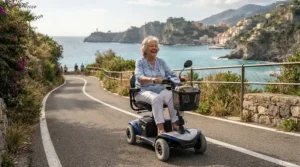
6. Pride Maxima Ultra HD 3-Wheel — best value 3 wheel mobility scooter with basket
Pride bills this as its toughest scooter, and the numbers back that up: a 500 lb weight capacity, a 49-inch turning radius, and up to 19.8 miles of range from a single charge. Flat-free, non-scuffing tires eliminate roadside puncture repairs entirely, while a full LED lighting package — headlights, turn signals, and taillights — brings a genuine safety upgrade that budget scooters frequently skip.
Here’s what the spec sheet won’t tell you, but the standard-equipment list does: this scooter ships with a front basket, a depth-adjustable high-back seat with a 4-point swivel, and a USB charging port built directly into the tiller. Based on the spec comparison against the Companion HD above, the Maxima trades a slightly wider turning radius for a genuinely larger 500 lb weight rating at a comparable price point — a trade worth considering depending on your own build and the width of your usual outdoor routes.
Pros:
- ✅ 500 lb capacity at a genuinely competitive price point
- ✅ Standard front basket, no accessory purchase needed
- ✅ Flat-free tires remove puncture risk entirely
Cons:
- ❌ 19.8-mile range is modest for all-day outings
- ❌ Solid tires transmit more vibration than pneumatic tires
Check current price for the Pride Maxima Ultra HD 3-Wheel — expect a range generally similar to other 500 lb-capacity 3-wheel scooters, roughly $2,400-$3,200. It’s a genuinely strong value pick for anyone who wants basket-ready convenience without paying premium-tier prices.
7. EWheels EW-38 — best budget-friendly all-terrain 3 wheel scooter
Rounding out the list is the most affordable entry here, and it still punches well above budget-tier expectations: a 700-watt brushless motor, a 500 lb weight capacity, and — remarkably for this price bracket — a 43-mile range on a single charge, the longest of any scooter in this comparison. Tubeless tires resist flats, electric magnetic brakes provide consistent stopping power, and a full LED lighting setup plus an anti-theft alarm system round out a feature list that’s unusually complete for an entry-level price.
What most buyers overlook about the EW-38 is that “budget” here refers to price, not capability — the weight capacity and motor output actually match or beat several pricier scooters on this list. Aggregated buyer feedback on EWheels’ scooter lineup tends to praise value-for-money most consistently, while noting that documentation and customer support responsiveness can be less polished than legacy medical-equipment brands.
Pros:
- ✅ 43-mile range is the longest of any scooter here
- ✅ 500 lb capacity rivals scooters twice the price
- ✅ Tubeless tires plus full LED lighting standard
Cons:
- ❌ Newer brand with a smaller established review base
- ❌ Fewer official accessories than legacy medical brands
At the time of research, the EWheels EW-38 is typically priced under $2,200, making it the most accessible heavy duty mobility scooter on this list. If budget is the deciding factor, this is where to start looking.
Practical Usage Guide: Your First 30 Days Outdoors
Getting a new scooter is the easy part — the first month is where good habits either form or don’t. Start with the break-in period: nearly every manufacturer on this list recommends charging batteries daily for the first two weeks, even from a partial discharge, because lead-acid battery packs need that repeated cycling to reach their full rated capacity. Skip this step and you’ll swear your scooter’s range is 15% shorter than advertised — because, functionally, it is.
Before your first real outdoor ride, walk the route on foot first. Check for curb heights above your scooter’s ground clearance rating, soft shoulders that could bog down smaller tires, and any slope steeper than your model’s rated safe climbing angle. This single habit prevents the single most common first-month mistake: getting a scooter stuck or tipped somewhere with no easy way to call for help.
A few other early wins: adjust the tiller angle and seat position before you ever leave the driveway, not after your wrist starts aching two miles in. Keep tire pressure in the manufacturer’s recommended range if you’ve got pneumatic tires — underinflated tires are the number one cause of mysteriously sluggish range complaints. And build a simple weekly habit of wiping down the frame and checking brake response, since outdoor grit accumulates in ways indoor use never does.

Real-World Scenarios: Matching Riders to Scooters
Consider three different outdoor riders. First, a retired teacher living on a quarter-acre lot with a gravel driveway and a weekly trip to a farmers’ market three blocks away — low daily mileage, but tight turns and a bumpy surface matter more than range. The Golden Companion HD or Pride Maxima Ultra HD 3-Wheel fit this pattern well, trading maximum range for maneuverability and a basket that’s actually useful for produce.
Second, a rural retiree whose nearest neighbor is a half-mile down an unpaved road, with genuinely long outdoor stretches between any two points. Range stops being a nice-to-have and becomes the entire decision. The EWheels EW-38 or Pride Pursuit XL — the two longest-range scooters on this list — are the logical picks, since a scooter that runs out of charge a mile from home is a far bigger problem in a rural setting than an urban one.
Third, a couple who want to explore local trails together rather than one rider trailing behind the other on foot. That’s a narrow use case, but it’s exactly what the EWheels EW-66 was designed to solve, with its two-passenger capacity and shock-absorbing suspension built for exactly this kind of shared outdoor mobility.
Research tracking outdoor falls among community-dwelling older adults found that uneven walking surfaces and broken pavement were consistently linked to increased fall risk — a strong argument for matching your scooter’s tire type and clearance to your actual local terrain, not just the smoothest sidewalk near your house.
How to Choose a Mobility Scooter for Outdoor Use
- Start with weight capacity, not speed. Every scooter on this list is rated for a maximum combined weight of rider plus cargo — exceeding it isn’t just a warranty violation, it measurably degrades braking and stability.
- Match tire type to your terrain. Pneumatic tires absorb shock better on gravel and grass; solid tires never go flat but ride firmer on rough ground.
- Check ground clearance against your actual curbs. A scooter with 3 inches of clearance will scrape on obstacles a 5-inch model glides over.
- Prioritize range over top speed. A faster scooter that runs out of charge a mile from home is a worse outcome than a slower one that gets you all the way back.
- Consider turning radius for your environment. Tight paths and crowded outdoor markets favor 3-wheel scooters; open trails favor the wider stability of 4-wheel designs.
- Factor in transport and storage realistically. A 300-lb scooter isn’t going in most car trunks — check if it disassembles if you’ll need to transport it.
- Don’t skip the lighting package. Full LED lighting isn’t cosmetic — it’s the difference between being visible at dusk and being a hazard.
3 Wheel vs 4 Wheel Mobility Scooter: Which Wins Outdoors?
This is the debate that trips up more first-time buyers than any spec on the sheet. A 3 wheel mobility scooter turns tighter — often by a foot or more of turning radius — because there’s no second front wheel to work around. That’s a real advantage on winding garden paths or crowded outdoor markets. But that same single front wheel is also the reason 3-wheel scooters are more prone to tipping sideways on a hard cross-slope, since there’s less of a stable base fighting the lean.
A 4-wheel scooter sacrifices some of that tight turning for a genuinely wider, more planted stance — the kind of stability that matters most on sloped lawns, cambered sidewalks, or uneven trail edges. Reviewers and mobility specialists alike tend to agree that four wheels is the safer default recommendation for anyone regularly riding on grass, gravel, or anything short of flat pavement, while three wheels remains the better choice for tight indoor-outdoor hybrid use where turning radius genuinely rules the day.
| Factor | 3 Wheel | 4 Wheel |
|---|---|---|
| Turning radius | Tighter | Wider |
| Side-slope stability | Lower | Higher |
| Best terrain | Paths, tight spaces | Grass, gravel, slopes |
The takeaway from this comparison is straightforward: don’t pick based on wheel count alone — pick based on whether your daily outdoor routes involve more tight turns or more uneven cross-slopes, since that single factor predicts real-world satisfaction better than almost any other spec.

All-Terrain Tire Tread and Ground Clearance: What Actually Matters
Tire tread gets treated like a footnote, but it’s arguably the single most consequential spec for anyone shopping a mobility scooter for outdoor use. Pneumatic (air-filled) tires with deep, aggressive tread — the kind found on the Shoprider Enduro XL4 and Drive Cobra GT4 — flex around small rocks and roots rather than transmitting the impact straight to the frame, which is exactly why full-suspension models pair them by default. Solid, flat-free tires trade that cushioning for zero puncture risk, a fair trade for riders who value low maintenance over outright ride comfort.
Ground clearance works alongside tread, not instead of it. A scooter with 3 inches of clearance will scrape on the same curb transition that a model with 5+ inches clears without a second thought — and that scrape is exactly the moment a rider risks a stall or a tip. The general rule holds across every heavy duty mobility scooter in this roundup: bigger tires, deeper tread, and more clearance consistently correlate with confident performance once you leave paved sidewalks behind.
Battery Range for Outdoor Trips: Long-Term Cost & Realistic Expectations
Advertised range numbers assume ideal conditions — flat ground, moderate temperature, a rider well under maximum capacity. Real-world battery range for outdoor trips typically comes in 15-25% under the advertised figure once you factor in hills, cold weather, and a fuller battery discharge cycle. That’s not a defect; it’s physics, and every manufacturer’s fine print says as much.
| Scooter | Advertised Range | Best Realistic Use Case |
|---|---|---|
| EWheels EW-38 | 43 miles | Rural, long-distance daily use |
| Pride Pursuit XL | 29 miles | Extended park loops, errands |
| EWheels EW-66 | 35 miles | Long trips, two riders |
| Golden Companion HD | 16 miles | Short, frequent local trips |
Looking at the range spread here, the practical lesson is to buy meaningfully more range than your typical daily need — a 16-mile scooter used for a 12-mile round trip leaves almost no safety margin once terrain and cold weather eat into that number, while a 40-mile scooter covering the same trip has real cushion. Over a multi-year ownership period, replacement battery packs typically run a few hundred dollars every 12-18 months of regular outdoor use, a cost worth budgeting for regardless of which model you choose.
Safety, Stability, and Outdoor Regulations Guide
Stability on uneven ground comes down to a formula every engineer already knows: wider wheelbase plus lower center of gravity plus functioning suspension equals a scooter that resists tipping. Every model in this roundup checks at least two of those three boxes, which is exactly why we included them — plenty of budget scooters on the broader market check none.
There’s also a regulatory layer worth understanding if your outdoor routes cross public parks, trails, or government-managed land. Under the Americans with Disabilities Act, the Department of Justice’s guidance on mobility devices confirms that wheelchairs and scooters used by people with mobility disabilities must generally be permitted in any area open to pedestrian use, with only narrow safety-based exceptions. That’s a meaningful protection for anyone who’s ever worried about being turned away from a public path.
✨ Ready to find your match? Compare current listings and pricing for any scooter above before you commit — availability shifts fast. 😊

FAQ
❓ What is the best mobility scooter for outdoor use on grass?
❓ How far can a heavy duty mobility scooter travel on one charge?
❓ Is a 3 wheel mobility scooter safe on hills?
❓ Do all mobility scooters with baskets come with one standard?
❓ What ground clearance do I need for uneven sidewalks?
Conclusion
Choosing the right mobility scooter for outdoor use really does come down to matching three numbers — weight capacity, tire type, and range — to your actual daily terrain, rather than chasing the highest top speed on the spec sheet. Whether that means the tight-turning convenience of the Golden Companion HD, the long-haul range of the Pride Pursuit XL, or the sheer capability of the EWheels EW-66 for two riders at once, there’s a genuinely strong option above for nearly every outdoor routine.
Take the time to walk your typical routes, note the curbs and slopes you’ll actually face, and use the comparison tables above to narrow things down before you buy. A little homework now saves a lot of frustration — and a possible return shipment — later.
Recommended for You
- Electric Mobility Scooter For Seniors: 7 Best Picks For Independence In 2026
- Seated Electric Scooter For Adults: 7 Comfortable Picks (2026)
- Racing Electric Scooter Guide 2026: 7 Fastest Picks Ranked
Disclaimer: This article contains affiliate links. As an Amazon Associate, I earn from qualifying purchases. If you purchase products through these links, we may earn a small commission at no additional cost to you.
✨ Found this helpful? Share it with your friends! 💬🤗
