
In This Article
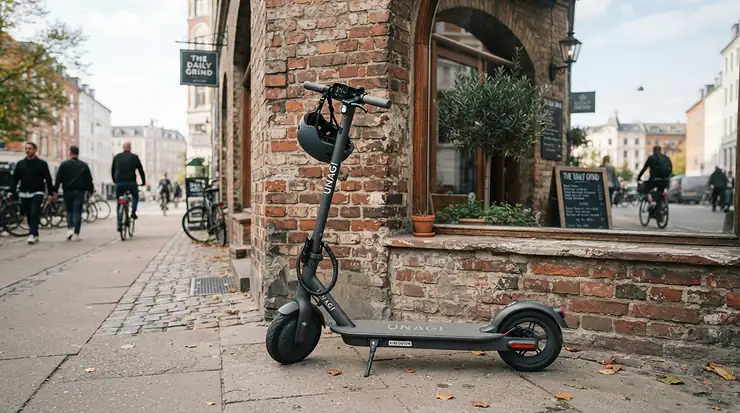
An electric moped with removable battery for apartment dwellers is a seated, throttle-driven two-wheeler whose lithium pack unlatches from the frame. You carry the pack inside, charge it where you can watch it, and leave the heavier vehicle locked up outside. Think of it as the commuter version of a phone you can charge in another room. 🔋
Here’s the apartment problem in one sentence: nobody wants to wrestle a 150-pound machine through a lobby, up a stairwell and into a studio that already has a futon, a bike and a suspicious amount of cardboard. A pack you can lift out solves most of that. It doesn’t solve everything, though, and that’s the part most buying guides skip.
Fire officials are blunt about why. FDNY’s public safety messaging urges people to charge and store lithium-ion micromobility devices outside wherever possible. Many renters can’t. So this guide treats the battery as the main character: how much capacity you actually need, what the certification labels mean, and how to handle indoor charging practices without gambling with your lease or your smoke detector.
I researched seven real models with removable or replaceable packs, from entry-level seated scooters to full-size mopeds. I haven’t ridden any of them, so everything below is spec analysis and aggregated review themes from published roundups, not hands-on testing. Where the evidence is thin, I’ll say so.
Quick Comparison Table: 7 Removable-Battery Mopeds at a Glance
Before the deep dive, here’s the field on one screen. “Removable” means the pack comes off the frame according to the sources I reviewed. Confirm it on the exact listing, because brands sell several versions of the same model name.
| Product | Pack (V / Ah) | Removable? | Price Tier | Best For |
|---|---|---|---|---|
| OUXI V8 | 48V / 15Ah | Yes | Mid | Certified-battery commuters |
| Segway eMoped E110A | About 48V / 30Ah (dealer sheet) | Reported, confirm per listing | Premium | Short, brand-backed city commutes |
| NIU MQi GT | 48V / 31Ah ×2 | Yes | Premium | Long commutes, dual packs |
| TST R004 | 48V / 15Ah | Yes | Mid | Heavier riders, couples |
| GREATWORK K7 | 480Wh (V/Ah not stated) | Yes | Budget | Groceries, short hops |
| Maxshot V1SPRO | 42V / 10.5Ah | Replaceable | Budget | Small closets, light riders |
| CYCROWN RunMini | 36V / 10.4Ah | Yes | Budget | Petite riders, beginners |
Looking at the table, pack size and price rise together, but certification doesn’t track price at all. The budget Maxshot V1SPRO lists UL 2272, while some pricier entries rely on brand claims you’ll need to verify. If you live above the ground floor, the smaller packs on the GREATWORK K7, Maxshot V1SPRO and CYCROWN RunMini are easier to haul. The trade-off is range.
💬 Just one click — help others make better buying decisions too!😊
Top 7 Picks: Electric Moped with Removable Battery for Apartment Dwellers
1. OUXI V8 — UL 2849 listing and a 720Wh pack
The OUXI V8 leads with its battery: a removable 48V 15Ah pack, which multiplies out to about 720Wh. Its Amazon listing title carries a UL 2849 certification claim, and the brand says the pack is UL-certified too.
The motor is rated 750W (1,000W peak) with a claimed top speed around 32 mph. The owner’s manual puts throttle range at 28-37 miles and charging at 5-7 hours. On paper, 37 miles from 720Wh is roughly 19Wh per mile, a sensible figure for a mid-weight machine. IP54 protection handles splashes, not a pressure washer or a monsoon.
Here’s the apartment angle. A 720Wh pack is a bigger object to carry and a bigger energy store to charge than the 370-480Wh packs on the cheaper scooters here. A dual-battery V8 Max exists if you want more range, but that’s twice the pack to supervise. Treat the certification claim like any other: check the label on the battery itself.
Reviewer sentiment is positive but not spotless. One roundup gave it the highest rating in its field, while noting tire durability concerns. I couldn’t verify a large independent review pool, so weigh that lightly.
Pros:
- ✅ UL 2849 claim on the listing
- ✅ Removable 48V 15Ah pack
- ✅ Dual-battery Max version available
Cons:
- ❌ Frame weighs around 84 lbs
- ❌ Tire durability flagged in roundups
Pricing runs from the mid-$400s for base versions to around $1,000 for the dual-battery Max, so check current price. For renters who want a verifiable safety story, it’s the best value in this group.

2. Segway eMoped E110A — brand-backed city commuter with real torque
The Segway eMoped E110A is the “grown-up” option here, built around 30 mph speeds and a typical range of about 35 miles. Its published specs list 1.5kW max motor output and 88 Nm of torque at the drive wheel.
That torque figure matters more than the headline speed. It’s what keeps you moving on an overpass instead of crawling up it. The frame weighs 179 lbs, with a 60-inch wheelbase, and an IPX5 rating covers rain-spray. Battery numbers vary by source: a dealer sheet lists 1,440Wh (30Ah), while launch coverage mentioned a larger 1.8kWh pack. Using the dealer figure, 35 miles works out to about 41Wh per mile, the thirstiest in this roundup. That’s the cost of a heavier, faster vehicle.
For apartment life, the frame stays outside and only the pack comes in. That makes the Segway eMoped E110A a better fit for buildings with secure ground-level parking than for walk-ups with a narrow stair. Launch coverage notes you can add a second battery to extend range, but confirm which version you’re buying.
I couldn’t find a large body of independent owner reviews for this exact model, so I won’t summarize sentiment I can’t verify.
Pros:
- ✅ About 35-mile typical range at 30 mph
- ✅ 88 Nm torque for hills
- ✅ Optional second pack extends range
Cons:
- ❌ 179 lb frame is hard to maneuver
- ❌ Capacity figures differ between sources
Dealer listings I saw ran roughly $3,000-$4,300, so check current price. It’s justified if you value brand support and torque over a low entry price.
3. NIU MQi GT — two removable packs for serious range
The NIU MQi GT is the range champion of this roundup, with two removable 31Ah lithium packs (48V, roughly 1.5kWh each). NIU quotes about 4 hours to charge one pack and 4.5 hours for both, and each pack weighs about 11 kg (24 lbs).
A 3,000W Bosch motor pushes the top speed to roughly 43 mph, which changes your legal picture. At that speed, many states treat it as a moped or motorcycle with registration, license and insurance requirements. Check your DMV before you buy. The practical upside is flexibility: run both packs for maximum range, or carry just one up to the apartment while the other stays in the scooter.
Here’s what the spec sheet won’t tell you, but dealer coverage hints at: 24 lbs per pack is manageable once, and miserable on a daily fourth-floor climb. NIU also claims its battery design retains 80% capacity after 600 full cycles on its NQi GT page, so treat that as a brand claim rather than a lab result.
Published reviews praise the easy handling and quick-release batteries, and criticize limited storage and a somewhat stiff chassis. The app tracks battery status and GPS.
Pros:
- ✅ Two removable 31Ah packs
- ✅ 4-4.5 hour charging
- ✅ App battery monitoring and GPS
Cons:
- ❌ Little storage space
- ❌ About 254 lbs, plus likely registration
Market data puts it around $2,000-$3,500 depending on year and dealer, so check current price. It’s expensive, but it’s the only pick here that can replace a car for longer commutes.
4. TST R004 — heaviest load rating in the group
The TST R004 is rated for 450 lbs, the highest capacity here, with a 750W motor (1,500W peak) and a removable 48V 15Ah pack, about 720Wh. Reviewers describe the pack as an anti-theft design that locks to the frame.
The 60-mile figure is for pedal-assist mode. Throttle-only range will be lower, so plan around 28-37 miles as a conservative guess based on similar 720Wh packs. At 66 lbs, it’s lighter than the OUXI V8, which helps if you’re lifting it over a curb. Charging takes 6-7 hours, a natural fit for an overnight cycle, but note that overnight is exactly when you shouldn’t be asleep next to it (more on that later).
The analysis comes down to who you are. If you’re a heavier rider, or share the bike with a partner, the 450 lb rating gives breathing room that 265-300 lb scooters can’t. The sources I reviewed didn’t name a safety certification, so ask the seller for UL 2849 documentation before buying.
Reviewer themes are consistent: strong power, comfortable suspension, and weight and assembly as the main complaints.
Pros:
- ✅ 450 lb capacity
- ✅ Dual suspension for rough streets
- ✅ Removable 720Wh pack with lock
Cons:
- ❌ Certification not stated in sources
- ❌ Assembly may overwhelm beginners
Pricing wasn’t published in the roundups I reviewed, so check current price. It’s a strong value if the certification question gets a clear answer.
5. GREATWORK K7 — lightest frame, biggest grocery basket
The GREATWORK K7 is the budget runabout: a removable 480Wh pack, up to 30 miles claimed range, a 20 mph top speed and a 4-hour charge. Listed weight is about 59.5 lbs with a 300 lb rider limit.
That 4-hour charge is genuinely handy. A smaller pack fills faster and gives you a shorter window of risk. Motor figures vary by listing (one source says 750W base and 1,200W peak, another 1,000W with a 1,500W peak), so read the exact version you’re buying. Hill claims of 25-30 degrees sound dramatic, but real-world climbing drops with rider weight and battery level.
For apartment dwellers, this is the “grab the pack, take the stairs” model. The seat reportedly fits two and the basket handles groceries. The caveat is evidence: one roundup noted only 15 reviews at the time, plus one negative performance review. I wouldn’t treat that as a verdict either way, just thin data.
Pros:
- ✅ 480Wh pack, 4-hour charge
- ✅ Large cargo basket
- ✅ Lightest frame at about 60 lbs
Cons:
- ❌ Very small review pool
- ❌ No certification stated
Around $300 at the time of research. Cheap enough to be worth it for short trips, but verify certification before charging it indoors.

6. Maxshot V1SPRO — UL 2272 listing, most-reviewed budget option
The Maxshot V1SPRO is technically a seated e-scooter rather than a full moped, which makes it a good example of a lithium battery electric scooter for apartment living. Listings show a 42V 10.5Ah replaceable pack (about 441Wh), a 500W motor, 22 mph and around 22 miles of range.
Its UL 2272 certification appears in the listing details. That’s the standard for personal e-mobility devices, and it’s a real differentiator at this price. The pack is also modest: 441Wh across 22 miles works out to about 20Wh per mile, roughly in line with the OUXI V8. The rider limit is 265 lbs, and solid honeycomb tires mean no flats.
For a closet-sized apartment, it folds and is far lighter than the mopeds here. The trade-off is power. Reviewers in one roundup flagged weak brakes for heavier riders, slow acceleration and struggles on hills. It’s also the most-reviewed model in that roundup (854 reviews), so the pattern is more credible than the 15-review GREATWORK K7.
Pros:
- ✅ UL 2272 listing claim
- ✅ Folds for closets and trains
- ✅ Large review base
Cons:
- ❌ Struggles on steeper hills
- ❌ 265 lb rider limit
The roundup’s price range for the whole budget field ran from about $270 to $670, and this model sits at the entry level. Check current price. It’s the best fit if your commute is flat and short.
7. CYCROWN RunMini — compact frame for smaller riders
The CYCROWN RunMini pairs a removable 36V 10.4Ah pack (about 374Wh) with a 500W motor, 16-inch fat tires and full suspension. Claimed range is 13-30 miles depending on mode, and the top speed is 20 mph.
That range spread is the real story. Thirty miles from 374Wh implies about 12Wh per mile, which is optimistic. Treat the low end, 13 miles, as your planning number for hills and heavier riders. The frame is small, and the 330 lb limit is generous for its size, though it weighs about 82 lbs. That’s heavy for something with a tiny battery.
The listing says it is “safety certified,” but doesn’t name the standard. In my view that’s a red flag, not a feature. Ask the seller exactly which UL standard, and request the certificate before you plug it in at home.
Reviewer themes: it suits beginners and light urban riding, less so heavier riders or long commutes. Brakes may squeal early on, and the tires can feel slick when wet.
Pros:
- ✅ Five speed modes
- ✅ Compact frame for petite riders
- ✅ Removable pack
Cons:
- ❌ 82 lb for a small battery
- ❌ Certification standard unnamed
Pricing wasn’t published in the sources I reviewed, so check current price. It’s fine as a beginner machine, but it’s the weakest value if you can’t verify the certification.
Indoor Charging Practices: A Setup Guide for Small Apartments
If you live above ground level, indoor charging practices aren’t optional. Here’s the routine fire-safety guidance points toward, adapted for a one-bedroom.
- Let the pack cool first. Bring it in and wait until it’s back to room temperature. Fire-safety guidance recommends charging at room temperature.
- Pick a hard, clear surface. Tile, concrete or a metal tray, never a bed, couch or pillow. Massachusetts fire officials also advise keeping packs away from combustibles.
- Use only the charger that came with it. Generic chargers are a documented problem. Check the voltage label on the charger against the pack.
- Plug straight into the wall. Skip the extension cord, and don’t stack six devices on one outlet.
- Stay present. Don’t charge while you sleep or leave the apartment. Fire departments consistently advise against unattended charging.
- Keep it away from exits. Don’t charge in a hallway or by a window or door. A UL survey found 49% of riders who charge at home block fire exits.
- Inspect weekly. Look for swelling, cracks, odd smells or hot spots, and stop using any pack that shows them.
- Replace after a crash. A knocked pack can be damaged even if it looks fine.
A smart plug or outlet timer adds a layer, but it’s not a substitute for the battery’s internal management system. If your building offers a shared charging room, use it. It beats your living room every time.
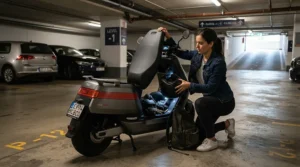
Real-World Scenarios: Which Moped Fits Which Renter?
Specs are abstract. Here are three profiles to make the choice concrete.
The third-floor walk-up renter. You commute four miles round trip, budget around $300-$500, and ride five days a week. A GREATWORK K7 or Maxshot V1SPRO makes sense because the packs are small and you only need ~441-480Wh. Keep the frame locked downstairs, and the pack comes up with you.
The elevator-building commuter. You ride 12 miles each way over hills, and your building has secure ground-floor parking. The OUXI V8 is the best-documented fit at roughly 720Wh, and the Segway eMoped E110A is the stronger climber if you can afford it. At 12 miles each way, you’ll want a pack that can handle the full 24 miles with margin, which rules out the budget scooters.
The couple with shared cargo. You share one vehicle, carry groceries, and have a bike room downstairs. The TST R004‘s 450 lb rating gives you headroom, though you’ll want written certification before charging it indoors.
The long-haul rider. If your commute runs 20+ miles each way at near-highway speeds, the NIU MQi GT is the only pick here that fits, but expect registration and insurance paperwork.
Portable Battery Electric Moped for Renters: What to Check Before You Sign or Buy
A portable battery electric moped for renters has a hidden constraint: your lease. Here’s how to work through the most common problems.
Problem: your lease bans e-mobility devices. Some buildings do, citing liability and fire risk. Ask in writing before you buy, and keep the reply. A removable pack doesn’t override a lease clause.
Problem: no ground-level parking. Choose a lighter frame (the GREATWORK K7 or Maxshot V1SPRO) so you can carry the whole vehicle if needed. A heavy frame like the Segway eMoped E110A only works with secure parking.
Problem: theft. A removable pack helps, because a thief can’t ride away with a dead frame as easily. Use a quality lock regardless.
Problem: insurance. Check whether your renter’s policy covers e-mobility devices and battery fires. Many don’t by default, so ask your insurer directly.
Problem: carrying the pack. Look up the pack’s weight before buying. NIU packs, for example, are about 24 lbs each. If you have stairs, that number matters more than top speed.
How to Choose an Electric Moped with Removable Battery for Apartment Dwellers
Start with the decision that matters most, then work outward.
- Check the certification first. Look for UL 2849 (e-bikes), UL 2272 (personal e-mobility) or UL 2271 (batteries). If the listing doesn’t name the standard, ask.
- Match capacity to commute. Use real watt-hours, not just Ah, and keep a 30% reserve.
- Weigh the pack, not just the frame. You’ll lift it daily.
- Confirm the pack actually comes off. Variants differ.
- Check your speed class. Above roughly 30 mph, expect moped or motorcycle rules.
- Read the lease. If it bans e-mobility, the best moped is useless.
- Plan your charging spot. Know where you’ll charge before you buy, not after.
Battery Capacity in Ah: What the Number Really Means
Battery capacity in Ah tells you how much charge a pack holds, but not how much energy. The fix is simple: watt-hours equal amp-hours times volts. A 48V 15Ah pack holds about 720Wh, while a 36V 10.4Ah pack holds about 374Wh. The Ah numbers look closer than the energy really is.
| Product | Volts | Ah | Approx. Wh | Claimed Range | Best For |
|---|---|---|---|---|---|
| OUXI V8 | 48 | 15 | 720 | Up to about 37 mi | Commuters |
| Segway eMoped E110A | 48 (derived) | 30 | 1,440 (dealer) | About 35 mi | Hilly commutes |
| NIU MQi GT | 48 | 31 ×2 | About 1,488 each | About 43-50 mi | Long commutes |
| TST R004 | 48 | 15 | 720 | Up to 60 mi (pedal assist) | Heavier riders |
| GREATWORK K7 | Not stated | Not stated | 480 | Up to 30 mi | Short trips |
| Maxshot V1SPRO | 42 | 10.5 | 441 | About 22 mi | Flat commutes |
| CYCROWN RunMini | 36 | 10.4 | About 374 | 13-30 mi | Beginners |
Dividing claimed miles into watt-hours is a quick sanity check (my arithmetic on claimed figures). Most of these land around 12-20Wh per mile, while the heavier Segway eMoped E110A lands near 41. If a claim implies a number far below that, expect real-world range to disappoint. And since claimed ranges are generally optimistic, cut them by about 30% when planning your commute.
Lithium-Ion Battery Safety: Standards, Certifications and Rules
Lithium-ion battery safety is the part of this decision you shouldn’t outsource to a product listing. Three UL standards matter: UL 2849 covers e-bike electrical systems, UL 2272 covers personal e-mobility devices like scooters, and UL 2271 covers replaceable battery packs. A certified product has been tested for things like electrical shock during charging and the safety of the whole electrical system.
Regulators are catching up. In June 2026, the CPSC published a proposed rule that would make these UL standards mandatory for micromobility products. According to a summary of CPSC data, it counted 227 incidents between 2019 and 2023, including 39 deaths, and charging was the biggest hazard pattern. You can read the agency’s own preliminary regulatory analysis for the background. It’s a proposal, not a final rule, so check CPSC for its current status.
What this means for you: certification reduces risk but doesn’t eliminate it. Buy certified, use the original charger, and don’t charge unattended. If a listing claims certification but you can’t find the standard named on the battery or in the documentation, treat that as unverified.
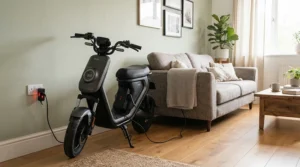
Lithium Battery Electric Scooter for Apartment Living: Moped vs Scooter vs E-Bike
A lithium battery electric scooter for apartment living is the smaller, lighter cousin of the moped. It folds, fits a closet and usually tops out around 20-22 mph. That makes it easier to live with, and less capable on hills and long routes.
| Option | Battery You Can Carry In? | Apartment Fit | Speed Class | Best For |
|---|---|---|---|---|
| Removable-pack moped | Yes | Frame outside, pack inside | Up to about 30 mph | OUXI V8, TST R004 |
| Seated e-scooter | Often | Folds into a closet | About 20-22 mph | Maxshot V1SPRO, GREATWORK K7 |
| Gas moped | No (fuel instead) | Needs fuel storage and ventilation | About 30 mph | Riders without outlet access |
Looking at the comparison above, the removable-pack moped is the best compromise if you have secure parking. Seated scooters are better if space is your biggest constraint. A gas moped avoids lithium charging entirely, but trades it for fuel handling, which doesn’t suit most apartments. Whichever you choose, the electric options cost far less per mile to run.
Common Mistakes When Buying
Trusting “UL certified” without proof. Many listings use the phrase loosely. Ask for the standard name and document. New York City, for example, prohibits the sale of devices and batteries that don’t meet recognized standards, which is a good benchmark wherever you live.
Buying by peak watts. Peak output is a marketing number. Rated power and battery size predict real performance far better.
Ignoring pack weight. A great moped with a pack you can’t lift is just a lawn ornament.
Skipping the lease. A ban means you can’t keep the moped, however good it is.
Buying a third-party replacement battery. Aftermarket packs have been linked to fires. Use manufacturer-approved replacements.
Believing the range claim. Cut it by roughly 30% for planning.
Long-Term Cost & Maintenance
Electric mopeds are cheap to run. As an illustration, at $0.20 per kWh (check your own rate), a full charge of a 720Wh pack costs roughly 14 cents. Even at the heavier Segway eMoped E110A‘s 1,440Wh, you’re at under 30 cents per full charge.
The real cost is the battery. NIU claims its packs retain 80% capacity after 600 full cycles, which, if true, means several years of daily commuting. Treat that as a brand claim. Budget packs may degrade faster, and replacement cost can be a big share of the original price, so ask what a replacement pack costs before you buy.
Maintenance is light: tire pressure, brake pads and checking the pack. Keep batteries stored at room temperature, away from heat and anything flammable.
Features That Actually Matter (And Those That Don’t)
Matter: a named, verifiable safety certification; real watt-hours; pack weight; a lockable removable battery; dual brakes; and a clear warranty.
Don’t (much): peak wattage claims, app features you won’t use, flashy color options and “up to” top speeds you can’t legally reach on most city streets.
A removable pack is the headline feature for renters, but only if it’s certified and you can actually lift it. Everything else is secondary.
FAQ
❓ Can I charge an electric moped battery inside my apartment?
❓ How many Ah do I need for a 10-mile commute?
❓ Will my landlord let me keep an electric moped?
❓ Is UL 2272 or UL 2849 certification really necessary?
❓ How long does a removable moped battery last?
Conclusion
The best electric moped with removable battery for apartment dwellers isn’t the fastest or the cheapest. It’s the one whose battery you can lift, certify and charge responsibly. For most renters with secure parking, the OUXI V8 offers the clearest safety story and a sensible 720Wh pack. If you can spend more and want torque and brand support, the Segway eMoped E110A is the stronger climber, and the NIU MQi GT is the long-range option, with registration paperwork attached.
On a tighter budget, the Maxshot V1SPRO brings a UL 2272 listing, while the GREATWORK K7 and CYCROWN RunMini are cheap but need more certification homework. The TST R004 is the one to consider if you need a 450 lb rating. For any of them, check the label, read your lease and follow the indoor charging practices above.
Recommended for You
- Electric Moped For Adults: 7 Best Picks For 2026
- Adventure Helmet With Sun Peak: 7 Best Picks For 2026
- Off-Road Riding Boots For Trail Riders: 7 Best Rugged Picks 2026
Disclaimer: This article contains affiliate links. As an Amazon Associate, I earn from qualifying purchases. If you purchase products through these links, we may earn a small commission at no additional cost to you.
✨ Found this helpful? Share it with your friends! 💬🤗
