
In This Article
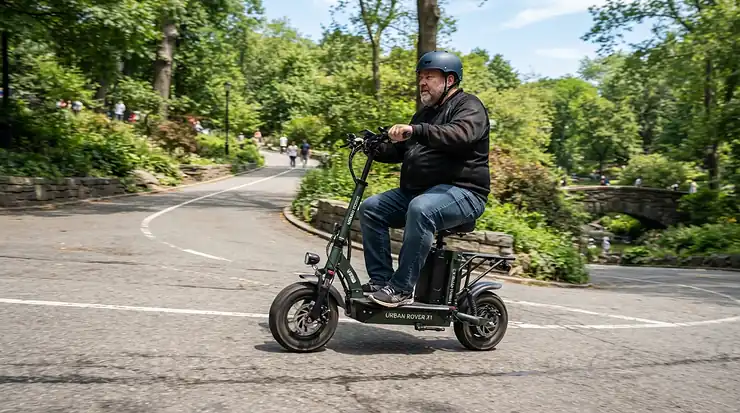
An electric scooter with seat for heavy riders over 300 lbs is a seated or sit-stand e-scooter built around a rated payload above 300 lbs. It has a stiffer frame, higher-torque motors, and tires and brakes sized for real mass. Standard commuter models typically stop at 220 to 265 lbs. For bigger riders, “just grab a popular one” is advice that ends badly.
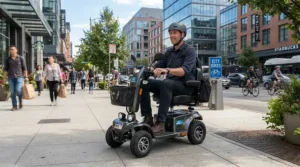
Shopping this category feels like reading a menu where every dish is “legendary.” One listing promises a 6000W motor, a 50 mph top speed, a 330 lb rating and a price that wouldn’t cover a decent office chair. Wikipedia’s overview of e-scooters lists the deck, stem, tires, suspension, brakes, controller and motor as the core parts. For a heavier rider, every one of them gets leaned on harder. This guide is about knowing which parts to interrogate.
A quick transparency note: I haven’t ridden these scooters, and I won’t pretend I have. What follows is built from manufacturer specs, independent roundups and reviewers, and aggregated owner feedback, with the thin spots called out. This page also contains affiliate links, explained in the disclaimer at the end.
You’ll get seven real models rated from 330 to 550 lbs. You’ll also get plain-English breakdowns of maximum payload rating, motor torque and reinforced frame construction. There is fit advice too, for anyone shopping for a heavy duty electric scooter with high weight limit or a big and tall electric scooter for adults. Prices stay as ranges, because they move more often than the weather.
Quick Comparison: 7 Seated Scooters Built for Riders Over 300 lbs
| Product | Rated Load | Motor | Claimed Range | Tires | Best For |
|---|---|---|---|---|---|
| AONIU M4 | 330 lbs | 800W peak | 31 mi | 10″ pneumatic | Budget riders under ~300 lbs |
| INSDRGN C14PRO | 330 lbs | 1300W peak, 45 Nm | 35 mi | 14″ pneumatic | Hilly commutes |
| iScooter F7 | 330 lbs | 1000W | 45 mi | 16″ fat | Rough pavement, light trails |
| FOHOLO F19 | 440 lbs | Dual motor | 65+ mi (stated) | 13″ tubeless | Longer rides, bigger riders |
| T/TAN T-002 | 500 lbs | 5600W dual | 45 mi (12-15 at top speed) | 11″ pneumatic | Power-hungry 350+ lb riders |
| Tumotcy K8 | 550 lbs | 5600W dual | Not stated | 11″ pneumatic | Maximum load, steep hills |
| EMOVE RoadRunner Pro V2 | 420 lbs (352 lbs “ideal”) | 4,000W nominal | 40-50 mi (aggressive riding) | 14×3″ tubeless | Premium daily riding |
Looking at the comparison above, the AONIU M4, INSDRGN C14PRO and iScooter F7 share the same 330 lb ceiling. That makes them better matches for riders who sit comfortably under 300 lbs than for riders right on the line. The FOHOLO F19 and EMOVE RoadRunner Pro V2 step up to 440 and 420 lbs. The T/TAN T-002 and Tumotcy K8 are the only two here rated at 500 lbs or more. The EMOVE RoadRunner Pro V2 page itself names a lower “ideal” weight of 352 lbs, which is a useful reality check for every other number in this table.
💬 Just one click — help others make better buying decisions too!😊
Top 7 Electric Scooter With Seat for Heavy Riders Over 300 lbs: Expert Analysis
1. AONIU M4 — budget pick with a removable seat
The AONIU M4 is what you buy when you want sit-or-stand flexibility without a four-figure commitment. It carries a 330 lb rating on an aluminum unibody frame and pairs an 800W peak brushless motor with a 48V 10Ah battery. It rolls on 10-inch pneumatic tires. That’s enough muscle for flat commutes and gentle grades, but the small battery is the real limit. The claimed 31 miles and 28 mph are stated “under specific conditions,” so expect less with a larger rider aboard.
Based on the spec comparison, this fits riders up to roughly 290 to 300 lbs who want some headroom. Anyone closer to 330 lbs is riding at the ceiling. Roundups describe it as one of the most widely reviewed budget seated options, which at least means problems surface quickly. Complaints in the review summaries I found include a display that reads in km/h only, slow support on overseas orders, and fenders that crack for some owners.
Pros:
- ✅ Removable seat for sit-or-stand riding
- ✅ 330 lb rating at a budget-tier cost
- ✅ Cruise control and LCD display included
Cons:
- ❌ Display reportedly shows km/h only
- ❌ Some owners report cracked fenders
Budget roundups place it in the sub-$500 class, so check the current price. For a rider under 300 lbs on mostly flat ground, that’s strong value.

2. INSDRGN C14PRO — 45 Nm of torque for hilly commutes
The headline on the INSDRGN C14PRO isn’t the 1300W peak rating. It’s the 45 Nm of torque, which is what actually gets a heavy rider moving from a stoplight or up a driveway. Listings pair that with a 48V 13Ah battery, 14-inch pneumatic tires, dual suspension, dual braking and a UL 2272 certification claim. The rated top speed is a modest 20 mph, and for most heavy riders that’s a feature, not a flaw. Slower means more stopping margin. Claimed range is 35 miles, so apply a heavy-rider haircut.
My read is that this is the sensible pick for hilly city commutes in the 250 to 300 lb zone. One caution: retailer listings disagree on whether a seat ships with every variant, so confirm it’s included before you buy. Roundup reviewers praise the smooth ride from the big tires, the phone holder with USB charging, and the enclosed battery compartment. Reported frustrations are assembly that can take up to 90 minutes and the lack of a speedometer.
Pros:
- ✅ Large tires and dual suspension smooth the ride
- ✅ Phone holder with USB charging built in
- ✅ Enclosed battery compartment protects the pack
Cons:
- ❌ Assembly can take up to 90 minutes
- ❌ No speedometer, per reviewers
It sits in the mid-range tier with a one-year warranty listed. Check the current price, because torque per dollar is where it shines.
3. iScooter F7 — fat tires and a rear basket for rough pavement
The iScooter F7 is closer to a mini e-bike than a kick scooter. It has a 1000W rear hub motor, a 48V 10.4Ah battery and a 330 lb rating. Its 16-inch fat tires, about 3 inches wide, act as the suspension’s first line of defense. All that air volume soaks up cracks, gravel and light snow that would rattle a 10-inch tire. The listing claims 28 mph and 45 miles, and the seller notes that the top speed is for off-road use only. Treat 28 as a ceiling.
The seat is detachable, the rear basket is a genuine errand-runner, and braking comes from dual discs plus electronic assist. The trade-off is bulk. Sellers list roughly 67 lbs, though one roundup reports 77 lbs, so trunk loading is a two-handed job. Reviewers also flag a low seat and limited legroom. One buyer who is 6 feet tall and 235 lbs called it a bit cramped, so taller riders should treat fit as a real question.
Pros:
- ✅ Fat tires handle rough ground and light snow
- ✅ Detachable seat plus rear basket
- ✅ Adjustable handlebar and bright headlight
Cons:
- ❌ Heavy to lift into a car
- ❌ Low seat, limited legroom for tall riders
This is a mid-range-tier scooter, so check the current price. It’s a comfort-first value for riders near 300 lbs who live on bad pavement.
4. FOHOLO F19 — 13-inch tires and the longest claimed range
The FOHOLO F19 is for riders who’ve stopped pretending a 330 lb rating feels comfortable. It lists a 440 lb capacity, dual-motor drive, 13-inch tubeless pneumatic tires, a removable seat and triple braking. Its stated range is 65-plus miles, and marketing touts speeds up to 55 mph. Treat both as best-case figures for a light rider on a flat road. A 13-inch tire rolls over potholes the way a big wheel rolls over a curb crack. That matters when you’re the one absorbing the impact.
The trade is mass. At roughly 105 lbs on a heavier alloy steel frame, it’s not something you carry up stairs. Charging takes about 8 hours, and the listed 180-day warranty is short for a scooter at this level. On sentiment, I found little independent owner feedback. Most coverage repeats spec-sheet strengths, so I can’t honestly summarize owner opinion. Read the newest reviews before buying.
Pros:
- ✅ 440 lb rating adds real headroom
- ✅ Large 13-inch tubeless tires
- ✅ Adjustable handlebars and triple braking
Cons:
- ❌ Roughly 8-hour charge time
- ❌ Short 180-day warranty listed
It sits in the upper-mid tier, so check the current price. It’s good value on paper, but verify recent owner reports first.
5. T/TAN T-002 — 500 lb rating with dual-motor muscle
The T/TAN T-002 stacks a 5600W dual-motor setup, 11-inch off-road pneumatic tires, hydraulic brakes, turn signals and a removable seat, which ships included, onto a 500 lb rating. Here’s the spec math. A 48V 26Ah pack stores roughly 1,250 Wh. Pushing a 5600W peak through that is like asking a garden hose to feed a fire truck. You get brief bursts, not sustained output. A roundup reports 12 to 15 miles at top speed versus the 45-mile claim. It also notes that the advertised 50 mph is closer to 40 mph on GPS.
Reviewers praise the acceleration and braking. They also describe heavy construction, a controller that feels cheap, and an assembly step where you connect wires and fasten 8 screws. For 350 to 450 lb riders who need real torque, it’s one of the few seated options. Plan to inspect the wiring and hardware before your first ride.
Pros:
- ✅ 500 lb capacity with strong acceleration
- ✅ Hydraulic brakes, full lighting and turn signals
- ✅ Seat included in the box
Cons:
- ❌ Battery drains quickly at higher speeds
- ❌ Controller feels cheap, DIY wiring assembly
I couldn’t verify a stable street price, so check the current price. Value-wise it’s a power-per-dollar play for heavier riders.
6. Tumotcy K8 — the highest capacity at 550 lbs
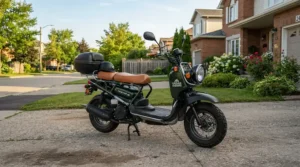
The Tumotcy K8 carries the biggest payload cushion on this list. It’s rated for 550 lbs, with dual-drive motors totaling 5600W, 11-inch pneumatic tires and a folding seat included. At 103.6 lbs, it’s a serious piece of hardware. A 400 to 450 lb rider still has 100-plus lbs of headroom, which is the difference between “rated” and “relaxed.” The charge takes about 8 hours, so it’s an overnight scooter.
A roundup quotes one large rider reporting strong hill power. The same roundup notes that tech support sent a working replacement rear brake. The complaints are specific: the throttle and brake levers share the same fingers, sharp edges have cut owners, and some report a front motor burning out. My advice is to run a hand over every edge on day one and practice braking in an empty lot before you hit traffic. That shared-finger layout needs muscle memory.
Pros:
- ✅ 550 lb rating, the highest here
- ✅ Strong hill power reported by a large rider
- ✅ Folding seat included
Cons:
- ❌ Throttle and brake share the same fingers
- ❌ Sharp edges and front-motor burnout reports
Check the current price, since I couldn’t confirm a reliable figure. It’s the value pick for the heaviest riders because nothing else here offers this much headroom.
7. EMOVE RoadRunner Pro V2 — premium seated build with 72V power
Next to the others, the EMOVE RoadRunner Pro V2 feels like switching from a rental car to a purpose-built machine. It uses dual brushless motors rated 4,000W nominal and 8,400W peak, fed by a 72V 40Ah Samsung 21700 pack of about 2,880 Wh. It has 14×3-inch tubeless hybrid tires, a hydraulic front fork with rear spring suspension, and DOT-fluid hydraulic brakes with 203 mm rotors. The spec sheet lists 420 lbs, but the description names 352 lbs as the ideal maximum. That’s the clearest example of “rated” versus “recommended” you’ll find. The seller also bases its performance figures on a 200 lb rider.
A Freshly Charged summary says the V2 fixes nearly every issue of the original, with a stronger frame, stiffer suspension and much better high-speed stability. It also notes the V2 is heavier, pricier and has rough edges. At 135 lbs with a non-removable battery, you charge it where it lives. Reviewers of the original RoadRunner said tall riders may feel squeezed and that its front suspension needed a stiff setting above roughly 290 lbs. Check whether the V2 changes your fit.
Pros:
- ✅ 72V, 2,880 Wh pack for serious range
- ✅ Full hydraulic brakes with large rotors
- ✅ Stronger frame and stiffer suspension than the original
Cons:
- ❌ 135 lbs with a non-removable battery
- ❌ Premium price and noted rough edges
It’s priced in the mid-$3,000s. It’s worth it mainly for daily riders who weigh under that 352 lb “ideal” mark.
✨ Ready to Check Current Pricing?
🔍 Take your commute to the next level with these carefully selected scooters. Click any highlighted product name to check current pricing and availability. Whether you need a budget starter or a 550 lb workhorse, there’s a seated option built for your weight!
Setup and First-30-Days Guide for Your Seated Heavy-Duty Scooter
A scooter that’s rated for your weight can still disappoint if you skip the boring first month. Here’s the playbook the spec sheet never gives you.
Day one. Before the first ride, tighten every bolt on the stem, fold latch, handlebars and seat. Several roundups flag assembly quirks, such as the 8 screws and wiring on the T/TAN T-002 and the 90-minute build on the INSDRGN C14PRO. Set tire pressure within the manufacturer’s range. I’d lean toward the upper end at your weight, since low pressure invites pinch flats. Test brakes at walking pace before you test them at speed.
Week one. Ride in the lowest power mode first and learn how the throttle responds with you aboard. Check bolts again after roughly 20 miles, when new hardware settles. Charge after rides, use only the supplied charger, and don’t leave the pack parked at 100% for weeks.
By day 30. Look for squeaks, flex or a wobbling stem. These are early warnings. Also watch for the classic first-month mistakes: overloading a basket, sitting too far back, and ignoring tire pressure until a flat forces the issue.
Real-World Scenarios: Matching Heavy Riders to the Right Scooter
Scenario 1: 285 lbs, flat 3-mile commute, tight budget, five days a week. The AONIU M4 fits. You keep about 45 lbs of headroom before gear, the 800W motor doesn’t have to fight hills, and the 10Ah pack easily covers a six-mile round trip. Charge it every other day and the small battery stays a non-issue.
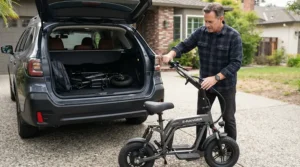
Scenario 2: 345 lbs, hilly 8-mile commute each way, daily. Skip the 330 lb class entirely, because you’d be over the ceiling. The Tumotcy K8 (550 lbs) or T/TAN T-002 (500 lbs) leave 150-plus lbs of headroom and dual motors for the climbs. Expect scooters over 100 lbs and plan ground-floor storage. Because range collapses at speed, ride at moderate settings rather than trusting the 45-mile claim.
Scenario 3: 300 lbs, weekend rides on gravel paths and cracked pavement, a few times a month. The iScooter F7 with fat tires and a basket is the comfort play. The INSDRGN C14PRO is the alternative if hills outnumber rough patches. A 300 lb rider on a 330 lb scooter has a cushion of about 10%. That’s fine for occasional rides and thinner for daily abuse.
How to Choose an Electric Scooter With Seat for Heavy Riders Over 300 lbs
- Start with payload headroom. Pick a rating comfortably above your weight with clothes and a bag. A 10 to 20 percent buffer is my rule of thumb, not an industry standard.
- Check continuous power and torque. Peak wattage is a sprint number. Look for continuous output and a motor torque figure, like the 45 Nm on the INSDRGN C14PRO.
- Inspect the frame. Reinforced frame construction at the stem, neck and deck matters more than paint or app features.
- Judge tires and suspension. Bigger pneumatic tires and real suspension keep a heavy rider from bottoming out.
- Demand serious brakes. Hydraulic or dual disc systems stop mass better than a basic drum or single caliper.
- Verify battery safety. Look for UL 2272 certification, which tests that the system doesn’t cause explosion, fire, battery rupture or shock hazards.
- Confirm fit. A big and tall electric scooter for adults needs adjustable handlebars, a sensible seat height and legroom for your inseam.
Maximum Payload Rating: The Number That Quietly Decides Everything
The maximum payload rating is the heaviest total load a manufacturer says the scooter can carry. That includes you, your clothes, your backpack and whatever’s in the basket. It’s the first number to check, and it’s easy to misread.
Think of it as a ceiling, not a comfort zone. One buyer’s guide points out that a 300 lb rating on a standard scooter is often a technical limit rather than a confidence limit. Freshly Charged makes the same point, advising riders to size up for a buffer. Bumps also spike the force on a frame well above your static weight. ERideHero’s heavy-adult scooter guide groups its picks into weight bands of 265-300, 300-330, 330-400 and over 400 lbs. Shopping by band beats shopping by hope.
The EMOVE RoadRunner Pro V2 shows why this matters. Its page lists 420 lbs but calls 352 lbs ideal. So it helps to ask which number a seller is promising. Also remember that most performance claims are measured with lighter riders. VoroMotors, for example, bases its figures on a 200 lb rider.
Motor Torque: Why Newton-Meters Beat Watts for Heavy Riders
Watts tell you how much work a motor can do. Motor torque tells you how hard it can push right now. For a heavy rider, torque is what you feel when pulling away from a light or crawling up a steep driveway.
Peak versus continuous wattage is where listings get slippery. One manufacturer’s buyer’s guide recommends a 750W continuous baseline for riders over 275 lbs. It also suggests looking for a stated ability to handle 10 to 15 percent grades. The INSDRGN C14PRO is one of the few here to publish torque, at 45 Nm. Dual-motor machines like the T/TAN T-002 and Tumotcy K8 split the load between wheels. That helps traction and thermal stress, though a headline 5600W is still a peak figure.
Voltage plays a quiet role too. A 72V system like the EMOVE RoadRunner Pro V2 can deliver the same power with less current than a 48V system, which generally eases strain on wiring and controllers. Expect any hill-climb claim to shrink as your weight climbs past the test rider’s.
Reinforced Frame Construction: Where Heavy-Duty Scooters Fail First
Reinforced frame construction is what separates a scooter rated for a heavy rider from one that’s merely tolerating one. A buyer’s guide from a scooter maker identifies the stem hinge, the neck where the stem meets the deck, and the deck itself as the stress points. Those are exactly where cheap builds crack.
Materials vary. Ridester notes that most real heavy-duty scooters use aircraft-grade aluminum alloy. The FOHOLO F19 uses a heavier alloy steel frame, and that explains part of its 105 lb weight. Weight isn’t automatically strength, but a 100-plus lb scooter usually has more metal where it counts. The AONIU M4 takes the opposite approach with a lighter aluminum unibody.
Look for the telltale signs of a weak build. These include a stem that flexes when you brake hard, a fold latch that rattles, and creaks over bumps. Reviewers have also noted wobble at speed on stiff-sprung designs and loosening folded handlebars on others. Photos of cracked stems in heavy-rider guides are a sobering reminder. Check the fold mechanism first, because it’s the weakest link on any foldable.
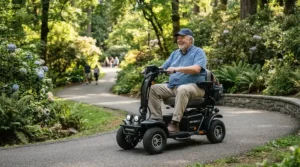
Heavy Duty Electric Scooter With High Weight Limit: Features That Actually Matter (And Those That Don’t)
A heavy duty electric scooter with high weight limit lives or dies on a short list of features. Everything else is garnish.
What matters: a payload rating with real headroom, continuous power, motor torque, solid brakes, big pneumatic tires, a frame that doesn’t flex, and a warranty that outlasts the first winter. The roundups I read show warranties ranging from 180 days on the FOHOLO F19 to one year on the INSDRGN C14PRO listing.
What doesn’t matter as much: the biggest headline wattage, an inflated top speed, fancy app features, and a chunky LCD. A 50 mph claim is meaningless if you’ll ride 20 mph in a bike lane. And range numbers deserve skepticism. ERideHero says it tests range at real rider weights, which is exactly why published figures from sellers should be treated as optimistic.
Seat quality also matters more than people expect. A thick, wide, supportive seat makes a 12-mile ride tolerable. A thin one makes you hate your scooter by mile four.
Big and Tall Electric Scooter for Adults: Fit, Legroom, and Seat Position
A big and tall electric scooter for adults has to fit your body as well as hold your weight. Weight and height aren’t the same problem, and a scooter can solve one while failing the other.
Start with legroom. Reviewers say the original EMOVE RoadRunner can squeeze tall riders, and one roundup warns about limited legroom and a low seat on the iScooter F7. Adjustable handlebars help, and roundups note ranges such as 51 inches on the AiQite and 56.7 inches on the Goobee. Seat adjustability matters just as much, because a seat that’s too low jams your knees.
Width is the other factor. One roundup notes the Arwibon is unusually wide at 59 inches, which complicates tight spaces. Also measure your doorways and elevator, and ask whether you can lift 100-plus lbs. Many heavy-duty seated scooters weigh as much as a small refrigerator. A great fit that you can’t get inside your home isn’t a great fit.
Seated E-Scooter vs Standing Scooter vs Mobility Scooter
Not every heavy rider needs a seated e-scooter. Here’s how the main alternatives compare.
| Option | Typical Weight Capacity | Seat & Comfort | Portability | Best For |
|---|---|---|---|---|
| Seated e-scooter (e.g., iScooter F7) | 330-550 lbs | Narrow to medium seat, sit-or-stand | Moderate to poor (67-135 lbs) | Active commuters wanting speed |
| Standing heavy-duty e-scooter (e.g., Kaabo Wolf King) | Around 400 lbs | No seat | Poor, bulky | Riders who prefer standing and speed |
| Mobility scooter (e.g., Afiscooter C4) | Around 400 lbs | 18-22″ seat options | Disassembles, but heavy | Riders needing seat width or medical-style support |
The table makes the trade-off clear. Seated e-scooters like the iScooter F7 give you speed and agility for a moderate cost. The Kaabo Wolf King is a reviewer favorite for heavy riders but has no seat. Mobility scooters such as the Afiscooter C4 offer wide seats and are classed as Class II medical devices by one retailer. They also cost in the mid-$2,000s. If seat width or medical support is your priority, a mobility scooter wins. If you want to move briskly, a seated e-scooter does.
Safety, Battery Standards, and Regulations
Heavy riders put extra stress on a scooter’s battery system, and that makes certification a real safety question. The U.S. Consumer Product Safety Commission reported at least 208 micromobility fire or overheating incidents from 39 states between January 2021 and November 2022, resulting in at least 19 deaths, five of them tied to e-scooters. The agency urged manufacturers to comply with UL standards, including UL 2272. You can read the details in the CPSC news release.
UL 2272 evaluates the battery, charger and electronics as one system. In June 2026, the CPSC also moved to propose mandatory federal lithium-ion battery rules for micromobility products. So certification is becoming more than a nice-to-have.
Speed laws are the other half. Wikipedia notes that jurisdictions set their own rules for e-scooters on roads and footways, so a 50 or 60 mph claim won’t make a scooter legal anywhere. Wear a helmet, use only the supplied charger, and check local rules before you commute.
Long-Term Cost, Maintenance, and Value
The sticker price is only the opening bid. Over a few years, tires, brake pads, charging and any repairs add up. Cost per ride is the useful lens. As an illustration, a scooter in the mid-$3,000s used 250 times a year for three years works out to around $4 to $5 per ride in purchase cost. A sub-$500 scooter used the same way comes in under a dollar. The cheaper scooter wins on math, but only if it survives your weight.
| Product | Price Tier | Value Angle | Best For |
|---|---|---|---|
| AONIU M4 | Budget (sub-$500 class in roundups) | Cheapest way to sit and ride | Riders under ~300 lbs |
| INSDRGN C14PRO | Mid-range | Torque per dollar | Hills and daily commutes |
| iScooter F7 | Mid-range | Comfort and tire quality | Rough pavement |
| FOHOLO F19 | Upper-mid | Range and 440 lb rating, thin feedback | Longer rides |
| T/TAN T-002 | Mid-to-upper | Power for bigger riders | 350+ lb riders |
| Tumotcy K8 | Mid-to-upper | Maximum headroom | Heaviest riders |
| EMOVE RoadRunner Pro V2 | Premium (mid-$3,000s) | Build quality, 72V power | Daily premium riders |
Tiers are relative, and I couldn’t verify stable street prices for every model, so check current pricing. The cheapest scooters make sense for lighter, occasional riders. The EMOVE RoadRunner Pro V2 pays off only with frequent use, while the Tumotcy K8 and T/TAN T-002 are what you buy when headroom is the whole point. Longer warranties also lower your risk, which is why the 180-day terms on some models matter.
Frequently Asked Questions
❓ What is the best electric scooter with seat for heavy riders over 300 lbs?
❓ How much headroom should I leave under the maximum payload rating?
❓ How far will a heavy duty electric scooter with high weight limit really go?
❓ Is a mobility scooter better than a big and tall electric scooter for adults?
❓ Should I look for UL 2272 certification before I buy?
Conclusion: Buy for the Rating, Then for the Details
The best electric scooter with seat for heavy riders over 300 lbs isn’t the one with the biggest wattage on the box. It’s the one with real payload headroom, honest motor torque, and reinforced frame construction you can trust, matched to your body and your route.
Here’s the short version. If you’re under about 290 lbs and watching your budget, the AONIU M4 is the entry point. Hilly commutes favor the INSDRGN C14PRO, and rough pavement favors the iScooter F7. If you need more range and a 440 lb rating, the FOHOLO F19 is worth a look, but check recent owner feedback first. Riders in the 350 to 450 lb range should look hard at the T/TAN T-002 and Tumotcy K8. The EMOVE RoadRunner Pro V2 is the premium option for daily riders under its 352 lb ideal weight.
Whatever you pick, a heavy duty electric scooter with high weight limit deserves a careful first month. Check the bolts, set the tire pressure, learn the throttle and watch for early flex. A big and tall electric scooter for adults should fit you as well as carry you.
Recommended for You
- Electric Moped With Removable Battery For Apartment Dwellers: 7 Best
- Electric Moped For Adults: 7 Best Picks For 2026
- Adventure Helmet With Sun Peak: 7 Best Picks For 2026
Disclaimer: This article contains affiliate links. As an Amazon Associate, I earn from qualifying purchases. If you purchase products through these links, we may earn a small commission at no additional cost to you.
✨ Found this helpful? Share it with your friends! 💬🤗
