In This Article
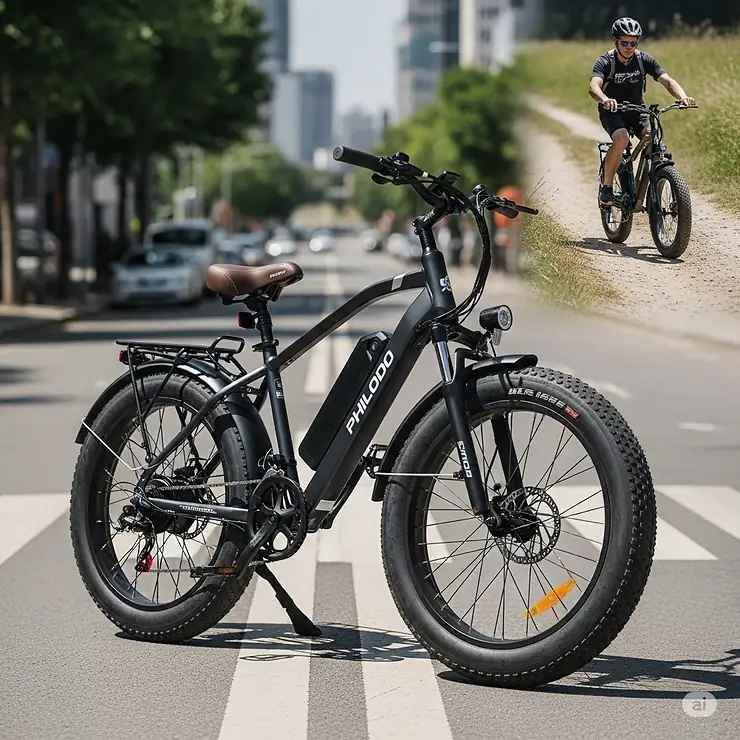
A philodo 48v fat tire ebike 3000w is a dual-motor electric bike from the Philodo brand. It pairs a 48-volt battery system with 26-by-4-inch fat tires and advertises 3,000 watts of combined peak motor power, delivered by two 1,500W hub motors. It is built for sand, snow, gravel and steep hills.
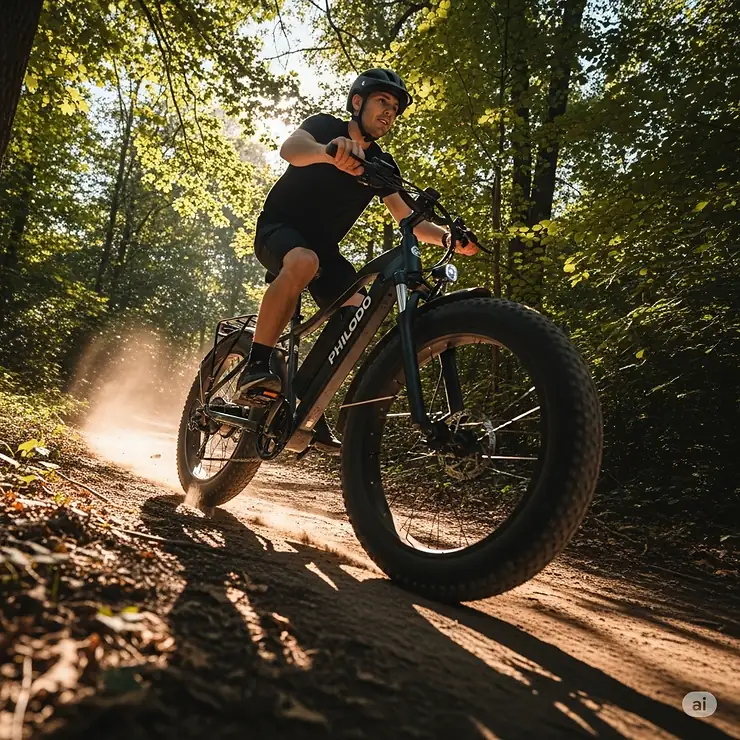
Sounds like a tank with a throttle, and that’s not far off. The heaviest bike in this guide weighs roughly 100 pounds, and the tires are wide enough to float over loose ground. The spec sheets promise speeds around 35 mph. But product titles bury one thing: that 3,000W figure is a peak number, a short-burst ceiling, not a cruising rating. Learning the difference between peak and continuous motor power is the most useful skill you can bring to this category. It changes how you read every spec, every claim and every price tag.
So instead of recycling a product listing, this guide does the homework. It pulls together real specs for the philodo 48v fat tire ebike 3000w family and sets them against six genuine rivals. Then it translates the numbers into what they mean on a hill, in the snow and in your garage. Where I could verify aggregated owner feedback, I summarize it. Where I couldn’t, I say so. There are no invented testimonials and no pretend test rides.
Hunting trails, snow commutes, or just a bike that laughs at hills? Here’s the lay of the land. ⚡
Quick Comparison: Seven 3000W-Class Fat Tire Ebikes at a Glance
Before the deep dive, here’s the whole field on one screen. Four of the seven run on 48V. The last three show what changes when the platform steps up or down in power.
| Model | Peak Motor Power | Battery | Best For |
|---|---|---|---|
| Philodo H8 | 3000W (2×1,500W) | 48V 26Ah (1,248Wh) | All-round fat tire riding on 26-inch wheels |
| Philodo Jumbo | 3000W (2×1,000W rated) | 48V 46Ah (2,208Wh) | Long-range trips and heavy-duty use |
| KETELES K800 | 4000W (2×2,000W) | 48V 23Ah (1,104Wh) | Value seekers wanting extra headroom |
| AMYET S8 | 3000W (2×1,000W rated) | 48V 25Ah (1,200Wh) | Compact, budget-friendly 20-inch power |
| Cheevalry G20 | 3000W | 48V 20Ah (960Wh) | Short, punchy rides on a budget |
| Philodo Forester | 5000W (2×2,000W rated) | 60V 26Ah (1,560Wh) | Step-up torque for steep climbs |
| Philodo Falcon | 5000W (4,000W rated) | 60V 32Ah (1,920Wh) | Rugged terrain and big range |
Looking at the table, the Philodo H8 and AMYET S8 share the same 3000W headline. The Philodo H8 rolls on 26-inch wheels while the AMYET S8 uses 20-inch ones, and that matters on rough ground. If range is your obsession, the Philodo Jumbo‘s 2,208Wh pack is in another league, holding roughly double the energy of most rivals here. The 60V Philodo Forester and Philodo Falcon aren’t 48V bikes, but they show what a few extra volts buy you.
💬 Just one click — help others make better buying decisions too!😊
Top 7 Philodo 48v Fat Tire Ebike 3000w Picks and Alternatives: Expert Analysis
Every entry below is research-based analysis: real specs translated into real-world meaning, plus aggregated review sentiment where it exists. None of it claims hands-on testing.
1. Philodo H8 — 3000W all-rounder on 26-inch fat tires
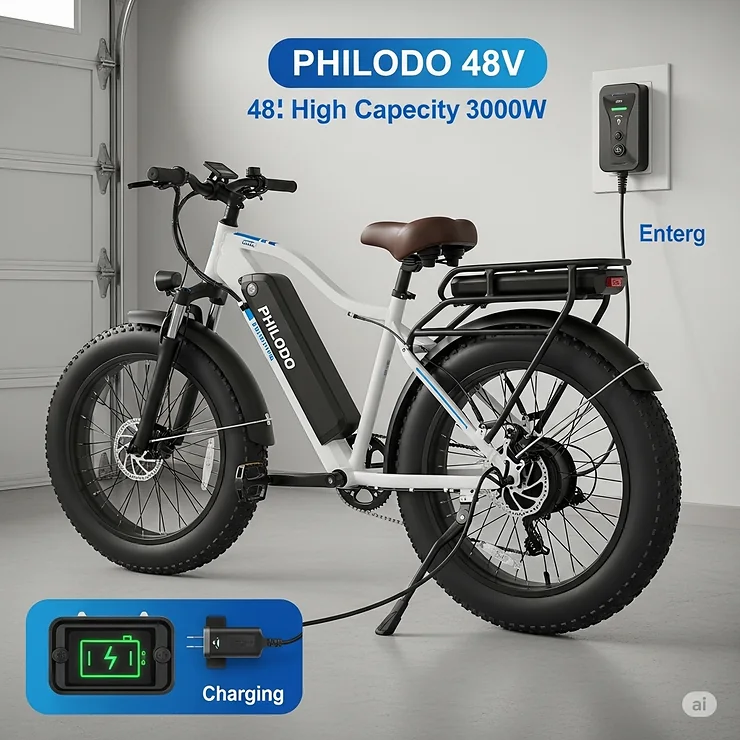
Think of the Philodo H8 as the centerpiece of the lineup. It has two geared hub motors rated at 1,500W peak apiece, a removable 48V 26Ah pack and 26×4-inch Chaoyang tires. It’s the bike most shoppers picture when they type philodo 48v fat tire ebike 3000w into a search bar.
The 1,248Wh battery (48V × 26Ah) is the number to respect. Listings claim 40–62 miles, but that range assumes pedal assist and mostly one motor. Lean on both motors and the throttle, and reviewer data from the bigger-pack Philodo Forester (roughly 46–54Wh per mile) points nearer 23–27 miles. That’s my own back-of-the-envelope estimate, not a test result. The spec sheet also lists hydraulic disc brakes, an ignition lock, a lockable removable battery and a 330-pound payload for riders between 5’2″ and 6’4″.
Based on the spec comparison, this suits riders who want one bike for snow, gravel and errands. They should treat dual-motor mode as the spice, not the main course. One caution: retailer listings disagree. Some show 2,000W combined with a 20Ah pack, and an older review page describes a 500W, 13Ah variant. Confirm the exact SKU before you buy.
On sentiment, the Amazon listing showed 4.3 out of 5 stars across 139 ratings at the time of research. That’s a decent score from a modest pool. I couldn’t verify deep independent durability reports, so treat longevity as unproven.
Pros:
- ✅ Dual 1,500W-peak motors with front-motor switch
- ✅ 330-pound payload and wide rider-height range
- ✅ Removable battery with ignition and battery locks
Cons:
- ❌ Throttle-heavy riding cuts range sharply
- ❌ Specs differ between retailer listings
Price check: published figures clustered around the $2,000–$2,500 range at the time of research, so check current price. Verdict: fair value if you’ll use the power, overkill if you won’t.
2. Philodo Jumbo — dual-battery stamina with 2,208Wh
The Philodo Jumbo answers one question: what if the battery were simply enormous? Two 23Ah packs, one external and one inside the frame, combine for 48V 46Ah, or 2,208Wh. That’s about 1.8 times the energy in the Philodo H8.
The motors are rated 2×1,000W with 1,500W peaks, and ERideHero lists 174 Nm of torque. Retailer specs add a 6061 aluminum frame, full suspension, hydraulic discs and a Shimano 7-speed drivetrain. They also claim IPX6 water resistance and brake levers that cut motor power when you squeeze, a thoughtful safety touch. Two chargers ship in the box, at roughly 7–8 hours per battery. Using the same 46–54Wh-per-mile yardstick, hard dual-motor riding works out to roughly 41–48 miles. The 100-mile claims live in pedal-assist, single-motor territory.
This is the pick for riders who live far from an outlet: hunting camps, long gravel loops, multi-day tours. The trade-off is mass. ERideHero lists roughly 101 pounds, so think about lifting, storage and transport before you commit.
On sentiment, ERideHero showed no community reviews yet, and I found no sizable independent review pool. I can’t responsibly summarize owner opinion, and you shouldn’t assume the best.
Pros:
- ✅ Largest battery in this roundup
- ✅ Full suspension and hydraulic disc brakes
- ✅ Brake levers cut motor power instantly
Cons:
- ❌ Roughly 100 pounds to lift and store
- ❌ Premium price with a thin review record
Price check: around the mid-$2,000s ($2,400–$2,600 range) at the time of research. Verdict: you’re paying for capacity, so it’s worth it only if range is your dealbreaker.
3. KETELES K800 — 4000W peak headroom for the money
The KETELES K800 raises the headline number. Each motor peaks at 2,000W, for 4,000W combined, on a 48V 23Ah (1,104Wh) pack. Higher peak watts mostly mean stronger bursts on climbs and getaways. They don’t mean a longer day, and the pack is smaller than the Philodo H8‘s.
The listing describes 26×4-inch tires, hydraulic brakes, a lockable fork and five riding modes: walk, normal, assist, pure electric and cruise. Claimed range is about 40–50 km in pure electric mode (roughly 25–31 miles) and 80–100 km with assist (roughly 50–62 miles). Cruise mode is a quiet range-saver on flat stretches, because steady speed sips less energy than constant throttle stabs.
Buyer feedback on the Walmart listings is encouraging but small-sample. Ratings showed 4.1 stars from 36 reviews on one page and 4.8 from 14 on another. Reviewers praise the power and easy assembly, and one rider reported a top speed near 34 mph. A 5’6″ buyer found the frame tall. That’s a genuine fit warning for shorter riders.
Pros:
- ✅ 4000W peak for strong hill pull
- ✅ Five riding modes including cruise
- ✅ Hydraulic brakes and lockable fork
Cons:
- ❌ Tall frame for shorter riders
- ❌ 1,104Wh pack limits hard-riding range
Price check: around the $1,000–$1,100 range at the time of research. Verdict: strong value if you fit the frame and ride sensibly.
4. AMYET S8 — compact 20-inch punch with switchable AWD
The AMYET S8 trades wheel size for agility. Its 20×4-inch tires and full suspension with a lockable fork make it nimbler and lower to the ground than the 26-inch bikes. The cost is a rougher ride over big obstacles, since smaller wheels drop into holes more eagerly.
Dual 1,000W motors (3,000W peak) draw from a removable 48V 25Ah (1,200Wh) battery. The listing claims 34 mph, up to 75 miles of range and a 330-pound load limit. It states UL 2849 certification, so verify the paperwork. It arrives about 95% pre-assembled for riders listed at 5’5″–6’5″. Switchable all-wheel drive is the practical highlight. Run one motor on dry trails to stretch the battery, then switch both on for snow, mud or climbs.
Sentiment is mixed but useful. Walmart showed ratings of roughly 3.9–4.0 from about 93–97 reviews. One owner says it climbs hills with a full load, while another reported battery issues. That split is a reason to check warranty terms and the seller’s support record.
Pros:
- ✅ Switchable AWD for traction when needed
- ✅ Nimble compact 20-inch wheels
- ✅ Mostly pre-assembled out of the box
Cons:
- ❌ Mixed reports on battery reliability
- ❌ Small wheels roll less smoothly over obstacles
Price check: around the $1,000 range at the time of research, with promotions that vary, so check current price. Verdict: good value for trail play, but read the warranty first.
5. Cheevalry G20 — a speed-forward budget entry
The Cheevalry G20 is the spec-sheet sprinter of the group. It advertises 3,000W peak, a 37 mph top speed and a 48V 20Ah (960Wh) battery on 20×4-inch off-road tires. It’s compact, loud about its numbers, and priced like a bike that expects you to ride it in short bursts.
That 960Wh pack is the smallest here. At the same 46–54Wh-per-mile hard-riding yardstick, my rough estimate is 18–21 miles when you’re using both motors aggressively. That’s fine for a trail loop or a neighborhood blast, and tight for a long day away from a charger. Bigger riders should also ask how a smaller pack feels under a 3,000W peak draw. The current is the same, but the pack has less capacity to absorb it.
On sentiment, the Walmart listing showed about 14 reviews, too few to draw conclusions about durability or service. If you pick the Cheevalry G20, buy from a seller with a clear return policy.
Pros:
- ✅ Claimed 37 mph top speed
- ✅ Compact, easy-to-handle frame
- ✅ Lower entry cost than the Philodo models
Cons:
- ❌ Smallest battery in this roundup
- ❌ Very small review sample
Price check: around the $1,100 range at the time of research. Verdict: fun and punchy for short rides, but not a long-haul bike.
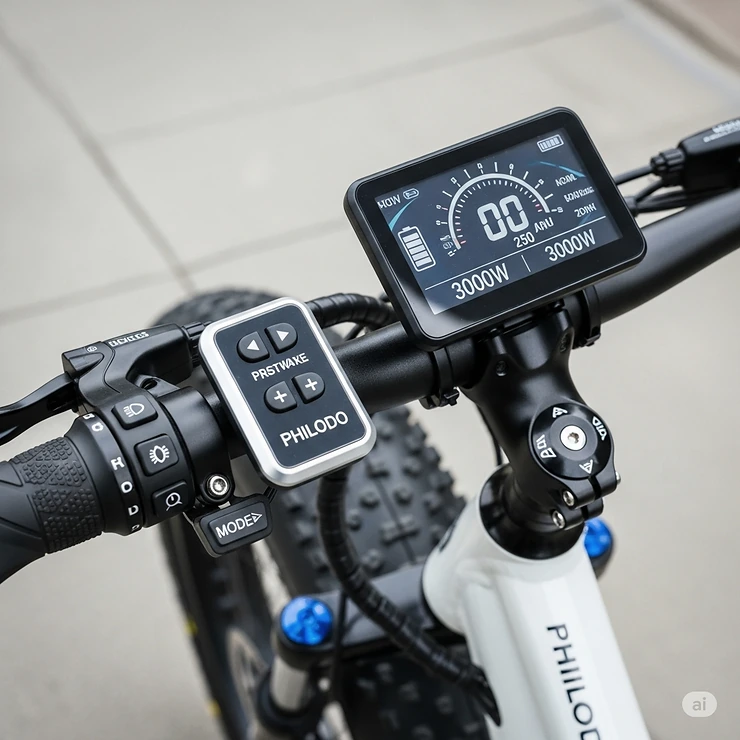
6. Philodo Forester — 60V torque at a reachable price
The Philodo Forester is where the Philodo lineup stops being a 48v fat tire ebike 3000w and becomes something stronger. It runs on a 60V platform with 2×2,000W rated motors (5,000W peak), 210 Nm of torque and a 60V 26Ah (1,560Wh) battery. One retailer page lists 25Ah, another more confirmation that you should check the SKU. ERideHero lists the bike at about 95 pounds.
This is the best-documented bike here. BikeRide’s review roundup scored it 86 out of 100. Reviewers say dual-motor mode climbs steep hills easily, and a double-press of the power button switches between rear-only and both motors. Range data gives real context. A 215-pound reviewer got 29 miles using the throttle in single-motor mode, and a 180-pound tester got 34 miles with throttle and pedal assist in dual-motor mode. The same roundup says the stated 5’5″–6’5″ fit range is exaggerated, since the seatpost has only about 4 inches of adjustment. It also notes that the motor power and unlocked speed exceed legal e-bike limits, and that the low-end components typical of budget dual-motor bikes bring drawbacks. Experts still call the value good.
Pros:
- ✅ 60V system delivers stronger torque
- ✅ Easy rear-only or dual-motor switching
- ✅ Experts rate its value highly
Cons:
- ❌ Limited seatpost travel for tall riders
- ❌ Power exceeds legal e-bike limits
Price check: around the $1,500 range at the time of research. Verdict: the smart step-up if you value torque over strict 48V compatibility.
7. Philodo Falcon — 60V 32Ah staying power for rugged ground
The Philodo Falcon is built for the back forty. It has a 60V 32Ah (1,920Wh) pack, 5,000W peak power, 26×4-inch tires and a full-suspension setup with a lockable fork. One buying guide notes six riding modes, including single motor, dual motor, cruise and walk assist. Owners cited there report confident grip on sand and snow where single-motor bikes spin out. That’s a secondhand summary, so weigh it accordingly.
The pack is the point. Using the 46–54Wh-per-mile yardstick, hard dual-motor riding works out to about 36–42 miles, with far more in the single-motor, pedal-assist modes. The catch is charge time: ERideHero lists about 11 hours. Six modes also give you real control over battery use, so you can run one motor on easy ground and save the second for the climb.
Based on the spec comparison, it’s the more expensive way to buy range than the Philodo Jumbo, with more torque and a smaller pack. If your trails are steep and remote, that’s a fair swap.
Pros:
- ✅ 1,920Wh pack for long outings
- ✅ Six riding modes including cruise
- ✅ Full suspension with lockable fork
Cons:
- ❌ Roughly 11-hour charge time
- ❌ 60V platform, not a 48V bike
Price check: around the $1,600 range at the time of research. Verdict: the pick for rugged terrain and long days.
Side-by-Side: Specs, Price Ranges and Review Snapshot
Here’s how the seven stack up on the numbers that drive a purchase. Claimed ranges are manufacturer figures, not independent tests.
| Model | Claimed Range | Review Snapshot | Price Range | Best For |
|---|---|---|---|---|
| Philodo H8 | 40–62 miles | 4.3★ from 139 ratings (Amazon listing) | $2,000–$2,500 | One-bike-does-it-all riders |
| Philodo Jumbo | Up to 100 miles | No verified community reviews | $2,400–$2,600 | Long-haul and heavy-duty use |
| KETELES K800 | ~25–31 miles electric; ~50–62 assist | 4.1★ (36) and 4.8★ (14) on Walmart | $1,000–$1,100 | Value and hill headroom |
| AMYET S8 | Up to 75 miles | ~3.9–4.0★ from ~93–97 ratings | Around $1,000 | Compact trail riding |
| Cheevalry G20 | Not verified | About 14 reviews | Around $1,100 | Short, punchy rides |
| Philodo Forester | Up to 70 miles | 86/100 BikeRide expert score | Around $1,500 | Steep climbs, value |
| Philodo Falcon | Up to 75 miles | Limited owner summaries | Around $1,600 | Rugged, remote terrain |
The pattern is clear. The Philodo H8 carries the most visible rating, but the Philodo Forester has the richest independent evidence, including real range numbers from reviewers. The KETELES K800 and AMYET S8 are the value plays, with small review pools and mixed signals on quality. The Philodo Jumbo and Philodo Falcon cost the most because you’re buying watt-hours, and for long trips that’s money well spent.
✨ Ready to Find Your Ride?
🔍 Take your trail days to the next level with these carefully selected bikes. Click on any highlighted item to check current pricing and availability. The right pick will turn steep hills, snow and sand into your favorite part of the ride!
Features That Actually Matter (And Those That Don’t)
Spec sheets in this category are loud. Here’s how to filter the noise.
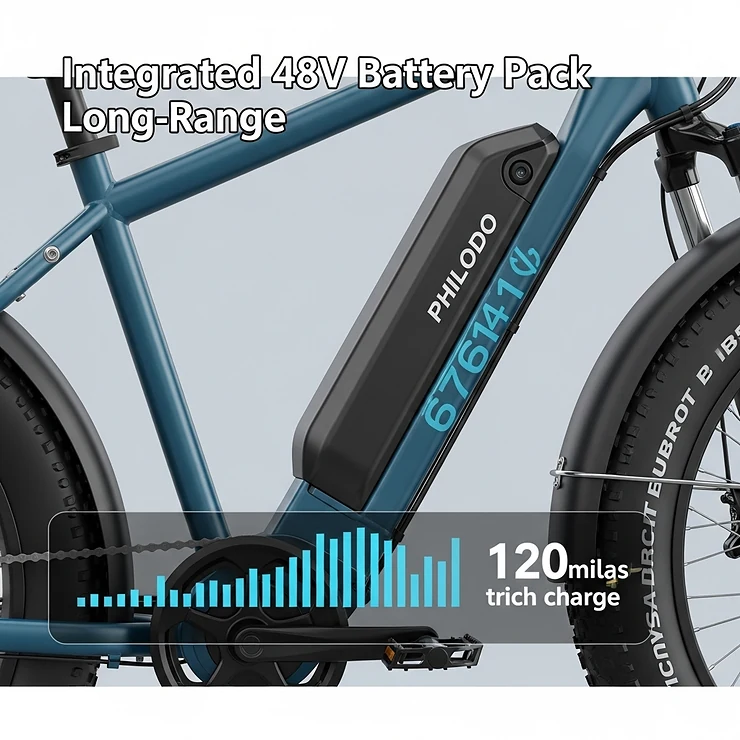
Watt-hours beat watts for range. A 3,000W peak tells you how hard the bike can pull for a few seconds. Watt-hours (volts × amp-hours) tell you how long the energy lasts. The Philodo Jumbo‘s 2,208Wh dwarfs the Cheevalry G20‘s 960Wh, even though both advertise 3,000W.
Torque beats watts for hills. The Philodo Jumbo lists 174 Nm and the Philodo Forester 210 Nm. That’s why the 60V bike feels stronger even before you compare headline wattage.
Voltage and pack size shape stress. At 48V, 3,000 watts means roughly 62 amps leaving the pack (watts ÷ volts). On a 26Ah pack, that’s about 2.4 times its capacity per hour, a real workload. On the Philodo Jumbo‘s 46Ah combined capacity, it’s closer to 1.4 times. That’s a quiet advantage of the bigger pack: the same current spread over more cells.
Brake sensors and hydraulics are worth paying for. Motor-cutoff levers and hydraulic discs matter more at 35 mph and 100 pounds than another gear.
What doesn’t matter: top-speed claims and “climbs 37 degrees” bullets. They describe ideal conditions, and the Philodo Jumbo listing itself shows both a 25 km/h limited mode and an unlocked top speed. Ignore the superlatives, then read the pack size.
How to Choose a Philodo 48v Fat Tire Ebike 3000w
Short answer: choose by battery watt-hours, fit and legality first, and peak watts last. Here’s the order I’d work through.
- Decide how often you’ll use both motors. Mostly assisted riding means a smaller pack works. Frequent throttle use means size up.
- Match watt-hours to ride length. Using the 46–54Wh-per-mile hard-riding yardstick from reviewer data, multiply your round trip by 54 and compare it to the pack.
- Verify the exact SKU. Voltage, amp-hours and wattage differ across listings of the same name.
- Check safety certification. Look for UL 2849 certification on the whole electrical system, not just the battery, and ask the seller for proof rather than trusting a title.
- Confirm fit. Check seatpost travel, standover height and the 330-pound payload against your body plus gear.
- Check local rules. More on that below. Power and speed beyond common e-bike limits can restrict where you ride.
- Read the warranty. With small review pools, support quality is part of the product.
Philodo 48v Fat Tire Ebike 3000w vs Single-Motor Fat Tire Ebikes
A single-motor fat tire bike is the traditional alternative: simpler, lighter and usually cheaper. Here’s the honest tradeoff.
| Factor | Dual-motor 3000W peak (e.g., Philodo H8) | Typical single-motor fat tire ebike |
|---|---|---|
| Hill climbing and torque | Two motors share the load | Adequate for moderate grades |
| Traction in sand and snow | AWD helps when both motors run | One driven wheel |
| Weight | Heavier (Philodo Jumbo is roughly 101 lbs) | Usually lighter |
| Range when ridden hard | Shorter unless the pack is big | Often longer per watt-hour |
| Trail and road legality | More likely to exceed common e-bike limits | More likely to fit 750W-class rules |
| Best For | Steep, loose or snowy terrain | Commuting and light trails |
If your terrain is flat, a single-motor bike will likely serve you better and cost less. The dual-motor premium pays off on loose ground, steep grades and heavy loads, where two driven wheels do real work. Remember too that the second motor costs you weight and energy even when you aren’t using it. A bike like the Philodo H8 lets you switch that motor off, which softens the penalty.
Safety, Regulations & Compliance Guide
Here’s the part many listings skip. Federal law defines a low-speed electric bicycle as a two- or three-wheeled vehicle with fully operable pedals and a motor under 750 watts. Powered by the motor alone, it must stay under 20 mph for a 170-pound rider. A 3,000W-peak bike with a 35 mph claim sits well outside that definition. The Philodo Forester‘s reviewers say as much, noting power and unlocked speed above legal e-bike limits.
What does that mean in practice? Rules for roads, bike paths and trails are set by states, cities and land managers, and many follow a three-class system capped around 750W and 28 mph. Treat these bikes as off-road or private-land machines unless your local rules say otherwise. Check trail regulations before you ride, ask your insurer how they classify the bike, and don’t assume a “street legal” claim in a listing applies to your jurisdiction.
Certification is a separate issue. UL 2849 tests the complete electrical system. New York City passed a law in 2023 requiring third-party certification of e-bikes and their batteries. Industry reports say federal regulators have moved toward making UL 2849 mandatory. A certified bike is easier to insure and safer to charge indoors, so ask for the certificate on any bike you’re considering, including the KETELES K800 and AMYET S8, whose listings state UL 2849.
Battery Safety & Charging: Treat 1,248Wh Like It Matters
A pack like the Philodo H8‘s holds the energy of a small appliance, and lithium-ion fires are why safety rules exist. Electrical-inspector trade reporting on federal data counted 208 micromobility fire or overheating incidents between early 2021 and late 2022, with at least 19 deaths. In 2023 the CPSC publicly called on manufacturers to comply with safety standards for battery-powered products.
Practical habits cut the risk:
- Use only the charger supplied for your model. The Philodo Jumbo‘s chargers are specified at 54.6V 3A.
- Charge on a hard, non-flammable surface, away from exits and bedding, and don’t leave it charging while you sleep.
- Store packs at room temperature, not in a freezing or baking garage.
- Stop using any pack that swells, smells, gets unusually hot or has been crushed in a crash.
- Never put lithium-ion batteries in household trash. Use a battery recycling drop-off.
Two packs, like the Philodo Jumbo‘s, mean double the charging discipline. Charge them one at a time if you can.
Practical Usage Guide: Your First 30 Days
The first month decides how happy you’ll be with a bike this size.
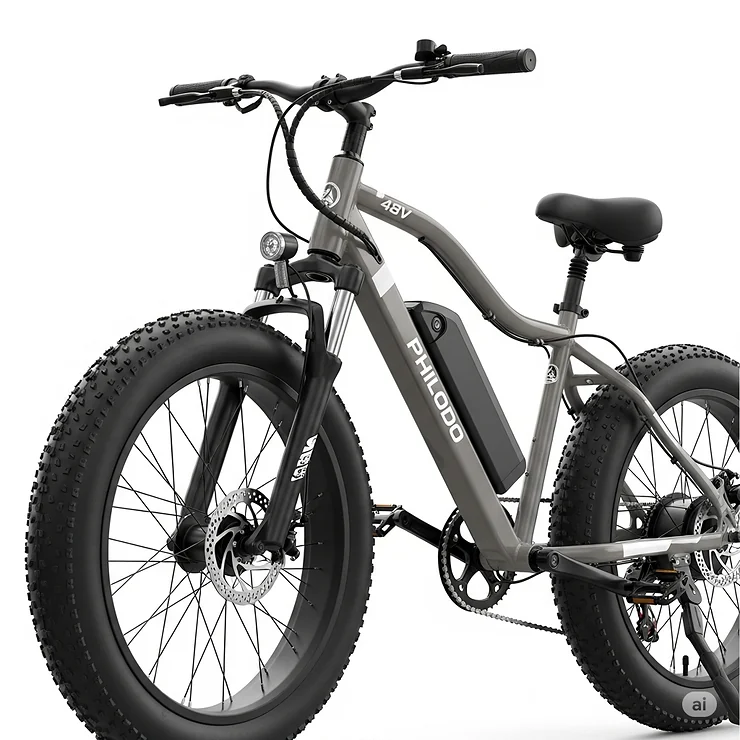
Day one: check everything. Retailer text for the Philodo H8 itself reminds buyers to check that parts are tightened before riding. Go over axle nuts, stem, bars and pedals, and confirm the brakes engage evenly.
Week one: ride gently. Learn the throttle in single-motor mode before enabling dual-motor. Dual drive from a standstill launches a 100-pound bike harder than most people expect. Bed in hydraulic discs with a series of firm stops, not a single panic stop.
Tires: Fat tires work best well below road-bike pressure, but follow the sidewall limits and adjust for your weight and surface. Soft pressure floats on sand and snow, and firmer pressure rolls better on pavement.
Maintenance rhythm:
- Weekly: check tire pressure, brake feel and quick-release or axle tightness.
- Monthly: inspect brake pads and rotors, clean and lube the chain, and look over wiring connectors for rubbing.
- Seasonally: check suspension fork action, torque spoke and bolt tension, and store packs partially charged if the bike will sit.
Common first-30-day mistakes: running both motors on flat ground, ignoring cold-weather range loss, and storing a wet bike with the battery attached.
Real-World Scenarios: Which Bike for Which Rider?
These are illustrative profiles, not real customers, but they show how the numbers translate.
The snow-belt commuter (12 miles round trip, five days a week). Budget is mid-range, roads are icy and parking is outdoors. The Philodo H8 fits: 1,248Wh covers the commute even with dual-motor traction, and the ignition and battery locks suit outdoor parking. Bring the pack inside to keep it warm.
The backcountry hunter or trail hauler (20+ miles, limited charging). Range and torque matter more than price. The Philodo Falcon‘s 1,920Wh and six riding modes, or the Philodo Jumbo‘s 2,208Wh, make sense. The Philodo Jumbo also adds full suspension and a second pack, but weighs about 100 pounds, so plan how you’ll load it.
The weekend loop rider (6–8 miles, a few times a month). You don’t need a monster pack. The AMYET S8 or KETELES K800 gives you AWD and strong climbing for roughly half the cost of the premium models. At this usage level, battery health matters more than peak watts, so charge sensibly.
Common Mistakes When Buying a Philodo 48v Fat Tire Ebike 3000w
- Confusing peak with rated power. A 3,000W peak is not a 3,000W motor. The Philodo Jumbo is rated 2×1,000W, which is why the distinction matters.
- Ignoring watt-hours. A bike with a bigger peak and a smaller pack can feel faster and still strand you sooner.
- Trusting titles. “UL certified” in a listing means little without a certificate for the full system.
- Skipping the SKU check. The Philodo H8 shows up with different motor wattages and battery sizes across retailers, and 1,104Wh and 1,248Wh figures appear for the same 26Ah name.
- Forgetting weight. Ask who will lift it, where it will live and how it will travel.
- Overlooking fit. The Philodo Forester‘s limited seatpost travel is a reminder that a stated height range isn’t a guarantee.
Long-Term Cost & Maintenance
Cost of ownership is where heavy dual-motor bikes either justify themselves or don’t. Start with cost per ride. A $2,000–$2,500 bike used for 150 rides a year over four years comes to about $3.30–$4.20 per ride before maintenance. Cut the rides in half and the figure doubles, which is why overbuying power you won’t use is the most expensive mistake.
Energy is the cheap part. A full 1.2 kWh charge costs well under a dollar at typical household rates. Consumables are where the money goes: fat tires, brake pads and rotors, chains and cassettes all wear faster on a 100-pound bike carrying big loads. The battery is the long-term line item. Packs lose capacity with cycles and heat, and a replacement is the priciest wear part, so check availability and warranty before you buy. A bike like the Philodo Jumbo gives you two packs, which can spread cycle wear but doubles the replacement bill.
For budget bikes such as the Cheevalry G20, the real cost risk is support. A cheap bike with no parts supply can cost more than a pricier one with a responsive service team.
FAQ
❓ How fast does a philodo 48v fat tire ebike 3000w really go?
❓ How long does a philodo 48v fat tire ebike 3000w take to charge?
❓ Can a philodo 48v fat tire ebike 3000w handle heavy riders and cargo?
❓ Is 48V enough, or should I pick a 60V fat tire ebike?
❓ Can I ride a philodo 48v fat tire ebike 3000w in snow and sand?
Conclusion
Strip away the marketing and the story is simple. A philodo 48v fat tire ebike 3000w is a heavy, powerful, genuinely capable machine for loose and steep ground. The 3,000W is a peak, the battery is the real range number, and the legal fine print matters.
For most riders, the Philodo H8 is the sensible center of the field. Its 1,248Wh pack, 330-pound rating and locks suit all-round use. The Philodo Jumbo is the choice when range is non-negotiable and you can live with about 100 pounds. If you’d rather save money, the KETELES K800 and AMYET S8 offer strong power for around $1,000, with small review pools and mixed signals on battery reliability. The Cheevalry G20 is for short, punchy rides. The 60V Philodo Forester and Philodo Falcon are the step-up for torque and rugged distance.
Whichever you choose, verify the SKU and the safety certification, match watt-hours to your real rides, and check local rules before you ride. Do that, and the numbers on the spec sheet will turn into the ride you pictured.
🚴♂️ Ready to ride? Compare current pricing and availability on your favorite pick, double-check the exact model, and get ready for hills, snow and sand that finally feel small. ⚡
Recommended for You
- Addmotor E Bike: 7 Best Models Ranked (Honest 2026 Guide)
- Jansno Ebike Review: 7 Models Ranked (Honest Buyer’s Guide 2026)
- Velowave Ebike: 7 Best Models Ranked (Honest 2026 Guide)
Disclaimer: This article contains affiliate links. As an Amazon Associate, I earn from qualifying purchases. If you purchase products through these links, we may earn a small commission at no additional cost to you.
✨ Found this helpful? Share it with your friends! 💬🤗
