
In This Article
Somewhere around mile four on a standing scooter, your calves start sending you a memo. It’s not a complaint yet — more like a polite tap on the shoulder. By mile seven, that tap turns into a full-blown grievance. This is the exact moment most commuters start Googling “seated electric scooter for adults” at 11 p.m., half-convinced they’ve invented a new category of vehicle that doesn’t actually exist.

It does exist. And in 2026, it’s better than it’s ever been.
A seated electric scooter for adults is exactly what it sounds like: a scooter with a saddle, so you ride like you’re on a tiny motorcycle instead of surfing a skateboard with a handlebar bolted on. Some come with the seat built into the frame from the factory. Others use a removable seat post you can pop on for the commute and pop off for weekend tricks (if you’re into that sort of thing). Either way, the result is the same — your legs stop doing all the work, your lower back stops complaining, and the ride stops feeling like a fitness test disguised as transportation.
This guide walks through seven real, currently-sold models spanning roughly $300 to $2,250, because “best” means something different depending on whether you’re commuting two miles to a coffee shop or twenty-five miles to an office park. We’ll cover genuine spec breakdowns, honest trade-offs, real aggregated review sentiment, and the practical stuff nobody puts on the product page — like why your seat height matters more than your top speed, and why a $300 scooter can still be the right answer for plenty of riders.
Quick Comparison Table: Seated Electric Scooters for Adults at a Glance
| Scooter | Motor | Top Speed | Range | Seat Type | Best For |
|---|---|---|---|---|---|
| GoTrax A5 | 400W (550W peak) | ~15.5 mph | ~15.5 mi | Built-in | Absolute budget starters |
| Razor EcoSmart Metro HD | 350W | 15.5 mph | 12 mi | Built-in padded | Classic cruiser comfort |
| Hiboy S2 | 350W | 18.6 mph | 17 mi | Optional add-on | Foldable value commuting |
| isinwheel H7 | 1000W-1500W (model dependent) | Up to 20-38 mph | Up to 43 mi | Built-in | Suspension on a budget |
| Segway Ninebot MAX G2 (+ seat kit) | 450W (1000W peak) | 22 mph | 43 mi | Removable | True removable-seat setup |
| EMOVE RoadRunner V3 | Dual motor, 500W cont. | 34 mph | 53 mi (claimed) | Built-in, ergonomic | Moped-style performance |
| JackRabbit XG Pro | 749W | 20-24 mph | 48+ mi | Built-in saddle | Ultralight premium |
Looking at the spread here, the story isn’t really about who “wins” — it’s about matching your commute to the machine. The GoTrax A5 and Razor EcoSmart Metro HD are built for short, slow, local trips where comfort matters more than speed, while the EMOVE RoadRunner V3 and JackRabbit XG Pro are aimed at riders who want real range and don’t mind paying for it. The Segway Ninebot MAX G2 sits in an interesting middle spot: buy the scooter for its speed and range, then decide later whether you want the seat.
💬 Found the scooter that fits your commute? Save this list — you’ll want to compare specs again before you buy.
Top 7 Seated Electric Scooters for Adults: Expert Analysis
1. GoTrax A5 — the cheapest real sit-down setup you can buy
At around $300, the GoTrax A5 isn’t trying to impress anyone with numbers — it’s trying to be the least painful entry point into seated riding, and on that front it delivers. The 400W motor (with a 550W peak rating on some retailer listings) pushes the A5 to roughly 15.5 mph, with a claimed range around 15.5 miles on the 12-inch pneumatic tires.
Here’s what those numbers mean in practice: this is a neighborhood scooter, not a highway commuter. A 15 mph top speed keeps you well within most state scooter speed caps, and the pneumatic tires soak up potholes and cracked sidewalks far better than the hard rubber wheels you’ll find on cheaper standing scooters. Based on the spec comparison against other sub-$400 models, the A5’s built-in seat and rear basket combo is unusually complete for the price — most competitors at this tier make you buy the seat separately.
The A5 is for someone running errands, hitting a bus stop a mile away, or handling short trips around a retirement community or campus. It’s not for someone who wants to go 20 miles round-trip to an office.
Reviewers consistently mention the A5’s comfortable seat, generous tire size, and practical rear basket as its strongest points, with independent 2026 scooter coverage repeatedly flagging it as a genuine entry-level pick rather than a toy with a seat bolted on.
Pros:
- ✅ Lowest price point of any real seated scooter on this list
- ✅ 12-inch pneumatic tires smooth out rough pavement
- ✅ Built-in rear basket adds real errand-running utility
Cons:
- ❌ 220 lb weight limit rules out heavier riders
- ❌ 15.5-mile range won’t cover longer commutes
Around $300, the GoTrax A5 is the value pick for short-distance riders who just want to sit down and go — you’re not paying for speed, you’re paying for accessibility.
2. Razor EcoSmart Metro HD — the classic padded-seat cruiser
Razor built the EcoSmart Metro HD as a purpose-built seated scooter from the ground up, not a standing scooter with an afterthought seat, and that shows the moment you sit on it. The 350W hub motor delivers a top speed up to 15.5 mph with a range up to 12 miles, and it rides on genuinely large 16-inch pneumatic tires — nearly twice the diameter of what most budget scooters use.
What most buyers overlook about tire size is how much it changes ride quality on cracked asphalt. Bigger wheels roll over gaps and debris that would jolt a smaller-wheeled scooter to a stop, and that matters enormously when you’re seated rather than standing with bent knees to absorb shock. The bamboo deck gives your feet room to shift position on longer rides, and the padded saddle sits on a steel frame rated for riders up to 220 lbs.
Reviewers consistently praise the EcoSmart Metro HD’s comfort and the practicality of its detachable luggage rack and basket, while a common complaint in user reviews is that the seat height is awkward to adjust and the scooter ships with no built-in lights.
This is the pick for someone doing short, flat, local trips — think a mile to the corner store, not a daily highway-adjacent commute — who prioritizes a genuinely cushioned ride over speed or range.
Pros:
- ✅ Large 16-inch pneumatic tires smooth out bumps and cracks
- ✅ Padded seat plus bamboo deck built for comfort, not just speed
- ✅ Detachable basket handles groceries and bags easily
Cons:
- ❌ No built-in lights for low-visibility riding
- ❌ Seat height adjustment is fiddly according to owner reports
In the $500-$700 range depending on retailer and promotions, the EcoSmart Metro HD earns its reputation as the scooter people picture when they hear “seated electric scooter.”
3. Hiboy S2 — foldable value with an optional seat kit
The Hiboy S2 wasn’t originally designed as a seated scooter, but it’s become one of the most common budget picks for riders who want the option — Hiboy and third-party sellers both offer attachable seat kits that clamp onto the S2’s long deck and stem. Under the hood, you get a 350W front hub motor delivering an 18.6 mph top speed, a 17-mile range from its 270Wh battery, and dual braking (electronic plus disc) that punches above its price class.
Here’s what the spec sheet won’t tell you: the S2’s 8.5-inch solid tires are quieter and more puncture-proof than pneumatic alternatives, but they transmit more road vibration straight into the deck — and by extension, into a seat if you add one. Independent testing measured the S2 hitting 18.9 mph and accelerating from 0-15 mph in under 7 seconds, numbers that hold up well against pricier competitors.
Reviewers consistently note that the S2 punches above its weight on speed and acceleration for the price, though a common thread in feedback is that ride comfort suffers at higher speeds due to the solid tires and lighter suspension.
This is a smart pick for the rider who wants the flexibility to ride standing most days and seated on longer trips, without paying a premium for a purpose-built seated frame.
Pros:
- ✅ Folds compactly for apartment storage or car trunks
- ✅ Strong acceleration and braking for its price class
- ✅ Seat is optional — buy it now or add it later
Cons:
- ❌ Solid tires transmit more vibration than pneumatic options
- ❌ 220-265 lb weight limit is modest for a versatile commuter
Priced around $400-$470 depending on configuration, the S2 works best as a “grow into it” seated scooter rather than a dedicated one.
4. isinwheel H7 — hydraulic suspension on a budget
The isinwheel H7 exists to answer one question: what if a scooter under $750 had the suspension and braking of something twice the price? The base H7 runs a 1000W-1500W motor (specs vary slightly by retailer listing and region) capable of up to 20 mph in its US-market commuter trim, with a genuinely long claimed range up to 43 miles. Front and rear hydraulic suspension plus hydraulic disc brakes are the standout features here — components you’d typically expect on scooters costing $1,000 or more.
Based on the spec comparison, what sets the H7 apart from similarly-priced competitors isn’t raw power, it’s ride quality. Dual hydraulic suspension absorbs impacts that would rattle a rider’s spine on a rigid-frame budget scooter, which matters enormously for anyone riding seated over cracked pavement or gravel paths. The built-in seat, NFC keyless unlock, and large storage basket round out a package clearly designed around daily practicality rather than just speed bragging rights.
Reviewers consistently highlight the dual suspension and hydraulic brakes as standout value at this price tier, while some owners note the scooter’s weight (around 111 lbs shipped, though the ride weight is lower) makes it less portable than folding alternatives.
This is the pick for someone commuting several miles daily over rough urban streets who wants suspension comfort without paying premium prices.
Pros:
- ✅ Dual hydraulic suspension rare at this price point
- ✅ Hydraulic disc brakes for stronger, more controlled stops
- ✅ Long claimed range up to 43 miles on a single charge
Cons:
- ❌ Heavier build reduces portability compared to folding scooters
- ❌ Motor power and top speed vary by exact model/listing
In the $650-$750 range, the H7 is the clearest example on this list of getting genuine componentry upgrades without a genuine price jump.
5. Segway Ninebot MAX G2 — best true removable seat design
If the phrase “electric scooter with removable seat” is what brought you here, this is the pairing to know: the Segway Ninebot MAX G2 scooter combined with Segway’s official add-on seat accessory. The G2 itself runs a 450W nominal (1000W peak) rear motor, hits 22 mph, and covers a genuinely impressive 43-mile range off its 551Wh battery — numbers that put it ahead of most seated-specific competitors even before the seat goes on.
The seat kit clips onto the deck and stem with a locking base, adjusts in height to fit different riders, and folds flat to the side for storage when you want to ride standing. What most buyers overlook about seat kits like this: not every scooter accepts one safely. Deck length and mounting-point geometry matter — a seat clamped onto a short-deck scooter can flex dangerously, which is why Segway’s factory-matched kit (rather than a generic universal seat) is the safer choice here.
Reviewers consistently praise the G2’s dual suspension and long real-world range, with the official seat accessory earning strong marks for shock-absorbing comfort and reliable install, though it’s worth noting the seat is compatible with the MAX G2 and G65 specifically — not older Ninebot MAX models.
This setup is ideal for the rider who wants genuine flexibility: commute seated on weekdays, ride standing for a quick errand, and never be locked into one riding style.
Pros:
- ✅ 43-mile range and 22 mph top speed lead this price tier
- ✅ Official seat kit is height-adjustable and removable in minutes
- ✅ Dual suspension smooths out the ride with or without the seat
Cons:
- ❌ Seat sold separately adds to total cost
- ❌ Not compatible with all Segway Ninebot models — check compatibility first
Scooter plus seat lands in the $750-$900 range combined, making the Segway Ninebot MAX G2 the strongest argument on this list for buying flexibility over commitment.

6. EMOVE RoadRunner V3 — moped-grade power and range
The EMOVE RoadRunner V3 doesn’t pretend to be a scooter with a seat bolted on — it’s built from the frame up as a hybrid between an electric scooter and a light moped, and the spec sheet backs that up. Dual motors (a 350W front and 500W-1000W rear depending on configuration) deliver a manufacturer-claimed top speed of 34 mph and a claimed range of 53 miles, pulled from a substantial 1,124Wh removable battery.
Here’s what the spec sheet won’t tell you: independent testing groups have clocked the V3 slightly above its claimed top speed (over 36 mph) while measuring real-world range closer to 30-33 miles rather than the full 53-mile claim — a common and expected gap between lab-rated and real-world numbers on any EV. What most buyers overlook is the seat itself: it’s wider and more contoured than earlier RoadRunner generations, with a genuinely usable adjustable-height handlebar setup that accommodates riders from roughly 5’2″ to 6’2″ comfortably.
Reviewers consistently describe the throttle response as remarkably smooth for a scooter with this much power, and the hydraulic brakes and removable battery are frequently cited as standout features that justify the higher price versus cheaper “seat bolted on” alternatives.
This is the pick for a rider who wants genuine moped-replacement performance — real hills, real distance, real speed — in something still classified and priced like a scooter rather than a licensed vehicle.
Pros:
- ✅ Genuine dual-motor power handles hills other scooters can’t
- ✅ Removable battery simplifies charging and extends usable range
- ✅ Hydraulic disc brakes provide serious stopping power at speed
Cons:
- ❌ 77-78 lb weight makes it a two-person lift, not portable
- ❌ Real-world range runs meaningfully below the claimed 53 miles
In the $1,600-$1,800 range, the RoadRunner V3 is priced like a serious vehicle because, functionally, it’s replacing one.
7. JackRabbit XG Pro — lightest premium seated micro-ride
The JackRabbit XG Pro occupies its own category — technically a “micro e-bike” with foot pegs rather than a traditional scooter deck, but functionally it’s a seated personal mobility device that competes directly with premium seated scooters. A 749W rear hub motor delivers a 20 mph base speed (24 mph in an unlockable off-road mode for riders 18+), backed by a genuinely long 48+ mile range from its dual 360Wh RangeBuster battery setup.
What sets the XG Pro apart from every other product on this list is weight: at just 37 lbs, it’s roughly half the mass of the EMOVE RoadRunner V3 while offering nearly comparable range. Based on the spec comparison, that weight difference translates directly into portability — the XG Pro folds flat for train commutes, apartment storage, or trunk space in a way the RoadRunner simply can’t match. The tradeoff is top speed: at 20-24 mph versus the RoadRunner’s 34 mph, this is built for convenience and range over outright velocity.
Reviewers consistently describe the XG Pro’s fold-flat compact frame and light weight as class-leading, with the higher-rise handlebars and wider suspension tires drawing particular praise for comfort compared to the original JackRabbit XG.
This is the premium pick for a rider who values portability and daily-carry convenience as much as raw performance — someone taking transit part of the way and riding the rest.
Pros:
- ✅ Just 37 lbs — lightest seated option on this list by a wide margin
- ✅ 48+ mile range rivals scooters twice its weight
- ✅ Fold-flat design genuinely fits train commutes and small apartments
Cons:
- ❌ Top speed caps lower than performance-focused alternatives
- ❌ Premium price around $2,249 is a significant jump over mid-tier options
At around $2,249, the XG Pro is for the rider who’s already decided portability matters more than winning a drag race.
What Is a Seated Electric Scooter for Adults?
A seated electric scooter for adults is a personal electric vehicle built around a saddle or seat instead of a standing deck alone, letting riders sit down while operating the throttle and brakes. Seats may be built into the frame or attach as a removable accessory, and models range from sub-$300 commuter scooters to $2,000+ performance builds.
The category exists to solve one specific problem: standing scooters are exhausting over distance. A body braced against acceleration and braking forces for 20 or 30 minutes straight fatigues fast, particularly through the calves, quads, and lower back. Sitting redistributes that load onto the seat and your core, which is a huge part of why seated riders report being able to comfortably cover two, three, sometimes five times the distance they’d tolerate standing.
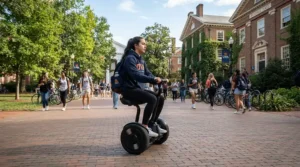
Seated vs Standing Riding: Which Is Actually Better?
This isn’t really a fair fight once distance enters the picture, but it’s worth being honest about where standing scooters still win.
Standing scooters are lighter, cheaper, and more maneuverable — no seat mass to haul around, no seat post to fold, and a lower center of gravity that some riders find more intuitive for weaving through crowded sidewalks. For a half-mile trip to grab coffee, a standing scooter is simply the more practical, portable tool.
But the physiology tips hard toward seated riding once you’re covering real distance. A conference paper on standing-posture fatigue from the International Association of Engineers found that even short bouts of prolonged standing — as little as 90 minutes — measurably increased muscle activity and perceived discomfort in the lower limbs and back compared to seated or supported postures. Translate that into scooter terms: a standing rider’s legs are doing continuous micro-stabilization work the entire ride, while a seated rider’s legs are essentially along for the ride.
What most buyers overlook about seated scooters is that the benefit isn’t really about laziness — it’s about consistency. A standing rider’s form degrades as they tire, which means their balance and reaction time degrade too, right as fatigue sets in. A seated rider’s posture barely changes from minute one to minute thirty, which is a meaningful safety consideration on longer or bumpier commutes.
The honest verdict: standing wins on short trips and tight portability needs, seated wins on anything past roughly two miles, and the crossover point is exactly where most commuters actually live.
How to Choose a Seated Electric Scooter for Adults
- Start with your actual commute distance, not your ideal one. If you’re going under 3 miles, a $300 built-in-seat model like the GoTrax A5 genuinely covers you — don’t overpay for range you won’t use.
- Check the weight limit against your actual weight, not a rounded-down guess. Motors and batteries lose performance fast when a rider is near the stated ceiling; leave headroom.
- Prioritize tire size and type over top speed. Larger pneumatic tires absorb more shock than raw motor wattage ever will, and comfort on a seated scooter lives or dies on the tires.
- Decide built-in versus removable seat based on how often you’ll actually want to stand. If the answer is “never,” built-in seats tend to be sturdier and better integrated.
- Match battery capacity to your round-trip distance, then add 30% buffer. Manufacturer range claims are lab-tested best cases; real-world range typically runs 15-30% lower.
- Look for hydraulic or dual disc brakes if you’re above 20 mph. Braking distance matters disproportionately more once real speed enters the picture.
- Factor in storage and portability realistically. A scooter that’s too heavy to carry up your apartment stairs will end up parked outside — or not used at all.
Ergonomic Seating Design and Cushioned Saddle Comfort: What Actually Matters
Not all seats are created equal, and the marketing copy rarely tells you why. An ergonomic seating design on a scooter typically means three things working together: adjustable seat height, a saddle shape that supports your sit bones rather than your soft tissue, and a seat post angle that keeps your spine in a natural, slightly forward-leaning position rather than bolt upright.
Here’s what the spec sheet won’t tell you: seat padding thickness matters less than seat width and shape. A thin, well-contoured saddle like the ones found on performance-oriented models such as the EMOVE RoadRunner V3 can be more comfortable over a 30-minute ride than a thick, flat cushion, because it distributes pressure across your sit bones instead of compressing everything underneath you evenly (and numbly).
Cushioned saddle comfort also depends heavily on suspension working in tandem with the seat. A scooter like the isinwheel H7, with dual hydraulic suspension, lets the seat do less shock-absorbing work because the frame is already handling bumps before they reach you. Compare that to a rigid-frame budget scooter where the seat cushion is the only thing standing between your spine and every crack in the pavement — no amount of foam fixes that mismatch.
Based on the spec comparison across this list, the general rule holds: pricier scooters pair suspension with a firmer, more shaped saddle, while budget scooters lean on thick padding to compensate for having no suspension at all. Both approaches work for short rides; only the suspension-plus-saddle combo holds up over longer distances.
Comfortable Seated Electric Scooter: Setup and First 30 Days
Getting genuine comfort out of a new seated scooter takes a little setup work most riders skip.
Adjust seat height before your first ride, not after. Sit on the scooter with both feet flat on the deck or footpegs — your knees should have a slight bend, similar to bike-seat positioning. Too high and you’ll be reaching for the throttle awkwardly; too low and your knees will do unnecessary work.
Set tire pressure to the manufacturer’s recommended PSI, then adjust for your weight. Underinflated pneumatic tires feel cushier initially but increase rolling resistance and drain your battery faster — a common first-30-days mistake that shows up as “my range doesn’t match the claim” complaints.
Break in mechanical disc brakes gradually. New brake pads need a bedding-in period of light, repeated stops before they reach full stopping power — don’t judge your scooter’s braking on day one.
Recalibrate your riding position weekly for the first month. Muscles adapt to new postures over roughly two to three weeks; what feels slightly off in week one often disappears by week three as your core and legs adjust to seated riding mechanics.
A common mistake in the first 30 days is treating a seated scooter exactly like a standing one — leaning into turns the same way, braking the same way. Seated weight distribution changes your center of gravity, and giving yourself a short adjustment period prevents both discomfort and the occasional wobbly first turn.
Real-World Scenarios: Who Should Buy Which Seated Scooter
The campus commuter, 1.5 miles each way, tight dorm storage. A folding, lightweight option matters more than range here. The Hiboy S2 with its optional seat kit fits this brief — foldable, affordable, and light enough to carry up dorm stairs without a fight.
The suburban parent running errands, 3-5 miles round trip, needs cargo space. Comfort and storage beat speed. The Razor EcoSmart Metro HD or GoTrax A5, both with built-in baskets and padded seats, handle grocery runs and school pickups without asking for much in return.
The office commuter, 15-20 miles round trip, mixed urban terrain. This is where range and suspension both matter. The isinwheel H7 or Segway Ninebot MAX G2 cover real mileage with enough suspension to survive potholed city streets, and the G2’s optional removable seat means standing days are still an option.
The moped-replacement rider, 20+ miles, hills, wants real power. The EMOVE RoadRunner V3 is built exactly for this — dual motors, real hill-climbing torque, and range that actually supports a full commute rather than a half-hearted attempt at one.
The multimodal commuter mixing train and scooter, needs to carry it through turnstiles. Weight beats everything else here. The JackRabbit XG Pro, at 37 lbs and fold-flat, is the only option on this list genuinely built for that use case.
Removable Seat vs Built-In Seat: Which Should You Choose
This decision comes down to how much you value flexibility versus structural simplicity, and it’s worth being honest about the tradeoffs on both sides.
A built-in seat — like the ones on the GoTrax A5, Razor EcoSmart Metro HD, or EMOVE RoadRunner V3 — is integrated into the frame’s mounting points from the factory. What most buyers overlook about built-in seats: they’re mechanically simpler and generally more stable under bumps and hard braking because there’s no separate clamp joint to flex or loosen over time.
A removable seat, like the official kit paired with the Segway Ninebot MAX G2, clamps onto the deck and stem, letting you switch between standing and seated riding depending on the day. The tradeoff is a potential weak point at the mounting joint — which is exactly why brand-matched, factory-designed seat kits matter so much more than generic universal seats. A universal seat clamped onto a scooter it wasn’t engineered for can flex dangerously under a bump, particularly at higher speeds.
The honest recommendation: if you know you’ll always want a seat, a built-in design tends to be sturdier and simpler. If your riding style genuinely varies — standing for quick errands, seated for longer commutes — a removable seat from the scooter’s own manufacturer, properly installed on a compatible deck, gives you real flexibility without meaningfully compromising safety.
Common Mistakes When Buying an Electric Scooter With a Seat
Shopping for a seated scooter trips people up in a handful of predictable ways.
Buying based on top speed alone. A 34 mph scooter sounds appealing on paper, but if your commute is two miles through a neighborhood with a 15 mph legal cap, that extra speed is dead weight you’re paying for and never using.
Ignoring weight capacity margins. Manufacturers rate max load under close-to-ideal conditions. Riders near the ceiling see meaningfully reduced range, slower acceleration, and shorter brake-pad life — buy up a tier if you’re within 15-20 lbs of the stated limit.
Skipping the UL 2272 certification check. This is a genuinely serious one. Battery fires in uncertified micromobility devices are a documented, tracked hazard — the U.S. Consumer Product Safety Commission has directly urged manufacturers and retailers to ensure compliance with recognized safety standards for exactly this reason. Skipping this check to save $50 is not a trade worth making.
Assuming a universal aftermarket seat fits any scooter safely. As covered above, deck length and mounting geometry vary enormously between models — a seat that isn’t matched to your specific scooter’s frame can be a genuine fall hazard, not just an inconvenience.
Underestimating charging time in daily planning. A scooter with a 34 mph top speed and a 12-hour full charge time isn’t practical for someone who needs it ready every morning without an overnight charge — check charge time against your actual schedule, not just range.
Long-Term Cost & Maintenance
The sticker price is only the opening chapter of what a seated scooter actually costs over a few years of ownership.
Tires are the most frequent replacement item — pneumatic tires need occasional tube patches or full swaps, typically running $20-$60 per tire depending on size, while solid tires avoid punctures entirely but transmit more vibration and can’t be repaired if they wear out or crack. Brake pads on disc-brake models generally last 500-1,000 miles before needing replacement, a low-cost maintenance item most riders handle themselves.
Battery degradation is the bigger long-term consideration, and it scales with both price and usage pattern. Lithium-ion batteries in this category typically retain 70-80% of original capacity after 500-800 full charge cycles — meaning a scooter charged daily might see noticeably reduced range within 18-24 months of heavy use. Removable-battery models like the EMOVE RoadRunner V3 have an advantage here: replacing just the battery pack, rather than the whole scooter, is meaningfully cheaper when degradation eventually sets in.
Total cost of ownership math favors the mid-tier options on this list more than it initially appears. A $300 GoTrax A5 that needs a battery replacement within two years of daily use may end up costing nearly as much as a $700 isinwheel H7 that was built with more durable componentry from the start — the cheaper upfront price doesn’t always translate to cheaper ownership.
Safety, Regulations & Compliance Guide
Seated electric scooters fall under the same state and local regulations as standing electric scooters in nearly every U.S. jurisdiction — there’s no separate “seated scooter” legal category. Most states cap scooter speeds at 15-20 mph on public roads, require no driver’s license (California, Arkansas, Massachusetts, and Missouri being notable exceptions with license requirements), and set a minimum rider age around 16.
Before you ride any of the faster models on this list — particularly the EMOVE RoadRunner V3 at its 34 mph claimed top speed — check your specific state and city rules. A scooter that legally caps at 20 mph in most jurisdictions may require moped-level registration once it crosses certain speed or wattage thresholds, and enforcement varies significantly by city.
Battery and electrical safety deserves equal attention. The U.S. Consumer Product Safety Commission has flagged UL 2272 (the standard for electrical systems in personal e-mobility devices) as critical for reducing fire risk in this product category, following reports of fire and overheating incidents tied to non-compliant devices. Every scooter on this list from an established manufacturer carries this certification — verify it directly on the product listing before buying from a less familiar brand, since certification claims aren’t always accurate on third-party marketplaces.
Helmet use, while not universally mandated for adult riders, remains one of the single biggest factors in reducing injury severity across documented e-scooter accident data, and it’s a habit worth keeping regardless of your local legal minimum.
Problem → Solution Guide
Problem: Your legs still get tired despite riding seated. This usually traces back to seat height, not the seat itself. If your knees are bent past roughly 90 degrees while pedaling the throttle, raise the seat post — most of the fatigue riders report on seated scooters comes from an incorrectly low seat forcing constant leg engagement.
Problem: The scooter feels unstable at higher speeds. Check tire pressure first — underinflated tires create a vague, floaty feeling at speed. If pressure’s correct, the issue may be a mismatch between your weight and the scooter’s rated capacity; models like the isinwheel H7 or EMOVE RoadRunner V3 with higher weight ratings handle high-speed stability more confidently for heavier riders.
Problem: Range falls noticeably short of the claimed number. This is normal, not a defect — real-world range typically runs 15-30% below manufacturer claims due to rider weight, terrain, temperature, and riding style. Budget accordingly rather than assuming a fault.
Problem: The removable seat feels loose or wobbly. Recheck that the mounting hardware is torqued to spec — clamp-style seat posts can loosen slightly after the first several rides as components settle. If looseness persists after retightening, the seat may not be a genuine match for that scooter’s deck geometry.
Problem: Charging takes longer than expected, disrupting your routine. Larger-battery models like the EMOVE RoadRunner V3 can take 9-12 hours for a full charge. If your schedule doesn’t allow for overnight charging, look toward faster-charging, smaller-battery options like the Hiboy S2, or invest in a second charger for a work-location top-up.

Frequently Asked Questions
❓ Is a seated electric scooter for adults better than a standing one for commuting?
❓ How much does a seated electric scooter with a removable seat cost?
❓ Do I need a license to ride a seated electric scooter?
❓ What weight limit should I look for in a comfortable seated electric scooter?
❓ Is a built-in seat or removable seat design safer?
Conclusion
There’s no single “best” seated electric scooter for adults, and honestly, anyone claiming otherwise is skipping the part where your commute, budget, and weight all matter more than a spec sheet ranking. What’s clear across all seven models here is that the category has matured fast — a $300 GoTrax A5 buys real comfort for short trips, while a $2,249 JackRabbit XG Pro buys genuine range in a package light enough to carry onto a train. In between, scooters like the isinwheel H7 and Segway Ninebot MAX G2 prove you don’t need premium pricing to get suspension, real range, and thoughtful seat engineering.
The through-line worth remembering: seat height, tire size, and weight-limit headroom matter more to your actual comfort than top speed ever will. Match those three things to your real commute, verify UL 2272 certification, and check your state’s scooter regulations before you ride — and whichever model you land on, you’ll spend a lot less time wondering why your legs are tired halfway through the ride.
Recommended for You
- Racing Electric Scooter Guide 2026: 7 Fastest Picks Ranked
- Dual Motor Electric Scooter Hill Climbing: 7 Elite Picks (2026)
- Dual Motor Electric Scooter: 7 Unstoppable 2026 Picks
Disclaimer: This article contains affiliate links. As an Amazon Associate, I earn from qualifying purchases. If you purchase products through these links, we may earn a small commission at no additional cost to you.
✨ Found this helpful? Share it with your friends! 💬🤗
