In This Article
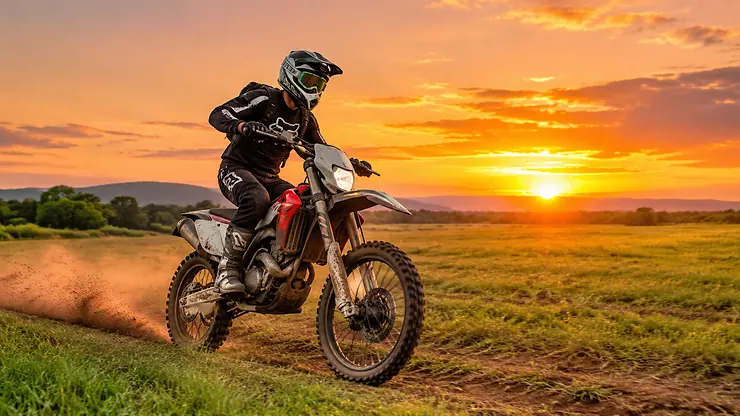
An electric dirt bike for adult trail riding is a battery-powered off-road motorcycle (or e-moto) sized to carry a full-grown rider over dirt, roots, and rocks. Its motor is rated in kilowatts, not pedal assist. Most models run roughly 40 to 65 mph, and in the US they are usually treated as off-highway vehicles rather than road bikes.
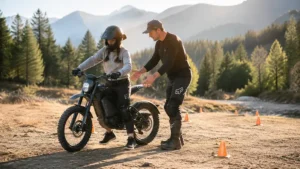
Here’s the odd magic of this category. You can now charge a serious trail machine in the garage, wheel it out the back gate, and ride without waking the street. No premix. No kickstart ritual. No clutch hand cramping on the third climb. Just a twist grip and a grin you didn’t plan on.
But the market is a minefield. Spec sheets brag about peak kilowatts, “adult-sized” frames, and claimed range figures that quietly assume a lightweight rider on flat ground. Buy the wrong one and you’ll outgrow it in a month, or sag its suspension on day one.
So this guide does the sorting. It covers seven real bikes, from roughly $1,300 to the low-$6,000s, researched from manufacturer specs and published reviews. You’ll get plain-English notes on motor power in kW, rider weight limits, and swappable battery packs, plus what actually makes a quiet electric dirt bike for backyard trails or a low maintenance dirt bike for adult beginners.
One reality check before you fall in love. These are off-road machines, so your riding spot must be private land with permission, a designated OHV park, or a route shown on the Forest Service motor vehicle use maps. Prices here are ranges at the time of research, so check current pricing before you buy.
Quick Comparison: 7 Electric Dirt Bikes at a Glance
| Model | Peak Power | Battery | Price Range | Best For |
|---|---|---|---|---|
| Heybike Villain | ~4.2 kW | 52V 26Ah (1.35 kWh), removable | $1,300–$1,500 | Budget starters, lighter adults |
| Yozma IN 10 Pro | 5.5 kW | 60V 27Ah (1.62 kWh) | $1,900–$2,100 | Value-minded trail riders |
| Sur-Ron Light Bee X | 8–10 kW (by year) | 60V 40Ah or 72V 35Ah, removable | $3,000–$4,000 | First “real” trail bike |
| Talaria Sting R MX4 | ~8–9 kW | 60V 45Ah (2.7 kWh), swappable | $3,800–$4,100 | Long mixed-terrain rides |
| Segway Dirt eBike X260 | 5 kW | 1.92 kWh, swappable | $5,000–$6,500 | Easy pack swaps, big-brand backing |
| Sur-Ron Ultra Bee HP | 21 kW (higher in Turbo) | 74V, swappable | $6,000–$7,000 | Aggressive, experienced riders |
| Talaria Komodo | 32 kW peak | 97.2V 45Ah (4.38 kWh) | $5,700–$6,500 | Heavier riders, technical terrain |
Looking at the table, the real story is the price cliff between the roughly $2,000 bikes and the mid-$3,000s. That jump buys roughly double the peak power and a much bigger parts ecosystem. The Heybike Villain and Yozma IN 10 Pro are best treated as “try it without betting the house” options. At the top, the Talaria Komodo and Sur-Ron Ultra Bee HP are performance machines that new riders should grow into, not start on.
💬 Just one click: help other riders make better buying decisions too! 😊
Top 7 Electric Dirt Bike Picks for Adult Trail Riding: Expert Analysis
Each pick below is ordered from entry-level to flagship. Specs come from manufacturer and retailer listings, and review sentiment is summarized from published reviews, not hands-on testing. Where sources disagree, I say so.
1. Heybike Villain — cheapest ticket to real trail speed
The Heybike Villain is the budget wildcard: a pint-sized mid-drive e-moto that costs about what a decent mountain bike does, yet claims 45 mph. Heybike lists a 4,160W peak motor, 190 Nm of torque, and a removable 52V 26Ah (1.35 kWh) pack. In practice, that’s plenty of punch for rolling singletrack and backyard loops, but a modest energy tank. Think a few hours of mixed riding, not an all-day epic.
At roughly 125 lb with 14-inch and 12-inch wheels, it’s easy to flick around and easy to pick up after a tumble. It’s rated for riders up to about 6’1″ and a 265-lb load, which is more adult-friendly than the “teen bike” marketing suggests. One published review had a 5’11”, 240-lb rider enjoying it. Another review roundup flagged mixed messaging on water resistance, so rinse it gently and skip the pressure washer. The tiny wheels turn tight but feel twitchy over big roots.
Pros:
- ✅ Lowest entry price in this guide
- ✅ Light enough for easy handling
- ✅ Removable battery for indoor charging
Cons:
- ❌ Small wheels get nervous on rough trails
- ❌ Smaller battery limits long rides
Expect to pay around $1,300–$1,500. Strong value if your trails are moderate and your expectations are honest.
2. Yozma IN 10 Pro — 5.5 kW for roughly two grand
The Yozma IN 10 Pro is the “wait, that’s only two grand?” bike. Yozma lists a 5,500W peak mid-drive motor, 220 Nm of torque, and a 60V 27Ah (1.62 kWh) battery. By my math that’s about 30% more motor and 20% more energy than the Heybike Villain. It’s the gap between a backyard hooligan and a bike that handles genuine climbs.
It weighs about 121 lb, sits on 17-inch and 14-inch wheels, and has a 30.7-inch seat. Yozma suggests riders from roughly 4’7″ to 6’3″, though published opinions split on fit: one reviewer found it heavy for smaller riders, another suggested larger adults look at bigger frames. Load ratings vary by listing, from about 265 to 330 lb, so confirm with the seller.
Review sentiment is warm. Electrek called it a standout value, and Racer X described it as fun. However, one aggregated roundup noted a buyer’s unit arriving with a stripped brake-lever bolt and a missing throttle bolt. It also suggested some online customer reviews look auto-generated. Translation: check every fastener before ride one, and read reviews skeptically.
Pros:
- ✅ Strong power for the money
- ✅ Hydraulic brakes and inverted fork
- ✅ Fits a wide range of rider heights
Cons:
- ❌ Quality-control stories warrant a bolt check
- ❌ Long-term durability data is thin
Around $1,900–$2,100. Excellent value if you inspect it carefully on arrival.
3. Sur-Ron Light Bee X — the platform everyone builds around
The Sur-Ron Light Bee X is the bike the whole segment orbits. Its forged-aluminum frame, removable battery, and enormous aftermarket mean parts and advice are everywhere. Specs shift by year. The 2025 version is listed at 8 kW peak with a 60V 40Ah (2.4 kWh) pack, while the 2026 refresh claims a 10 kW peak (6 kW rated), a 72V 35Ah (2.52 kWh) pack, about 130 lb, and a 220-lb max rider.
Why does weight matter? A 130-lb bike is dramatically easier to drag out of a rut than a 195-lb one, and beginners drop bikes. Visordown reported the earlier battery lifting out in about 10 seconds, at roughly 25 lb. Reviewers consistently praise agility and parts support. One comparison noted that the Talaria Sting R MX4‘s factory fork is sturdier and more tunable than the Light Bee X’s stock one, so heavier riders may eventually budget for suspension upgrades.
Pros:
- ✅ Lightest serious trail bike here
- ✅ Huge aftermarket and dealer support
- ✅ Removable pack for easy charging
Cons:
- ❌ Stock suspension may tire heavier riders
- ❌ Specs differ across model years
Roughly $3,000–$4,000 depending on dealer and year. The safest “first real bike” bet.
4. Talaria Sting R MX4 — big 2.7 kWh pack, gearbox drivetrain
The Talaria Sting R MX4 looks like a Light Bee cousin but bets on endurance. It carries a 60V 45Ah (2.7 kWh) swappable pack, listed peak power of roughly 8–9 kW depending on year and seller, and about 145 lb of curb weight. The max load is around 100 kg (220 lb).
Unlike belt-reduction rivals, it uses a gearbox. That means no belt to replace, but an oil change roughly every 3,000 miles, according to one comparison. Talaria’s own marketing calls the drivetrain extremely quiet, and some versions are factory-limited to about 20–25 mph until you remove the limiter at your own risk.
Electric Cycle Rider’s first look praised the tougher fork but flagged a rattling battery in its compartment, a complaint carried over from the previous MX3. That’s worth checking on any unit you buy. For riders who want the longest ride per charge without stepping up to full-size bike weight, the spec sheet is persuasive.
Pros:
- ✅ Largest battery among the mid-weight bikes
- ✅ Sturdier, more adjustable stock fork
- ✅ Gearbox avoids belt replacements
Cons:
- ❌ Reported battery rattle in its compartment
- ❌ Heavier than the Light Bee X
Around $3,800–$4,100. Good value for range-hungry riders.
5. Segway Dirt eBike X260 — easiest pack swap, big-brand backing
The Segway Dirt eBike X260 leads with convenience. Its battery swaps in seconds, and Segway lists a 5 kW max motor, 184 ft-lb of torque, a 1.92 kWh pack, and a claimed 74.6-mile range (almost certainly at gentle speeds). Top speed is 46.6 mph, with 0–31 mph in about 4 seconds. The bike weighs about 121 lb with the battery, 97 lb without.
Here’s the catch: Segway’s rider payload is 220.5 lb and the stated rider age is 18–55. Heavier adults should look elsewhere, whatever a few retailer pages claim. The battery is rated IP65 and the controller IP67, which is reassuring for damp trails.
Honest caveat on reviews: retailer listings show only a handful of ratings, such as a 4.6 from a single review, so there’s no deep sentiment to aggregate. One roundup site summarizes it as affordable and versatile. Several listings also showed it sold out or in-store only, so confirm availability before you plan around it.
Pros:
- ✅ Pack swaps in seconds
- ✅ Very light for the power
- ✅ Water-resistant battery and controller
Cons:
- ❌ 220-lb payload excludes heavier riders
- ❌ Thin review base and spotty stock
Around $5,000–$6,500 depending on the seller. Only worth it if the swap convenience matters to you.
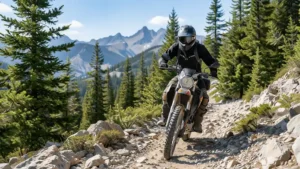
6. Sur-Ron Ultra Bee HP — motorcycle punch at roughly 195 lb
The Sur-Ron Ultra Bee HP sits between lightweight e-motos and full-size electric motorcycles. Listed output is 21 kW peak (up to 24.5 kW in Turbo on the X HP variant), with about 59 mph top speed, roughly 384 ft-lb of wheel torque, and a 74V swappable pack. Pack capacity appears as 40Ah to 60Ah depending on year and listing, and the battery weighs about 47 lb.
Quick math shows why peak kW isn’t sustained power. At 21 kW, a 3 to 4.4 kWh pack would empty in roughly 9 to 13 minutes of full throttle. Real riding is nowhere near that, but it explains why range collapses when you ride flat-out. The bike carries five power modes including Crawl, traction control, and four levels of regen.
That’s a lot of machine for a beginner. Reviewers describe the platform as proven and well supported. One retailer notes it gained weight versus earlier Ultra Bees. Some listings give a 100 kg max load, so verify yours.
Pros:
- ✅ Huge power with traction control
- ✅ Swappable battery and five ride modes
- ✅ Strong aftermarket support
Cons:
- ❌ Too much bike for first-timers
- ❌ Heavier and pricier than the Light Bee X
Around $6,000–$7,000. Premium, but justified for experienced riders chasing speed.
7. Talaria Komodo — 32 kW flagship with the biggest rider capacity
The Talaria Komodo is the heavyweight here, with 32 kW peak (8.6 kW rated), 754 Nm of claimed torque, and a removable 97.2V 45Ah (4.38 kWh) pack. Top speed is about 65 mph and range is up to roughly 70 miles. At 98 kg (216 lb) it’s heavier than the little bikes, but it carries the highest rider rating of the group at 160 kg (about 353 lb). Other specs include a 910 mm (35.8-inch) seat, 315 mm ground clearance, and an IP67-rated pack.
It’s off-road only, and some regional versions ship factory-limited to about 20 mph. Electrek’s launch coverage framed the weight as the price of the extra power and battery. For tall or heavier riders who’ve been squeezed by smaller frames, this is the one that actually fits. For short beginners, the 35.8-inch seat height is a real barrier.
Pros:
- ✅ Highest rider capacity in this guide
- ✅ 4.38 kWh pack for long rides
- ✅ 315 mm ground clearance for technical terrain
Cons:
- ❌ Tall seat intimidates shorter riders
- ❌ Overkill power for novices
Around $5,700–$6,500. The best fit if you’re a bigger rider with experience.
How to Choose an Electric Dirt Bike for Adult Trail Riding
The short answer: match peak power, weight rating, and battery size to your weight, skill, and trail, then verify where you can legally ride.
- Check the rider weight limit first. Add your gear weight and keep a margin. A bike at its limit sags and wears out faster.
- Match kW to your skill. Beginners do best at 4–10 kW with adjustable ride modes.
- Convert battery volts and amp-hours to kWh. Multiply the two. That’s the real fuel tank.
- Decide whether you need swappable battery packs. If you ride more than two hours at a stretch, a spare is transformative.
- Confirm seat height and weight. If you can’t flat-foot it or lift it, you’ll drop it more.
- Check your legal riding spot. Private land, OHV parks, or designated routes only.
- Read recent reviews skeptically. Look for repeated quality complaints, not one-off rants.
Notice what’s missing: top speed. It’s the loudest number on the page and the least useful one on a technical trail.
Motor Power in kW: What the Numbers Mean on the Trail
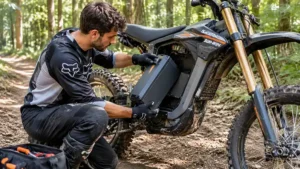
Motor power in kW is the headline spec, but two numbers hide behind it. Peak is what the motor delivers briefly. Rated (or continuous) is what it holds without overheating. The Talaria Komodo lists 32 kW peak but only 8.6 kW rated, and the Sur-Ron Light Bee X lists roughly 10 kW peak against 6 kW rated. Peak decides how hard the bike launches. Rated decides how it behaves on a long climb.
For reference, one kilowatt is about 1.34 horsepower, so 32 kW lands near 43 hp, which matches what sellers quote.
Here’s the useful grouping. At 4–6 kW (Heybike Villain, Yozma IN 10 Pro, Segway Dirt eBike X260), you get a playful trail bike for moderate terrain. At 8–10 kW (Sur-Ron Light Bee X, Talaria Sting R MX4), you get the sweet spot for most adults, with room to climb. At 20+ kW (Sur-Ron Ultra Bee HP, Talaria Komodo), you get motorcycle-level performance that punishes mistakes.
Common beginner error: buying the biggest kW number. A powerful bike on a loose hill is just a faster way to wash out the front end. Use Eco or Sport modes while you learn, and let skill catch up with the spec sheet.
Rider Weight Limits: Fit, Payload, and Suspension
Rider weight limits aren’t marketing fluff. They tell you what the frame, suspension, and tires were designed to handle. The figure also includes your helmet, armor, boots, and a hydration pack. Gear alone often adds 15 to 25 lb, which is why a 200-lb rider in full kit may already be at 220.
| Model | Listed Rider Limit | Fit Notes | Best For |
|---|---|---|---|
| Heybike Villain | 265 lb | Riders up to ~6’1″ | Lighter-to-average adults |
| Yozma IN 10 Pro | ~265–330 lb (varies by listing) | ~4’7″–6’3″ | Mid-size riders on a budget |
| Sur-Ron Light Bee X | ~220 lb | 84–88 cm seat range | Riders under ~200 lb |
| Talaria Sting R MX4 | ~220 lb (100 kg) | 870 mm seat | Mid-weight riders wanting range |
| Segway Dirt eBike X260 | 220.5 lb | Riders aged 18–55 | Lighter adults wanting easy swaps |
| Sur-Ron Ultra Bee HP | ~220 lb (some listings) | 910 mm seat | Experienced mid-weight riders |
| Talaria Komodo | ~353 lb (160 kg) | 910 mm seat | Heavier or taller riders |
The table points one way: if you’re above roughly 200 lb with gear, the Talaria Komodo is the only full-confidence option, and the Yozma IN 10 Pro and Heybike Villain are the budget alternatives. Retailer figures for the same bike often conflict, so trust the manufacturer’s page, not a reseller’s. Riders near a limit should also expect shorter range, since weight drains a battery fastest on climbs.
Swappable Battery Packs: Range Without the Wait
Swappable battery packs turn “I’m done for the day” into “give me ninety seconds.” The Segway Dirt eBike X260 advertises swaps in seconds, the Sur-Ron Ultra Bee HP pack weighs about 47 lb, and the Talaria Komodo pack weighs about 58 lb. A spare for the Talaria Sting R MX4 adds another 2.7 kWh. The catch: price a second pack before you buy the bike, because it’s a significant extra cost.
Pack weight matters more than people expect. A 58-lb battery is a real lift from a truck bed, while the Heybike Villain‘s smaller pack is easy to carry upstairs for charging.
Safety is not optional here. The CPSC has repeatedly warned about lithium-ion fire hazards, and a proposed federal rule on micromobility batteries was published in June 2026. It’s unclear how far it will reach off-road e-motos, so treat the guidance as best practice regardless. Use only the manufacturer’s charger, never charge unattended or overnight, keep packs away from exits and flammables, and retire any pack that swells or behaves oddly.
✨ Don’t miss your next ride!
🔋 Compare these swappable-pack bikes and tap any highlighted name to check current pricing and availability. Your trails won’t ride themselves! 🏍️
Quiet Electric Dirt Bike for Backyard Trails
A quiet electric dirt bike for backyard trails is a relative idea, not an absolute one. Vendor-published figures put gas dirt bikes at about 85–115 dB and electric models at roughly 50–80 dB, though these numbers vary widely by source and measuring method. For context, NIOSH sets a recommended limit of 85 dBA over eight hours, with allowable time halving for every 3 dBA above that. A gas bike blows past that quickly. An electric one largely doesn’t.
But electric isn’t silent. Motors whine, chains clatter, gearboxes hum, and knobby tires slap dirt. Talaria markets the Talaria Sting R MX4 drivetrain as extremely quiet, and it ships in some versions with a 20–25 mph limiter, which keeps noise and trail speed down for neighborly riding.
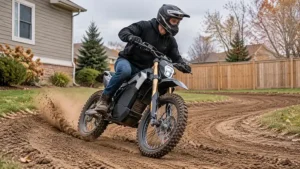
Practical backyard tips: ride in Eco mode, keep the chain lubricated, avoid early mornings, and use dirt loops that route away from property lines. Also check local noise ordinances, because some towns regulate off-road vehicles regardless of sound. The Heybike Villain, Yozma IN 10 Pro, and Sur-Ron Light Bee X make the most sense for a small property, since their weight and power don’t punish a modest yard.
Low Maintenance Dirt Bike for Adult Beginners
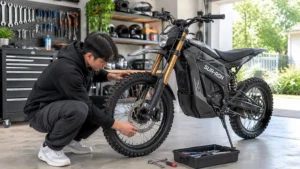
A low maintenance dirt bike for adult beginners means skipping the stuff that makes gas bikes a chore: no spark plugs, carburetor tuning, air filters, or oil changes (apart from gearbox oil on the Talaria Sting R MX4, roughly every 3,000 miles per one comparison). What remains is simple: chain or belt care, brake pads, tire pressure, bolt checks, and battery handling.
The running cost story is lopsided. A full charge of a 2.4–2.7 kWh pack uses about that many kilowatt-hours, so at typical household rates a full charge costs well under a couple of dollars. Dealers cite roughly 500–1,000 charge cycles per pack, or about 3–5 years of regular riding. Pack replacement is the real long-term cost, not fuel.
For beginners, pick on weight and simplicity. The Sur-Ron Light Bee X wins on parts availability and forgiving size. The Heybike Villain wins on price. The Segway Dirt eBike X260 emphasizes low upkeep in its own marketing, though its thin review base limits how much I’d lean on that. Skip the Talaria Komodo and Sur-Ron Ultra Bee HP until your throttle control is solid.
Electric vs Gas Dirt Bike for Trail Riding
| Factor | Electric | Gas |
|---|---|---|
| Noise | Roughly 50–80 dB (vendor figures) | Roughly 85–115 dB |
| Maintenance | Chain/belt, brakes, tires, batteries | Oil, filters, plugs, carb/fuel system |
| Power delivery | Instant torque, no clutch | Clutch and gear shifting |
| “Refuel” | 3–6 hours charging, or swap a pack | A couple of minutes at a gas can |
| Range | Roughly 40–70 miles claimed, less in hard use | Longer tank-based range |
| Best for | Backyards, noise-limited areas, beginners | Long remote rides, riders who love the sound |
The table shows electric winning on noise and upkeep, while gas wins on remote range and quick refueling. If you ride from your own property or near neighbors, the Sur-Ron Light Bee X and Yozma IN 10 Pro make the most sense. If your trails are hours from any outlet, gas still has a real edge unless you carry a spare pack for something like the Talaria Sting R MX4. Some riders also just prefer the sound and the clutch, which is a perfectly valid reason.
Where You Can Legally Ride: Safety, Regulations, and Gear
There’s no single national rule for where you can ride an electric dirt bike for adult trail riding. Access depends on federal land rules and state OHV regulations. The dependable spots are private land with the owner’s permission, designated OHV parks, and motorized routes shown on a Forest Service MVUM. Motor vehicle use maps are the legal reference: if a route isn’t on the map, public motor vehicle use there is prohibited.
State rules vary. California requires an OHV registration (green sticker) for public OHV land. Colorado requires OHV registration on public lands. Arizona uses an OHV decal for designated trails. Texas requires an OHV decal for public trails. Always confirm with your state’s OHV agency, because rules change.
Public roads, sidewalks, and non-motorized trails are generally off limits unless a bike is certified street-legal. Even trails open to mountain bikes may exclude motorized bikes. Dress for the crash, not the ride: helmet, goggles, gloves, boots, and body armor. Faster bikes like the Sur-Ron Ultra Bee HP and Talaria Komodo deserve full gear every time.
Your First 30 Days: Setup, Break-In, and Maintenance Schedule
Day 1: inspect everything. Check every fastener, especially brake levers and throttle hardware. A reviewer’s Yozma IN 10 Pro arrived with a stripped bolt and a missing throttle bolt, which makes this check essential. Set tire pressure per the manual and confirm brakes bite evenly.
Week 1: ride in Eco. Bed in the brakes with moderate stops, learn throttle response in an open field, and practice slow-speed control. Charge fully with the manufacturer’s charger only, and never overnight.
Week 2: re-torque. New bikes loosen up. Re-check axle nuts, handlebar clamps, and suspension bolts. Listen for battery rattle on bikes like the Talaria Sting R MX4.
Week 3: clean and lube. Rinse off mud gently, avoiding electronics, and lubricate the chain. Inspect brake pads.
Week 4: step up. Move to Sport mode only when climbs and corners feel boring.
Common first-month mistakes: riding at full power on day one, storing a battery fully drained, using a mismatched charger, and ignoring the weight limit. Fix those and you’ll avoid most of the expensive problems.
Real-World Scenarios: Which Bike Fits Which Rider?
Scenario 1: the backyard weekender. You’re 190 lb, own two acres, have a roughly $2,000 budget, and ride a few hours each weekend with neighbors nearby. The Yozma IN 10 Pro fits: strong 5.5 kW, light handling, and low noise at Eco settings. Inspect the bolts, and budget for upgrades if your trails get rocky.
Scenario 2: the big-rider forest explorer. You’re 6’2″ and 250 lb, riding public forest routes legally on weekends. The Talaria Komodo is the only option here with a rating that really covers you (about 353 lb), plus 315 mm of ground clearance for rough terrain. Plan on a higher price and a bigger learning curve.
Scenario 3: the long-ride beginner. You’re new to off-road, 175 lb, and want 3–4 hour rides with room to grow. The Sur-Ron Light Bee X gives you light weight and a huge aftermarket. The Talaria Sting R MX4 gives you more range per charge, and a spare pack makes either of them ride all day.
Scenario 4: the convenience buyer. You’d rather swap a pack in seconds than wait to recharge, and you’re under 220 lb. The Segway Dirt eBike X260 fits, provided you can confirm availability.
Frequently Asked Questions
❓ How long does it take to charge an electric dirt bike?
❓ Can you ride an electric dirt bike in the rain?
❓ How much does it cost to charge an electric dirt bike?
❓ Is a 4 kW electric dirt bike enough for an adult?
❓ How many years does an electric dirt bike battery last?
Conclusion
The best electric dirt bike for adult trail riding isn’t the one with the biggest kilowatt figure. It’s the one that fits your weight, your skill, and the trails you can legally reach. For tight budgets, the Heybike Villain and Yozma IN 10 Pro deliver surprising punch for the money. For most adults stepping into real trail riding, the Sur-Ron Light Bee X and Talaria Sting R MX4 hit the sweet spot of power, weight, and parts support. If swaps matter most, the Segway Dirt eBike X260 is worth chasing down. For experienced or heavier riders, the Sur-Ron Ultra Bee HP and Talaria Komodo offer motorcycle-level capability.
Before you buy, check three things: the rider weight limit against your gear-loaded weight, the battery’s real kWh, and the legal route you’ll actually ride. Then inspect every bolt on arrival and charge with the right equipment. Do that, and the biggest surprise won’t be the power. It’ll be how quiet the woods get when you shut it off.
✨ Ready to ride?
🏍️ Tap any highlighted bike above to check current pricing and availability, and find the trail machine that fits you!
Recommended for You
- Electric Dual Sport Vs Electric Dirt Bike: 7 Best Picks 2026
- Chopper Style Electric Bike For Adults: 7 Best Picks In 2026
- Half Helmet For Cruiser Riders: 7 Ultimate Picks (2026)
Disclaimer: This article contains affiliate links. As an Amazon Associate, I earn from qualifying purchases. If you purchase products through these links, we may earn a small commission at no additional cost to you.
✨ Found this helpful? Share it with your friends! 💬🤗
