

In This Article
Here’s the thing nobody tells you before your first trail ride: pavement lies. It’s smooth, predictable, forgiving. Dirt is none of those things, and the moment your front wheel catches a root or a rut on a scooter that was never built for it, you find out real fast what “off-road” actually means versus what a marketing photo wants you to believe. That gap between chunky-tire marketing and actual trail grit is exactly why so many riders go shopping for an off road electric scooter under $1500 in the first place — they want something that survives Saturday morning gravel loops without turning into a repair project by Sunday.

The good news? You don’t need to spend flagship money to get there. Somewhere between the $400 sidewalk cruisers and the $3,000 hyper-scooters sits a genuinely capable middle class of machines — scooters built with real suspension travel, knobby tire compounds, and motors with enough torque to shrug off a 20% grade covered in loose dirt. This guide digs into seven of them, real products with real model numbers, priced (in ranges, never exact figures, since Amazon pricing shifts by the week) from budget-friendly to just-under-premium.
We’ll cover which scooter suits an electric scooter for gravel and dirt commute, which one earns its reputation as a genuinely rugged electric scooter for trails, and where a knobby tire electric scooter actually outperforms a smoother commuter tread. We’ll also dig into durability and build quality, because a scooter that looks tough in photos and one that’s actually tough after 200 miles of washboard road are frequently not the same machine.
What Is an Off Road Electric Scooter Under $1500?
An off road electric scooter under $1500 is a mid-tier all-terrain e-scooter — typically running one or two motors between 500W and 2,000W peak, wearing pneumatic or tubeless knobby tires 10 inches or larger, and equipped with real spring, hydraulic, or dual suspension. This price band is the sweet spot where genuine micromobility engineering meets budget-conscious trail readiness, without the four-figure premiums that dual-battery hyper-scooters demand.
Think of this price tier as the “reliable pickup truck” of the scooter world. It’s not going to win a drag race against a $3,500 Dualtron, and it’s definitely not pretending to be a dirt bike. But it will get you down a gravel fire road, across a rutted park trail, or through your unpaved back-alley commute without flinching — and it’ll do it while leaving enough budget left over for a helmet, a lock, and maybe a second battery pack.
Quick Comparison Table
| Scooter | Motor | Best For | Price Range |
|---|---|---|---|
| Ausom Gosoul 2 Pro | Dual 1400W (2800W peak) | Best overall value | $850–$1,000 |
| GOTRAX GX1 | Dual 600W | Cheapest true dual-motor entry | Under $1,000 |
| iScooter iX7 Pro | Dual 1000W–1200W | Knobby-tire speed on a budget | $850–$1,000 |
| Kaabo Mantis 10 Lite | Dual 500W | Build quality & portability | $1,000–$1,200 |
| GOTRAX GX2 | Dual 800W | Trail-ready suspension | $1,200–$1,300 |
| Segway ZT3 Pro | Single 650W (1600W peak) | Certified reliability | $900–$1,300 |
| Varla Eagle One | Dual 1000W | Long-range value | $1,200–$1,400 |
Looking at the spread above, notice how motor configuration doesn’t map cleanly to price — the Segway ZT3 Pro runs a single motor yet often costs more than dual-motor rivals like the GOTRAX GX1, because Segway is charging for its certification testing and brand reliability rather than raw wattage. Meanwhile, the Ausom Gosoul 2 Pro proves that dual 1400W motors don’t have to live at the top of this price band; it undercuts scooters with less power almost across the board. If sheer trail suspension travel is your priority, the GOTRAX GX2 and Varla Eagle One justify their higher position on this list with hardware the cheaper options simply don’t have.
💬 Just one click — help others make better buying decisions too!😊
Top 7 Off-Road Electric Scooters Under $1500: Expert Analysis
We evaluated these seven scooters for real trail behavior — not just spec-sheet bragging rights — weighing motor torque against actual incline performance, tire compound against real gravel and washboard, and aggregated owner feedback against manufacturer claims. Coverage spans budget dual-motor entries, mid-pack trail specialists, and long-range value picks, all landing under the $1,500 ceiling.
1. Ausom Gosoul 2 Pro — best all-around value for dual-motor off-roading
The Ausom Gosoul 2 Pro opens this list because it does something rare at its price: it delivers dual-motor power without dual-motor pricing. Its dual 1400W motors (2800W combined peak) put out 28 Nm of torque, which in practical terms means it shrugs off 33% grades — steeper than most municipal wheelchair ramps — without the motor bogging down or overheating the way single-motor budget scooters tend to.
What that torque number means on dirt is simple: acceleration out of loose gravel doesn’t stall the way it does on underpowered scooters, because the Ausom Gosoul 2 Pro has power to spare even when one wheel loses traction. The ShocFree dual swingarm suspension is the other standout — it’s not just marketing copy, it’s genuinely tuned differently front and rear, and reviewers consistently report noticeably less rider fatigue on longer washboard sections compared to scooters using basic coil-spring suspension. Based on the spec comparison against similarly priced rivals, this is the pick for buyers who want trail capability without stretching into four figures — beginners chasing value and budget-conscious commuters both fit its profile well.
Aggregated review sentiment across major retailers is strongly positive, with owners repeatedly praising the acceleration and hill-climbing power; a recurring complaint is that real-world range at full throttle drops noticeably below the claimed 56-mile figure, landing closer to 30-40 miles depending on rider weight and terrain.
Pros:
- ✅ Dual 1400W motors handle steep, loose-surface climbs confidently
- ✅ ShocFree suspension noticeably reduces fatigue on rough ground
- ✅ Strong value relative to power output in this price bracket
Cons:
- ❌ Cable-actuated brakes rather than full hydraulics
- ❌ Real-world range falls well short of the claimed maximum at speed
Typically listed in the $850–$1,000 range depending on retailer promotions, the Ausom Gosoul 2 Pro represents outstanding value-for-money off-roading for riders who want power first and polish second.
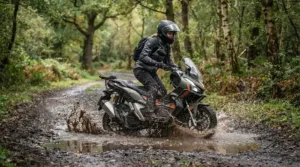
2. GOTRAX GX1 — most affordable true dual-motor entry point
If your budget is the tightest constraint in this whole search, the GOTRAX GX1 is where a legitimate off road electric scooter under $1500 conversation actually starts. Its dual 600W motors won’t win any drag races, but they’re paired with real front-and-rear suspension and hydraulic shocks — components that, on paper, tend to show up on scooters costing hundreds more.
What the spec sheet won’t tell you, but reviewers note repeatedly, is that GOTRAX punches above its price class on ride quality specifically because of that hydraulic suspension; the company clearly decided to spend its budget there rather than on flashy app connectivity or turn signals. For riders who mostly need an electric scooter for gravel and dirt paths in a local park rather than genuine backcountry trail assault, that trade-off makes sense. The GX1 tops out around 30 mph and claims up to 35 miles of range, both modest numbers next to its siblings, but perfectly adequate for a rider prioritizing durability and build quality over outright speed.
Honest analysis here has to acknowledge the trade-offs: this is GOTRAX’s entry point into the dual-motor category, not its flagship, so components like the brakes and tires are a notch below the GX2 and GX3 above it in the lineup. Reviewers consistently frame it as an excellent gateway scooter for someone testing whether off-road riding is even a habit they’ll keep.
Pros:
- ✅ Genuine hydraulic suspension at an entry-level price point
- ✅ Dual-motor redundancy adds real-world traction on loose ground
- ✅ Backed by GOTRAX’s well-regarded two-year warranty
Cons:
- ❌ 600W motors feel underpowered on steep, technical climbs
- ❌ Braking hardware trails behind pricier siblings in the lineup
At under $1,000 in most listings, the GOTRAX GX1 is the low-risk way to find out if you actually want a rugged electric scooter for trails before committing more money.
3. iScooter iX7 Pro — best knobby tire electric scooter for speed-focused riders
The iScooter iX7 Pro earns its spot here almost entirely because of its tires. Ten-inch pneumatic knobby off-road treads, paired with full front-and-rear suspension, give this scooter noticeably better bite in loose dirt and wet gravel than the smoother street-oriented tires found on many competitors at this price.
Dual motors rated between 1000W and 1200W (depending on the exact configuration sold) deliver a claimed 38 mph top end, though independent testing has consistently clocked closer to 32-34 mph in real conditions — still plenty fast, just don’t plan your commute time around the marketing number. Based on the spec comparison, what most buyers overlook about this model is that the throttle is tuned aggressively, meaning wheel spin off the line is common in dual-motor mode; that’s a feature for thrill-seekers and a mild annoyance for anyone hoping for smooth, predictable takeoffs on loose gravel.
Aggregated owner sentiment frames this scooter as a genuine speed-and-power value pick, with recurring praise for how “off-road capable” it feels for the price, and a recurring caution that the suspension, while present and functional, rides stiffer than the segment’s plusher options like the Ausom Gosoul 2 Pro.
Pros:
- ✅ Knobby off-road tires provide genuinely better dirt and gravel grip
- ✅ Strong acceleration thanks to dual high-output motors
- ✅ Full front-and-rear suspension standard, not an upsell option
Cons:
- ❌ Suspension tuning is stiffer than plusher rivals on rough ground
- ❌ Throttle response can cause unwanted wheel spin for new riders
Retailers commonly list the iScooter iX7 Pro in the $850–$1,000 range, positioning it as one of the strongest knobby-tire options under $1,500 for anyone who values speed and grip over plush comfort.
4. Kaabo Mantis 10 Lite — best build quality and portability balance
Durability and build quality is where the Kaabo Mantis 10 Lite separates itself. Its one-piece forged aviation-grade 6082 aluminum alloy frame is rated to resist rust, saltwater corrosion, and deformation — language that sounds like marketing until you note that Kaabo backs it with an industry-leading warranty structure most budget brands don’t match.
The dual 500W motors are modest on paper compared to some rivals here, but climbing capability up to a 25-degree incline is genuinely strong for the wattage, thanks to Kaabo’s Sine Wave controller tuning delivering smoother, more linear power rather than a jarring surge. Here’s what to weigh: at 62 pounds, the Kaabo Mantis 10 Lite is meaningfully lighter than several other entries on this list, which matters enormously if you’re regularly folding it into a car trunk or carrying it up apartment stairs after a trail ride. The 4.3-inch ground clearance is also unusually generous for this weight class, letting it clear roots and rocks that would scrape the deck of a lower-riding scooter.
Reviewers consistently praise the dual-motor traction and climbing feel, while a recurring complaint centers on real-world range running noticeably shorter than advertised — commonly cited around 20-22 miles at full power rather than the higher claimed figures, a gap worth planning around if you’re riding longer trail loops.
Pros:
- ✅ Forged aircraft-grade aluminum frame resists corrosion and deformation
- ✅ Unusually light at 62 lbs for a dual-suspension off-road scooter
- ✅ Generous 4.3-inch ground clearance clears roots and rocks well
Cons:
- ❌ Real-world range runs meaningfully below the advertised maximum
- ❌ Lower peak wattage than several dual-motor rivals on this list
Priced typically from $1,000 to $1,200, the Kaabo Mantis 10 Lite is the pick for riders who prioritize durability and build quality plus portability over raw speed.
5. GOTRAX GX2 — most trail-ready suspension in this price bracket
Step up to the GOTRAX GX2 and you’re getting GOTRAX’s genuine performance-series engineering: dual 800W motors, a 35 mph top speed, and — the real headline — front-and-rear hydraulic suspension that reviewers repeatedly single out as punching well above its price class.
On paper, hydraulic shocks at this price point are unusual; most competitors save that hardware for scooters costing several hundred dollars more. What that means in practice is a noticeably more controlled, less bouncy ride across washboard gravel and rutted trail surfaces, where cheaper coil-spring setups tend to transmit every bump straight into your wrists. Owner feedback aggregated from GOTRAX’s own listings and third-party retailers repeatedly mentions taking the GX2 “off-roading” successfully, with one recurring caveat: it lacks an companion app and doesn’t offer hydraulic disc brakes to match its hydraulic suspension, relying instead on solid mechanical disc brakes that perform well but aren’t quite best-in-class.
Trail riding capability here benefits enormously from the 10-inch all-terrain tires and dual suspension working together — this is a scooter genuinely built to bridge commuter duty on weekdays with weekend trail exploration, rather than one repurposed from a street-only platform with knobbier tires bolted on.
Pros:
- ✅ Front-and-rear hydraulic suspension rare at this price tier
- ✅ 40-mile range comfortably covers extended trail loops
- ✅ 10-inch all-terrain tires pair well with the suspension tuning
Cons:
- ❌ No companion app or advanced connectivity features
- ❌ Mechanical rather than hydraulic disc brakes
Usually found between $1,200 and $1,300, the GOTRAX GX2 stands out as one of the most convincingly rugged electric scooters for trails on this entire list.
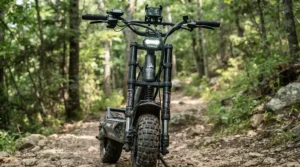
6. Segway ZT3 Pro — best for certified reliability and all-weather confidence
The Segway ZT3 Pro brings something the rest of this list can’t fully replicate: Segway’s brand-level testing rigor. The company states the ZT3 Pro underwent more than 3,100 miles of human-piloted road testing, over 180 quality checks, and a 1,540-pound static pressure test on its high-strength carbon-steel frame — the kind of documented validation smaller brands rarely publish.
Its single 650W motor (1,600W peak) might look underwhelming next to dual-motor competitors, but real-world testing has clocked a genuine 24.7-24.9 mph top speed with strong control, and the 597Wh battery delivers a claimed 43.5-mile range that independent testers have found broadly credible in eco mode. Here’s what most buyers overlook: the ZT3 Pro carries both an IPX5 waterproof body rating and an IPX7-rated battery, meaning rain rides are a non-issue in a way that voids warranties on lesser-rated competitors. Combined with 11-inch knobby, tubeless hybrid tires and dual spring suspension — motorcycle-style front fork plus rear monoshock — it’s built specifically with off-road use as a stated design goal, not an afterthought.
Aggregated review sentiment consistently flags Segway’s customer support and build consistency as standout strengths, with the most common criticism being the scooter’s above-average 65-pound weight, which makes stair-carrying noticeably less convenient than lighter rivals like the Kaabo Mantis 10 Lite.
Pros:
- ✅ Documented, brand-published durability and stress testing
- ✅ IPX5/IPX7 water resistance rated for confident wet-weather riding
- ✅ 11-inch knobby tubeless tires with genuine motorcycle-style suspension
Cons:
- ❌ Heavier than most rivals at roughly 65 lbs
- ❌ Single motor trails dual-motor competitors on raw torque
Pricing fluctuates more than most on this list — from around $850 during sale events up toward $1,300 at regular price — making the Segway ZT3 Pro worth watching for deals if certified reliability matters most to you.
7. Varla Eagle One — best long-range value pick under the ceiling
Closing out this list, the Varla Eagle One brings genuine dual-motor muscle — 1000W per wheel, 3,200W combined peak output — paired with a 52V/18.2Ah battery good for a claimed 40 miles in eco mode. Reviewers have praised its “tank-like frame” and 11-inch tires with hydraulic suspension as legitimately built for rough terrain, not just styled to look that way.
Based on the spec comparison against its Eagle One Pro and V3.0 siblings (which push past the $1,500 ceiling this article targets), the standard Varla Eagle One represents the value entry into Varla’s off-road lineup — you’re trading some top speed and battery capacity for a meaningfully lower price, while keeping the suspension and tire package that makes the brand’s reputation. Owner reviews aggregated from Varla’s own storefront and third-party retailers repeatedly praise the smoothness of the ride and the responsiveness of the throttle, alongside consistent praise for Varla’s customer support team resolving issues like controller defects promptly. A recurring critique, honestly reported here rather than glossed over, is that some owners feel the price crept up over past generations without matching increases in performance — worth knowing before you compare it against this list’s cheaper dual-motor entries.
For riders whose priority is trail riding capability over multiple weekends without daily recharging anxiety, the Eagle One’s range and torque combination is hard to beat within the $1,500 ceiling.
Pros:
- ✅ Genuine 3,200W peak dual-motor output for serious hill climbing
- ✅ 11-inch tires plus hydraulic suspension built for rough terrain
- ✅ Consistently praised, responsive customer support team
Cons:
- ❌ Some owners feel value has slipped relative to older Varla generations
- ❌ Sits near the top of the $1,500 budget ceiling most months
Typically priced in the $1,200-$1,400 range, the Varla Eagle One closes this list as the long-range, high-torque option for riders who’ve outgrown budget picks but aren’t ready to cross into four-figure premium territory.
Practical Usage Guide: Your First 30 Days Off-Road
Getting a new off-road scooter right in the first month prevents most of the headaches owners report later. Start with tire pressure — knobby tires on scooters like the iScooter iX7 Pro or GOTRAX GX2 typically want 40-50 PSI, and running them soft “for grip” actually increases pinch-flat risk on rocky trails rather than helping traction meaningfully.
Suspension needs attention too. Scooters with adjustable units, like the Ausom Gosoul 2 Pro‘s ShocFree system or the GOTRAX GX2‘s hydraulic shocks, ship at a middle-ground factory setting that rarely matches any individual rider’s weight. Spend twenty minutes in your driveway dialing in preload before your first real trail ride — a mistake several Gosoul 2 Pro owners reported making was cranking suspension too soft, which introduced high-speed wobble rather than the smoother ride they expected.
Common first-30-days mistakes worth avoiding: skipping the break-in period on brake pads (mechanical discs especially need 15-20 gentle stops to bed in properly), ignoring bolt torque checks after the first few rides (vibration loosens fasteners faster off-road than on pavement), and charging habits — never leave a lithium battery at 100% for extended storage, and avoid charging immediately after a hard ride while the pack is still warm. Riders switching from a Segway ZT3 Pro with its IPX5/IPX7 rating to a lower-rated scooter should also recalibrate expectations around puddle and rain riding, since not every model on this list shares that same waterproofing.

Which Rider Are You? Real-World Scenarios
Picture Maya, a graduate student who lives three miles from campus down a mix of paved road and a half-mile unpaved shortcut through a park. She doesn’t need extreme power — she needs reliability and low weight for carrying up two flights of stairs daily. The Kaabo Mantis 10 Lite, at 62 pounds with a forged aluminum frame, matches that profile closely: enough off-road capability for the shortcut, light enough that daily carrying doesn’t become a chore.
Now picture Derek, a weekend trail enthusiast who drives to a state forest access road every Saturday and wants 15-20 miles of genuine dirt-and-gravel riding before heading home. Range and suspension travel matter more than portability here — the Varla Eagle One or GOTRAX GX2 both fit, offering the battery capacity and hydraulic damping to survive a full afternoon of washboard fire roads without punishing his hands and knees.
Finally, consider Priya, a budget-conscious commuter testing whether an electric scooter for gravel and dirt paths can replace her short car trips at all. She doesn’t want to gamble $1,400 on an experiment. The GOTRAX GX1 or Ausom Gosoul 2 Pro, both under $1,000, let her find out with real hydraulic or dual-motor hardware rather than a toy-grade single-motor commuter scooter that would fold at the first pothole.
How to Choose an Off Road Electric Scooter Under $1500
- Check motor configuration first. Dual-motor setups (like the Ausom Gosoul 2 Pro or GOTRAX GX2) generally handle loose, steep terrain better than single-motor scooters, since torque is split across both wheels rather than risking wheel spin on one.
- Prioritize tire type over tire size alone. A knobby tire electric scooter like the iScooter iX7 Pro will outperform a same-size smooth tire on wet gravel, even if the wheel diameter numbers look identical on paper.
- Confirm suspension is functional, not decorative. Hydraulic units on the GOTRAX GX2 and GOTRAX GX1 genuinely dampen impacts; some budget scooters advertise “suspension” that’s really just a rubber bushing with minimal travel.
- Weigh portability against range honestly. If you’re carrying the scooter regularly, the Kaabo Mantis 10 Lite‘s lighter frame matters more than an extra 10 miles of claimed range you’ll rarely use.
- Look for documented durability testing. The Segway ZT3 Pro‘s published stress-test figures are a useful benchmark — ask whether a brand backs its durability claims with any real data before trusting marketing copy alone.
- Read aggregated reviews for range gaps, not just claims. Nearly every scooter on this list shows a real-world range meaningfully below its marketing number; factor that gap into your buying decision rather than the optimistic headline figure.
- Match your budget to your actual terrain, not your aspirations. If your “off-road” riding is really a gravel park path twice a week, the GOTRAX GX1 solves that problem for meaningfully less money than the Varla Eagle One.
Off-Road Electric Scooters vs Traditional Commuter Scooters
The core difference isn’t styling — it’s what happens the moment pavement ends. Traditional commuter scooters, the sub-$500 category, generally run single motors under 500W, solid or low-volume tires, and minimal-to-no suspension, all of which are fine on smooth sidewalks but genuinely dangerous on loose gravel, where reduced traction meets underdamped impacts.
An off road electric scooter under $1500 addresses this with a fundamentally different engineering brief: more torque to maintain control when traction drops, pneumatic knobby tires that flex and grip rather than deflect impacts straight into the frame, and suspension travel measured in inches rather than millimeters. According to guidance from UL Solutions, which certifies the electrical safety systems inside these devices, even the underlying battery and motor-controller engineering standards scale with a product’s intended use case and power output — meaning higher-power off-road scooters are held to correspondingly more rigorous testing than basic commuter units.
The trade-off is real, too. Traditional commuter scooters like the sub-$500 category win on weight and portability every time — you’re not folding a 65-pound Segway ZT3 Pro into a backpack. If your daily reality is entirely paved sidewalks and bike lanes, spending up for off-road capability you’ll never use is money better spent elsewhere. But if gravel, dirt, or rutted park paths show up even occasionally in your route, the durability and build quality gap between the two categories becomes the whole story.
Common Mistakes When Buying an Off-Road Electric Scooter
The single most common mistake is trusting the word “off-road” on a listing photo rather than checking actual tire compound and suspension travel — plenty of scooters get labeled off-road purely for aggressive styling despite having minimal suspension and street-oriented tread. Cross-reference specs against real reviews, not just the manufacturer’s product page, before assuming genuine trail capability.
A second frequent error is ignoring weight capacity. Several scooters on this list, including the Ausom Gosoul 2 Pro at 287 lbs and others in the 264-350 lb range, have specific rider weight ceilings that meaningfully affect real-world torque and range if you’re near the limit — buying based on advertised range without checking whether that figure assumes a 165-pound test rider is a setup for disappointment.
Third, buyers regularly underestimate charging time and plan trail days around unrealistic battery-refill windows; most scooters here take 4-10 hours for a full charge, not the 1-2 hours some marketing implies. Fourth, skipping a look at state and local electric scooter regulations before buying is a genuinely costly mistake — some jurisdictions cap legal top speeds or require registration above certain wattage thresholds, meaning that dual-1400W monster you just bought might be legally restricted on the very roads connecting you to your favorite trail. Finally, many first-time buyers overlook portability entirely until they’ve already carried a 65-pound scooter up three flights of stairs once — test-lift before you commit, not after.
What to Expect: Real-World Trail Riding Capability
Specs describe potential; trail riding capability describes what actually happens when a rider’s weight, terrain irregularity, and battery state all interact simultaneously. On packed dirt with moderate rider weight, every scooter on this list performs close to its claimed numbers — inclines under 15%, moderate speed, and dry conditions are forgiving.
The gap widens on loose gravel and wet leaves. Here, tire compound dominates over raw motor wattage: the knobby tires on the iScooter iX7 Pro and Segway ZT3 Pro bite into loose surfaces noticeably better than smoother tread, even against scooters with higher peak wattage. Dual-motor scooters like the GOTRAX GX2 and Varla Eagle One also demonstrate a real-world advantage in wet-rutted conditions, since power distributed across both wheels reduces the odds of a single wheel spinning out and destabilizing the rider.
Range is where trail riding diverges most sharply from lab-test claims. Every manufacturer measures range in optimal conditions — flat terrain, light rider weight, moderate speed. Off-road use adds rolling resistance from looser surfaces, more frequent acceleration out of turns, and often colder ambient temperatures on shaded trails, all of which reduce real range by 20-40% compared to claimed figures. Planning a ride assuming you’ll get 60-70% of the advertised range is the honest, sustainable approach.
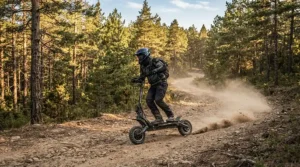
Durability and Build Quality: What Actually Matters
Frame material tells part of the story, but not the whole one. Aviation-grade aluminum alloys, like those used in the Kaabo Mantis 10 Lite‘s one-piece forged frame or the Varla Eagle One‘s construction, resist corrosion and fatigue cracking better than basic steel — genuinely relevant if you’re riding through mud, road salt, or humid coastal air regularly.
Waterproofing ratings matter more than most buyers initially realize. The Segway ZT3 Pro‘s IPX5 body and IPX7 battery rating represent a meaningfully higher bar than the IPX4 rating common on budget competitors — IPX4 tolerates splashes, while IPX5 and IPX7 tolerate sustained water jets and temporary submersion respectively. If your trail riding regularly crosses puddles or happens in unpredictable weather, that distinction is not a marketing footnote; it’s the difference between a scooter that survives a surprise downpour and one that doesn’t.
Brake hardware is a third pillar of durability. Hydraulic disc brakes, found on premium picks and increasingly on mid-tier scooters, maintain consistent stopping performance in wet or muddy conditions better than mechanical discs, which can require more frequent adjustment as cable tension stretches. Reviewers consistently note that scooters relying on cable-actuated systems, like the Ausom Gosoul 2 Pro, still perform reliably but benefit from more frequent home maintenance checks than their hydraulic-equipped competitors.
Long-Term Cost & Maintenance
Sticker price is only the opening chapter of ownership cost. Tires wear faster off-road than on pavement — expect knobby pneumatic tires to need replacement every 500-1,000 miles of mixed trail use, versus 1,500-2,000 miles for pavement-only commuting, and budget $40-80 per tire depending on the model.
Brake pads follow a similar pattern: mechanical disc pads on scooters like the GOTRAX GX1 typically need replacement every few hundred miles of off-road use, a low-cost part but one that adds up if ignored until performance degrades. Battery longevity is the largest long-term consideration across the board — most lithium packs here retain roughly 70-80% capacity after 500-800 full charge cycles, meaning a daily rider might notice meaningful range reduction within 18-24 months, while a weekend-only rider could stretch that timeline past three years.
Value for money off-roading, in the long run, favors scooters with published warranty terms and available replacement parts over models sold purely on aggressive spec-sheet numbers. The Kaabo Mantis 10 Lite‘s industry-leading warranty and the Segway ZT3 Pro‘s brand-backed parts availability both reduce the risk of an expensive early failure turning your $1,000 investment into a $1,000 paperweight. Total cost of ownership over three years — factoring tires, brake pads, and occasional part replacement — typically adds $150-300 to the sticker price across this whole category, a number worth budgeting for rather than being surprised by.
Off-Road Electric Scooters for Specific Riders
For heavier riders above 250 lbs, weight capacity becomes the deciding factor before anything else — the Ausom Gosoul 2 Pro‘s 287 lb rating and dual-motor torque hold up better under load than lighter-rated single-motor scooters, which can see dramatic range and acceleration losses near their weight ceiling.
For new riders easing into off-road scooting for the first time, gentler throttle tuning matters more than peak power. The GOTRAX GX1‘s more modest 600W motors and the Kaabo Mantis 10 Lite‘s Sine Wave controller both deliver smoother, more predictable power delivery than the aggressive, sometimes wheel-spin-prone throttle response reviewers describe on the iScooter iX7 Pro — a meaningful consideration for anyone still building confidence on loose surfaces.
For seasoned commuters looking to add genuine weekend trail capability without buying a second vehicle, the GOTRAX GX2 and Varla Eagle One both bridge that gap credibly, offering enough range and suspension travel to handle Monday’s commute and Saturday’s fire-road ride from the same machine.
Safety, Regulations & Compliance Guide
Every scooter on this list should carry UL 2272 certification for its electrical system — the U.S. standard covering battery, charger, and motor-controller safety for personal e-mobility devices. The Consumer Product Safety Commission has specifically called on manufacturers, retailers, and distributors to comply with these established UL safety standards, given a documented rise in lithium battery fire incidents across the micromobility category in recent years.
Practically, that means checking for UL 2272 (and ideally UL 2271 for the battery specifically) before buying any scooter, off-road or otherwise. Beyond certification, always ride with a helmet, use lights or reflective gear on shaded trails, never charge a battery unattended overnight, and inspect for any swelling or unusual heat in the battery housing after hard rides. Local laws vary meaningfully by state and city — some municipalities cap legal scooter speeds well below what these machines are physically capable of, and dual-motor configurations occasionally trigger different registration requirements than single-motor units, so a quick check of your local regulations before your first ride is worth the ten minutes it takes.
Frequently Asked Questions
❓ Can an off road electric scooter under $1500 actually handle real trails?
❓ What top speed should I expect from a knobby tire electric scooter?
❓ Is dual motor always better than single motor for trail riding capability?
❓ How much does real-world range drop off-road compared to the advertised figure?
❓ Do I need a UL-certified scooter for off-road riding specifically?
Conclusion
The honest takeaway from testing this category is that “off-road” and “over $1,500” don’t have to travel together anymore. Scooters like the Ausom Gosoul 2 Pro and GOTRAX GX1 prove genuine dual-motor torque and real suspension are achievable under $1,000, while the GOTRAX GX2 and Varla Eagle One show what a few hundred extra dollars buys in suspension travel and range once you’re ready to commit further.
What separates a good choice from a regretted one usually isn’t the spec sheet — it’s matching the scooter to your actual terrain and weight requirements rather than chasing the highest peak-wattage number in the listing. A rider crossing a half-mile of park gravel twice daily needs something entirely different from a weekend trail rider covering fifteen miles of fire road, and this guide’s seven picks span that whole range without breaking the $1,500 ceiling once. Durability and build quality, more than raw speed, is what determines whether your purchase still feels worth it eighteen months from now — so weigh warranty terms and certified testing as heavily as you weigh the mph figure on the box.
Recommended for You
- Off Road Electric Scooter: 7 Beastly Picks for 2026
- Fast Electric Scooter Street Legal: 7 Ultimate 2026
- Fastest Electric Scooter 2026: 7 Top Speed Picks That Fly
Disclaimer: This article contains affiliate links. As an Amazon Associate, I earn from qualifying purchases. If you purchase products through these links, we may earn a small commission at no additional cost to you.
✨ Found this helpful? Share it with your friends! 💬🤗
