

In This Article
Here’s the uncomfortable truth nobody tells you at the scooter shop: “fast” and “street legal” are not the same sentence, and the gap between them has ended more than one rider’s first ride with a very awkward conversation with a police officer. A fast electric scooter street legal enough to actually ride on your commute, in your state, without gambling on a fine, is a narrower category than the marketing photos suggest. Some machines hit 50 mph on a closed lot and 15 mph on your actual street. Others ship with paperwork that lets you register them like a moped. The difference matters more than horsepower.
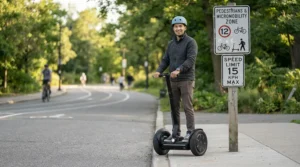
This guide cuts through the spec-sheet arms race. We researched seven real, currently available scooters spanning roughly $1,400 to $3,800, checked their motor and battery numbers against independent testing, and mapped how each one actually behaves once state law gets involved. You’ll get honest analysis of what each machine is genuinely good at, a breakdown of how U.S. speed regulations work state by state, what “DOT compliance” actually means for a two-wheeled personal vehicle (spoiler: it’s not what most sellers imply), and when registration and licensing kick in. By the end, you’ll know exactly which scooter fits your commute, your budget, and your local law — not just your Instagram feed.
What is a fast electric scooter street legal to ride? In practical terms, it’s a scooter whose operating speed on public roads stays inside your state’s low-speed device cap — typically 15 to 20 mph — even if the machine is mechanically capable of much more, or a higher-power model that’s been properly registered as a moped where that classification applies.
Quick Comparison: Fast Street-Legal Electric Scooters at a Glance
Before the deep dive, here’s how five representative models stack up on the numbers that matter most for a buying decision.
| Scooter | Top Speed (Claimed) | Price Range | Best For |
|---|---|---|---|
| Apollo Ghost | 34 mph | Around $1,499 | Entry into dual-motor performance |
| Varla Eagle One V2 | 40 mph | $1,600-$1,800 range | Budget hill-climbing and off-road mix |
| Kaabo Wolf Warrior 11+ | Up to 50 mph | $1,700-$2,000 range | Best power-per-dollar in the 50 mph class |
| VSETT 10+ | Up to 50 mph (off-road mode) | $2,300-$2,600 range | Longest range at high performance |
| EMOVE RoadRunner Pro | Up to 50 mph | $2,800-$3,800 range | Seated comfort, ships with registration paperwork |
Look closely and a pattern jumps out: the closer a scooter creeps toward 50 mph, the more its price and its legal complexity climb in lockstep. The Apollo Ghost sits at the accessible end, legal in more places without modification because its unlocked top speed is closer to what most states already tolerate for mopeds. The EMOVE RoadRunner Pro, on the other end, is functionally a light electric motorcycle wearing a scooter costume, and its manufacturer treats it that way by including a Manufacturer’s Certificate of Origin so you can title it properly. Speed and simplicity trade off against each other here, and that trade-off should drive your decision more than the number on the spec sheet.
Just one click — help others make better buying decisions too! 😊
Top 7 Fast Street-Legal Electric Scooters: Expert Analysis
We picked these seven to cover the realistic range a shopper actually faces: an accessible dual-motor entry point, a couple of well-rounded all-rounders, and a top tier that blurs into moped territory. Every spec below comes from manufacturer listings cross-checked against independent test data where available.
1. Apollo Ghost — best on-ramp into dual-motor performance
The Ghost earns its “on-ramp” reputation by giving first-time performance buyers real dual-motor thrust without the intimidation factor of a 50 mph machine. Its twin 800W motors combine for 1,600W of continuous output and roughly 2,000W peak, enough to push a claimed top speed of 34 mph, with independent GPS testing from outlets like ElectricScooterInsider recording closer to 38 mph under ideal conditions. The 52V 18.2Ah battery delivers a manufacturer-rated range up to 39 miles, though real-world mixed riding tends to land in the high 20s to low 30s.
What most buyers overlook about the Ghost is that its front and rear coil suspension does more heavy lifting than the speed number suggests — it’s the reason the Ghost feels planted at 30 mph while cheaper single-motor scooters start to shimmy. Reviewers consistently note that the acceleration is genuinely startling for the price bracket, with 0-20 mph times in the low four-second range, and that the 300-pound rider weight limit makes it one of the more inclusive performance scooters on this list.
Pros:
- ✅ Genuine dual-motor acceleration at an accessible price
- ✅ Front and rear suspension smooths real-world potholes
- ✅ High 300-lb weight capacity for a scooter this size
Cons:
- ❌ 39-mile claimed range trails newer 50 mph rivals
- ❌ 64-lb weight makes stair-carrying a two-hand job
The Apollo Ghost typically lists in the $1,499 to $1,849 range depending on brake configuration, and given the acceleration and build quality on offer, it’s a strong value pick for anyone stepping up from a basic commuter scooter for the first time.

2. Varla Eagle One V2 — best budget all-terrain hill climber
The Eagle One V2 was built to answer one question: can a scooter under $2,000 handle both smooth city streets and a genuinely rough weekend trail? Its dual 1,000W motors (3,200W peak) push a claimed top speed of 40 mph, though GPS-verified testing has clocked it closer to 36 mph — a gap worth remembering any time a spec sheet quotes a round number. The 52V 20.8Ah battery is rated for up to 42 miles, and torque figures around 36 Nm let it climb 25 to 30-degree grades without the strain you’d feel on lighter commuter models.
Here’s what the spec sheet won’t tell you, but user reports on outlets like MakeUseOf and LowBudgetAdventurer consistently mention: the dual coil suspension and wide 28-inch handlebars make the Eagle One V2 feel far more stable at speed than its price class would suggest, and the tightened steering geometry specifically counters the speed wobble that plagues cheaper 40 mph scooters. Five gear settings and a single-motor mode also mean a newer rider can ease into the performance rather than getting thrown in at the deep end.
Pros:
- ✅ Dual coil suspension tuned for rough pavement and light trails
- ✅ Five gear settings ease newer riders into full power
- ✅ 330-lb weight capacity, among the highest in this class
Cons:
- ❌ Independently tested top speed runs several mph below the claim
- ❌ Heavy build and long charge times reduce daily convenience
Priced roughly between $1,600 and $1,800 depending on retailer promotions, the Varla Eagle One V2 delivers legitimate off-road capability that pricier on-road-only competitors simply don’t offer.
3. Kaabo Wolf Warrior 11+ — best power-per-dollar in the 50 mph class
If the Ghost and the Eagle One are appetizers, the Wolf Warrior 11+ is where the entrée arrives. Dual 1,200W motors combine for 5,400W of peak output, and that muscle is why aggregate pricing trackers show it selling for close to $1,000 less than rival scooters with comparable acceleration. Riding on a 60V 26Ah battery, it reaches a manufacturer-claimed 50 mph (80 km/h) and a rated range near 56 miles (90 km), backed by patented hydraulic front suspension and rear spring suspension that were literally borrowed from Kaabo’s more expensive Dualtron-derived lineup.
Based on the spec comparison against similarly powered scooters, the Wolf Warrior 11+ punches well above its price bracket on raw hardware — full hydraulic brakes with optional ABS, an 11-inch tire option for off-road grip, and a 30-degree incline rating that few $2,000 scooters can match. Aggregated reviewer sentiment across sites like RiderGuide and Boarddeckhq frames this as a genuinely dual-purpose machine: thrill-seekers get their speed fix, while commuters who need a workhorse still find it practical day to day. The trade-off is size — at nearly 100 pounds, this is not a scooter you’re tucking under a desk.
Pros:
- ✅ 5,400W peak power rivals scooters costing far more
- ✅ Motocross-grade hydraulic suspension front and rear
- ✅ Climbs 30-degree inclines without motor strain
Cons:
- ❌ Nearly 100 lbs, unfriendly for stairs or transit
- ❌ 50 mph capability puts it firmly in moped-classification territory in most states
With street prices generally landing between $1,700 and $2,000, and some listings dipping under that mark during promotions, the Kaabo Wolf Warrior 11+ is frequently cited as the strongest value proposition among fastest electric scooter under $2000 contenders.
4. Nami Klima — quickest acceleration in its performance tier
Nami built its reputation on the Burn-E, a scooter so extreme it broke test-lab benchmarks and cost nearly $4,900. The Klima is Nami’s answer to buyers who wanted that pedigree without that price tag. Dual 1,000W motors (up to 5,400W peak) drive a GPS-verified top speed around 42 mph, and independent 0-30 mph acceleration testing has clocked the Klima at 4.9 seconds — a time that, on paper, rivals scooters costing twice as much. The 60V 25Ah battery (or 30Ah in the Max configuration) supports a manufacturer-rated range of 50 to 60 miles.
What most buyers overlook about the Klima is that its acceleration numbers matter more day-to-day than its top speed does — most urban riding never sustains 40-plus mph for long, but instant torque off the line is what actually makes a commute feel fast. Reviewers consistently describe the Klima’s hydraulic C-shaped suspension and low center of gravity as best-in-class for ride comfort, and the IP55 rating means light rain isn’t a dealbreaker. At 79 lbs, it’s also meaningfully lighter than the Wolf Warrior 11+ while delivering comparable punch.
Pros:
- ✅ Sub-5-second 0-30 mph acceleration rivals pricier scooters
- ✅ IP55 weather resistance for light-rain commuting
- ✅ Lighter than most competitors in its power class
Cons:
- ❌ Priced just over the $2,000 mark, missing budget-tier cutoffs
- ❌ 42 mph top speed means moped-level legal exposure on public roads
At a price point that hovers just above $2,000, the Nami Klima is worth cross-shopping against the Wolf Warrior 11+ for anyone who values acceleration and ride comfort over sheer top-end velocity.
5. VSETT 10+ — longest realistic range in the 50 mph class
The VSETT 10+ solves a problem the other scooters on this list mostly ignore: what happens when you actually want to ride at high performance for more than 20 minutes? Dual 1,400W motors accelerate the 10+ up to a claimed 50 mph in its off-road sport mode, while the factory-limited on-road setting caps it at 20 mph for street use. The 60V battery, available in 20.8Ah, 25.6Ah, or a 28Ah “10+R Edition” pack, gives VSETT room to claim a maximum range as high as 115 miles — a figure that assumes low, steady speeds, but even conservative mixed-use estimates from independent testers land well ahead of most rivals here.
Here’s what the spec sheet won’t tell you: the VSETT’s four-piston hydraulic brakes and dual adjustable suspension consistently earn praise from testers for stopping power that matches or beats scooters costing considerably more, with one measured braking distance of just over three meters from speed — genuinely impressive for a machine this heavy. The NFC key-lock immobilizer is also a small but meaningful theft deterrent that budget competitors skip entirely.
Pros:
- ✅ Dual-mode design separates legal street use from off-road performance
- ✅ Four-piston hydraulic brakes deliver exceptional stopping power
- ✅ Massive claimed range headroom versus competing 50 mph scooters
Cons:
- ❌ Real-world range falls well short of the 115-mile ceiling at sustained speed
- ❌ Weighs close to 100 lbs in higher-capacity battery configurations
Typically priced between $2,300 and $2,600 depending on battery size, the VSETT 10+ is the pick for buyers who want 50 mph capability but refuse to sacrifice range to get it.
6. Segway Ninebot GT3 Pro — most refined flagship with full support network
Segway didn’t invent the fast scooter category, but the GT3 Pro is a reminder of what a company with a decade of manufacturing scale can do once it decides to compete. A 72V electrical system feeds dual motors rated at 3,400W nominal and 7,000W peak, pushing a manufacturer-claimed top speed of roughly 50 mph and a headline range figure of 86 miles — numbers that, in independent testing, have only been matched by a handful of far more exotic scooters. Acceleration from 0 to 30 mph in Ultra Boost Mode comes in under four seconds.
Based on the spec comparison against boutique competitors, the GT3 Pro’s real edge isn’t raw performance, it’s everything around it: Segway’s app ecosystem, a documented service and repair network most enthusiast brands can’t match, and 11 x 3-inch slick tires specifically engineered for grip and heat management at sustained high speed. Reviewers consistently point out that at 117 lbs, this is a scooter that lives in a garage rather than an apartment closet, and it’s designed for riders who start and end trips at the same location rather than needing portability mid-commute.
Pros:
- ✅ Backed by Segway’s nationwide service and support network
- ✅ App-connected ride modes and telemetry tracking
- ✅ Purpose-built slick tires manage heat at sustained high speed
Cons:
- ❌ 117-lb weight rules out any kind of portability
- ❌ Roughly $2,700 price sits well above budget-tier alternatives
At approximately $2,700, the Segway Ninebot GT3 Pro costs more than most scooters here, but for buyers who prioritize brand support and software polish alongside speed, that premium buys real peace of mind.
7. EMOVE RoadRunner Pro — seated comfort at motorcycle-adjacent speeds
The RoadRunner Pro is where “electric scooter” starts to feel like an understatement. VoroMotors built this as a seated, moped-style machine with dual 60V 2,000W motors (6,000W peak) and 45A sine-wave controllers, and depending on the battery configuration — 30Ah, 40Ah, or 60Ah — it reaches a manufacturer-rated top speed near 50 mph, with independent testers at outlets like RiderGuide clocking real-world runs between 51 and 55 mph. Range scales with battery size too, from roughly 50 miles on the base pack to reported real-world figures near 55-75 miles on the largest 60Ah option.
What separates the RoadRunner Pro from every other scooter on this list is how VoroMotors handles the legal question directly: it ships with a Manufacturer’s Certificate of Origin specifically so buyers can pursue moped or motorcycle registration where their state allows it, rather than pretending the legal gray area doesn’t exist. Aggregated reviewer sentiment describes the memory-foam seat and low center of gravity as genuinely stabilizing at speeds where stand-up scooters start to feel sketchy, though the tradeoff is a weight that can exceed 115 lbs on the larger battery packs, and reviewers are consistent that this is not a scooter you carry up a flight of stairs.
Pros:
- ✅ Ships with a Manufacturer’s Certificate of Origin for registration
- ✅ Seated riding position adds real stability above 40 mph
- ✅ Removable battery allows swap-and-go charging
Cons:
- ❌ Can weigh over 115 lbs, eliminating portability entirely
- ❌ Ambiguous legal status in many states even with paperwork
Priced from roughly $2,800 up to $3,800 or more for the largest battery pack, the EMOVE RoadRunner Pro is the clearest example on this list of a scooter that should be registered like a vehicle, not ridden like a toy.
Practical Usage Guide: Setting Up and Riding Legally From Day One
Getting a fast scooter street-legal starts before you ever twist the throttle. First, confirm your state’s low-speed device threshold — usually 15 or 20 mph — and check whether your scooter has a “city mode” or app-based speed cap. Scooters like the VSETT 10+ ship factory-limited to 20 mph specifically so you can ride on public roads without modification, only unlocking full performance for private or off-road use. If your scooter doesn’t offer that split, treat the unlocked top speed as off-limits on any public street.
Second, register your VIN or serial number with the manufacturer within the first week; this protects your warranty and matters if the scooter is ever reported stolen. Third, budget your first 30 days for a break-in period: tire pressure should be checked weekly at first since new pneumatic tires settle, and hydraulic brake lines on models like the Wolf Warrior 11+ or VSETT 10+ often need a bleed-and-adjust after the first 50 to 100 miles as pads seat in. A common early mistake is charging a fully depleted battery to 100 percent and leaving it there overnight — lithium packs last longer when kept between 20 and 90 percent for daily use, reserving full charges for longer rides. Finally, if your scooter is seated and moped-classified, don’t skip the DMV title application; riding it unregistered exposes you to fines that dwarf the scooter’s price.

Real-World Scenarios: Matching Riders to the Right Scooter
Picture a 24-year-old grad student with a 3-mile commute across a mid-sized college town where local ordinance caps scooters at 15 mph on shared paths. Speed isn’t the priority here — legal simplicity and portability are. The Apollo Ghost, run in its lower power modes, or a scooter with a genuine 20 mph street cap, keeps this rider inside the law without a second thought, and its manageable weight means carrying it into a dorm or apartment isn’t a workout.
Now picture a suburban commuter with an 8-mile round trip on roads with a mix of 25 and 35 mph speed limits, where local law permits scooters on roads posted at 35 mph or under. This rider benefits from real range and stability more than outright top speed — the Nami Klima or VSETT 10+ in street mode fit well, since both deliver comfortable cruising well under their maximum capability with battery to spare for the return trip.
Finally, consider a rural or semi-rural rider with access to private land, a long driveway, or genuinely low-traffic roads where local enforcement is minimal to nonexistent. This is the buyer for whom the EMOVE RoadRunner Pro or Segway GT3 Pro’s full-speed capability actually gets used as intended — and critically, this is exactly the rider who should be pursuing moped registration rather than assuming rural roads mean no rules apply.
How to Choose a Fast Electric Scooter That’s Actually Street Legal
- Check your state’s low-speed device definition first. Most states cap street-legal unregistered scooters at 15 to 20 mph and under 750W of motor power — anything above that risks moped reclassification.
- Look for a documented city mode or speed lock, not just a marketing claim. Scooters like the VSETT 10+ build this in; others require manual app configuration.
- Match range to your actual commute, not the marketing number. Manufacturer range figures assume ideal conditions; plan on 60 to 70 percent of the claim in mixed real-world riding.
- Weigh portability against power honestly. A 100-lb scooter with 50 mph capability is a garage vehicle, not a fold-and-carry commuter.
- Confirm UL 2272 or equivalent battery certification before buying, since it affects both fire safety and where you’re legally allowed to charge and store the scooter.
- If the scooter is seated or exceeds 750W, ask about registration paperwork up front, the way EMOVE includes a Manufacturer’s Certificate of Origin.
- Budget for safety gear as part of the purchase, not an afterthought — a helmet and gloves matter more as speed increases, and several states legally require them under a certain age.
State Speed Limit Regulations for Electric Scooters
There’s no single federal speed limit for electric scooters, and that’s precisely why “street legal” depends entirely on your zip code. According to the National Conference of State Legislatures, at least 28 states plus Washington, D.C. have enacted specific e-scooter legislation addressing speed, minimum age, and roadway use, while the remaining states leave much of the regulation to individual cities. The most common pattern nationally sets a legal operating ceiling of 15 to 20 mph on public roads and bike lanes, even when a scooter’s design speed — its mechanical capability — is technically higher.
California and New York are useful examples of just how granular this gets. New York defines a qualifying electric scooter as incapable of exceeding 20 mph on motor power alone, but caps actual legal operation at 15 mph; exceed either threshold and the device can be reclassified as a moped requiring a license, DMV registration, and insurance. California similarly restricts scooter operation to 15 mph and to roads posted at 35 mph or under. Meanwhile, states like Pennsylvania and Delaware have avoided defining electric scooters at all in a way that permits road use, meaning ordinary stand-up scooters may not be legally operable on public roads or sidewalks there regardless of speed. The takeaway is blunt: a 50 mph scooter is perfectly legal to own almost everywhere, but riding it at full speed on a public road is illegal in the overwhelming majority of the country.
DOT Compliance Requirements: What They Actually Mean
“DOT compliant” gets thrown around loosely in scooter marketing, and it’s worth being precise about what it actually refers to, because there is no single federal Department of Transportation code that governs stand-up electric scooter speed or design the way there is for cars. What actually applies is a patchwork of three separate layers: federal product safety oversight through the Consumer Product Safety Commission, state vehicle classification law, and local route ordinances. For fire and electrical safety specifically, the relevant benchmark isn’t a DOT standard at all — it’s UL 2272, the certification the CPSC has explicitly called on manufacturers to meet for personal e-mobility devices, covering battery, charger, and drivetrain safety testing including overcharge and short-circuit scenarios.
Where a genuine DOT-adjacent requirement does show up is for scooters that cross into moped or motorcycle territory, since those categories fall under state motor vehicle codes that often reference federal motor vehicle safety standards for equipment like lighting, mirrors, and turn signals. This is exactly why higher-power seated scooters like the EMOVE RoadRunner Pro ship with a Manufacturer’s Certificate of Origin — it’s the document your state DMV needs to treat the vehicle as registrable at all. Practically speaking, when a listing says “DOT compliant,” ask the seller which specific standard they mean: UL 2272 battery certification, state moped equipment requirements, or neither. The honest answer usually matters more than the phrase itself.
Registration and Licensing: When Your Scooter Becomes a Moped
For the overwhelming majority of stand-up electric scooters — think 15 to 20 mph, sub-750W motors, no seat — most states require no registration, no license plate, and no insurance, treating them functionally like bicycles. That changes the moment a scooter crosses into higher power, higher speed, or seated territory. A seated electric scooter capable of 40 or 50 mph, like the EMOVE RoadRunner Pro or a fully unlocked VSETT 10+, routinely gets reclassified as a moped or motor-driven cycle, which can trigger a real DMV title application, a valid driver’s license or learner’s permit, and liability insurance, depending on the state.
The practical advice here is simple: don’t assume, verify. Some states, like North Dakota, explicitly require registration for scooters capable of exceeding 20 mph. Others leave the door open to ambiguity that benefits nobody — North Carolina, for instance, has no clear statutory definition for high-power scooters at all, leaving riders in a genuine gray zone that several manufacturers flag directly in their own product listings. If you’re buying anything on this list capable of more than 20 mph, budget time for a DMV visit and a phone call to your specific state’s motor vehicle division before you assume a scooter is ready to ride on public roads the day it arrives.
Electric Scooter Speed Comparison: Claimed vs Tested vs Legal Reality
Manufacturer top-speed claims and independently measured results rarely match exactly, and the legally usable speed on a public road is frequently lower than both. Here’s how the gap plays out across our lineup.
| Scooter | Manufacturer Claimed Top Speed | Independent Test Result | Typical Legal Street Speed |
|---|---|---|---|
| Apollo Ghost | 34 mph | Up to 38 mph (GPS-tested) | 15-20 mph in most states |
| Varla Eagle One V2 | 40 mph | ~36 mph (GPS-tested) | 15-20 mph in most states |
| Kaabo Wolf Warrior 11+ | 50 mph | ~50 mph (manufacturer-aligned) | 15-20 mph unless moped-registered |
| VSETT 10+ | 50 mph (off-road mode) | Factory street cap: 20 mph | 20 mph in built-in city mode |
| EMOVE RoadRunner Pro | Up to 50-51 mph | 51-55 mph independently tested | Moped speed limits once registered |
Looking at the numbers, the gap between what a scooter can do and what you’re allowed to do on public pavement is often larger than the gap between competing scooters’ top speeds. That’s precisely why the VSETT 10+’s dual-mode approach deserves more credit than it usually gets — building the legal cap directly into the hardware removes the guesswork that trips up owners of scooters like the Wolf Warrior 11+ or Nami Klima, which rely entirely on the rider’s judgment and local law rather than a physical governor.
Fastest Electric Scooter Under $2000: What You Actually Get
Shoppers searching specifically for the fastest electric scooter under $2000 are really asking a value question, and the honest answer is that this price band is where diminishing returns start to bite. The Kaabo Wolf Warrior 11+ is the strongest pick here, with street prices frequently landing between $1,700 and $2,000 for a machine that reaches a claimed 50 mph and rivals scooters costing hundreds more in peak power. The Varla Eagle One V2, typically $1,600 to $1,800, trades some top speed for genuinely useful off-road capability and dual suspension, while the Apollo Ghost, often available for $1,499 or less, remains the most balanced choice for a first-time performance buyer who doesn’t need 50 mph capability at all.
What most buyers overlook when hunting for a bargain in this range is that a $1,900 scooter with a 50 mph top speed usually cuts costs somewhere less visible than the motor — often suspension quality, brake componentry, or battery cell grade. Reviewers of the Wolf Warrior 11+ consistently note its hydraulic suspension and brake system as genuinely premium relative to price, which is a big part of why it dominates recommendations in this bracket, but that’s the exception rather than the rule. If a scooter under $2,000 promises 50-plus mph with no compromises anywhere, treat the claim skeptically and check independent test data before buying.
Common Mistakes When Buying a Fast Street-Legal Scooter
Buyers repeatedly make a handful of avoidable errors when shopping this category. First, assuming manufacturer top speed equals legal top speed — as the comparison table above shows, that gap is often 20 to 35 mph. Second, ignoring weight entirely until delivery day; a 100-plus-pound scooter changes how and where you can realistically store, charge, and transport it. Third, skipping the UL 2272 or equivalent certification check, which matters both for insurance purposes and for basic fire safety with lithium battery packs. Fourth, buying a seated, high-power scooter without confirming registration is even possible in your state — some jurisdictions simply won’t title certain devices regardless of the paperwork included. Fifth, underestimating range loss in cold weather or hilly terrain, which can cut a 50-mile claim closer to 30 in real winter commuting conditions.
Long-Term Cost and Maintenance of High-Speed Scooters
The purchase price is only the entry fee. Higher-performance scooters put more stress on tires, brake pads, and battery cells, and that shows up in your annual cost of ownership. Pneumatic tires on models like the Varla Eagle One V2 or VSETT 10+ typically need replacement every 1,000 to 2,000 miles depending on riding style, at roughly $40 to $80 per tire. Hydraulic brake pads on dual-motor scooters generally last longer than mechanical disc brakes but require occasional bleeding, a service that costs $30 to $60 if you’re not doing it yourself. Battery degradation is the biggest long-term line item: lithium packs on scooters like the Nami Klima or Kaabo Wolf Warrior 11+ typically retain 70 to 80 percent of original capacity after 500 to 800 full charge cycles, which for a daily commuter translates to noticeably reduced range within two to three years.
Safety compliance also has a cost dimension worth factoring in. The CPSC’s most recent micromobility hazard report documented over 300 micromobility-related fatalities between 2017 and 2024, with battery-related fire incidents a recurring hazard pattern tied specifically to non-certified charging equipment and damaged cells. Budgeting for a manufacturer-approved replacement charger rather than a cheap third-party alternative, and replacing a battery pack proactively once range drops noticeably, is cheap insurance against a genuinely dangerous failure mode.

Frequently Asked Questions
❓ What is the fastest street legal electric scooter you can buy in 2026?
❓ Is a 50 mph electric scooter legal to ride on the street?
❓ Do I need a license or registration for a fast electric scooter?
❓ What's the best fast electric scooter under $2000?
❓ How fast can an electric scooter legally go without being classified as a moped?
Conclusion
The fastest electric scooter street legal enough for your actual commute isn’t necessarily the one with the biggest number on the box — it’s the one whose speed, weight, and paperwork all line up with where and how you’ll actually ride it. If you want an accessible entry into real performance without touching moped territory, the Apollo Ghost or Varla Eagle One V2 deliver genuine thrills at a manageable price and legal footprint. If you’re chasing the 50 mph tier and want the best dollar-for-power ratio, the Kaabo Wolf Warrior 11+ is difficult to beat under $2,000. And if you’ve decided full-speed capability is worth the registration hassle, the EMOVE RoadRunner Pro and Segway GT3 Pro are built with that reality in mind rather than pretending it away.
Whatever you choose, treat the legal research as seriously as the spec sheet. A scooter sitting unused in a garage because it can’t be ridden legally is a far worse outcome than a slightly slower model you can actually take out every day.
Recommended for You
- Fastest Electric Scooter 2026: 7 Top Speed Picks That Fly
- Performance Electric Scooter 2026: 7 Powerful Picks
- Standing Electric Scooter for Tall Riders: 7 Best Picks in 2026
Disclaimer: This article contains affiliate links. As an Amazon Associate, I earn from qualifying purchases. If you purchase products through these links, we may earn a small commission at no additional cost to you.
✨ Found this helpful? Share it with your friends! 💬🤗
